Friday, January 02, 2026

 The Geezer has departed and will no longer provide new items.


Richard J. Klade left us on December 30, 2025 after 89 years of living well, laughing often, and loving much.

Dick was born Jan. 1, 1936 at Tomahawk, WI, to wonderful parents, Fred and Margaret Klade. As a youth, his passion was playing baseball on youth league, high school, American Legion, and county league teams. He also was a high school class president, saxophonist in the band, and a football player.

He started working at age 10 as a shoeshine boy and later was a waiter, farm and canning factory laborer, supermarket butcher, and printing shop helper. His savings and two small scholarships financed study at the University of Wisconsin-Madison, where he earned a journalism degree in 1957. At UW, he was a member of Sigma Delta Chi, professional journalism fraternity, and was elected president of Sigma Nu social fraternity.

He served with pride in the U.S. Army from 1958 to 1960, primarily as a troop information specialist at Fort Sill, OK.

Dick's professional work included stints as City Editor of the De Pere (WI) Journal-Democrat and Sports Editor of the Daily Tribune in Wisconsin Rapids. He also worked in public relations and sales promotion at The West Bend Company, Allis-Chalmers, and the McCoy Job Corps Center as an RCA employee. His writing occasionally appeared in the Sporting News and other national media. Dick achieved his two minutes of fame in 1973 when he presented a report on the "CBS Evening News with Walter Cronkite."

He joined a great outfit, the U.S. Forest Service, in 1968. He served as a writer-editor at the Forest Products Laboratory, Public Information Officer for the Boise National Forest and Eastern and Intermountain Regions, and Director of Research Information for the Intermountain Station in Ogden where he retired in 1994. He was awarded 11 Certificates of Merit for outstanding performance during his Forest Service career.

Along the way he was a charter member of the De Pere Junior Chamber of Commerce, a Kiwanis Club member in Boise, and for several years volunteered as a Greek Awards applications judge for Weber State University. He devoted more than 16 years to serving his neighbors in various capacities with the White Barn Homeowners Association in Pleasant View, UT.

Dick married the love of his life and best friend, Sandy, in West Bend, WI in 1961. Their son Lee, a stained glass artist in Plainwell, MI, was raised to be an honest man with good values by Sandy while his father pursued less important activities. Sandy, Lee, daughter-in-law Karen, and the little dog Rose remain with us, along with five nieces and nephews.

Dick loved his family, people of integrity, trying to hit golf balls (he got four holes-in-one, but said all were accidental), the Green Bay Packers, and Dixieland jazz, in about that order. He was a member of People's Church, a Unitarian-Universalist congregation in Kalamazoo, where for several years he chaired the Men's Discussion Group and met many new friends. 

Sunday, February 18, 2018

It Is That Time

There is a time for everything . . . so we are told.

The man who some 50 years ago was my favorite supervisor during my long career in writing and publishing also was one of the best communicators I've ever known. One day when he was sharing his thoughts on  public speaking, he presented a small list of keys to success in that field. The last one was, "When you've said what you needed to say, stop."

Since celebrating my 82 birthday a few weeks ago, I've started writing several posts but stopped with the realization that I had told that tale before on this blog. Really, I've nothing more to say. So, with fond memories of contacts with readers over the past 11 years, this is the time to stop.

I've enjoyed the journey. May yours be equally satisfying.

Tuesday, September 26, 2017

Now That's Optimism

Beautiful wife Sandy recently invested a few dollars in a new calendar. Nothing unusual about that, except that Sandy is enjoying her 75th year on this planet. And she bought a five-year calendar.

As one who is a half-dozen years older than her, I hurried to share the optimism by making a few entries in the Year 2022 section.

Friday, July 21, 2017

Way Too Much Pay For Play

My how salaries of American professional  football players have changed.

Washington Redskins quarterback Kirk Cousins recently turned down a long-term contract offer of $53 million. In 1924, the Green Bay Packers payroll for the entire team was $12,000. The 1924 team consisted of 18 players.

Ah, but inflation changes the picture. Yes, but the 1924 dollars are equivalent to only $171,530 in 2016 dollars. That would be about $9,530 per player, hardly a living wage. Of course, the 1924 salary money was not divided equally. Curly Lambeau was the Packers' player-coach that year, and he certainly got a bigger share than most, of not all, of the other players. Players in those days had to have other sources of income to survive.

We don't know the details of Cousins' $53 million contract offer, except that both he and the team have said the money was guaranteed, and not dependent upon performance or other factors.  We do know that top star quarterbacks in the National Football League are paid in the $10 million to $15 million per year range. Although Cousins has shown considerable potential, he is not yet an established top star. So let's assume his offer was for 5 years.

Is Cousins, or any athlete, worth $10.6 million per year?

Those who contend that professional football players are worth their huge compensation packages point out that careers can be cut short by injury at any time and the players cause teams to make the huge profits that enable them to pay top dollars to compete for talent.

Hogwash. Pay for professional football players has become ridiculous. Although some top surgeons in the U.S. can earn $1 million per year, average earnings for doctors in family practices, who strive to help rather than hurt others, are in the $200,000 per year area. The salary of the president of the United States is $400,000 per year.
Racing toward self-destruction?

A large share of the income of professional football teams is revenue from television contracts. Nevertheless, game ticket prices have soared to levels as exorbitant as player salaries and costs for food and drink in stadiums are likewise elevated.

There is mounting concern in this country about inequality in incomes between the rich and all others. A start at correcting the situation could be made in pro sports by winding down salaries of wealthy players and using the savings to reduce the costs for Joe Fan by lowering outrageous prices for tickets, hot dogs, and beer.

The current salary situation is well on the way to making me an ex-fan, and declining attendance figures for some teams indicate many already have become former supporters. Pro football is on a path of self-destruction if  drastic changes are not made .

Wednesday, May 31, 2017

Will Had Words For It

I recently was given a small volume of Will Rogers' sayings, and it proved to be a gem in several ways. Of course, it was fun to once again be entertained by the words of one of America's most beloved humorists. But of more interest, I thought, was how applicable many of  Rogers' sayings are to today's political and social situations.

The old Texas cowboy started his career in 1902 touring with a Wild West Show and then a circus in South Africa , Australia, and New Zealand. He performed in U.S. theaters for three decades, appeared in 70 movies, and published his observations on just about everything in some 400 newspapers until he died in 1935.

Rogers wrote all of his own material. He was an unusual comedian in that he wanted his humor to make a point, to say something true. I think he succeeded often. See if you agree after reviewing selected quotes in various categories from the small collection I read:

On Female Inequality

You can't pass a park without seeing a statue of some old codger on a horse, it must be his bravery, you can tell it isn't his horsemanship. Women are twice as brave as men, yet they never seem to have reached the statue stage.

On Civilization

There ain't no civilization where there ain't no satisfaction and that's the trouble now. Nobody is satisfied.

On the Pace of Life

I have never yet seen a man in such a big hurry that a horse or train wouldn't have got him there in plenty of time. If fact, nine-tenths of the people would be better off if they stayed where they are instead of going where they are going. No man in America if he didn't get where he is going would be missed.

On American Prosperity

We'll show the world we are prosperous, even if we have to go broke to do it.

On Taxes

I don't see why a man shouldn't pay inheritance tax. If a country is good enough to pay taxes to while you are living, it's good enough to pay in after you die. By the time you die you should be so used to paying taxes it would almost be second nature anyway.

On High Food Costs

Got a wire today from an old boy in Parsons, Kansas, and he wanted me to enter in a hog-calling contest; you know I used to be an awful good hog caller when hogs were cheap, but the way hogs have gone up in price it's changed the whole system of calling 'em. It would take Henry Ford hollering with his check book to get one to come to you nowadays. I hollered all morning just for three slices of bacon and it didn't come, so there ain't much use of me howling my head off to try and get a whole hog to come.

On the Criminal Justice System

There are two types of larceny, petty and grand, and the courts will really give you a longer sentence for petty that they do for grand. They are supposed to be the same in the eyes of the law, but the judges always put a little extra on for petty, as a kind of a fine for stupidness. "If that's all you got you ought to go to jail longer."

On Characteristics of Politics

Common sense is not an issue in politics; it's an affliction. Neither is honesty an issue in politics. It's a miracle.

On Political Parties

If we didn't have two parties, we would all settle on the best men in the country and things would run fine. But as it is, we settle on the worst ones and then fight over 'em.

On Congress

We have the best Congress money can buy.

On Foreign Relations

Several papers have asked, "What would Europe do if we were in difficulties and needed help?" So this is in reply to those inquiries: Europe would hold a celebration.

On Communism

Communism is like Prohibition; it's a good idea but it won't work.

On International Travel

A bunch of American tourists were hissed and stoned yesterday in France, but not until they had finished buying.

On Cars and Driving

The trouble with us is America is just muscle bound from holding a steering wheel; the only place we are callused from work is the bottom of our driving toe.

On War and Peace

If we can just let other people alone and do their own fighting, we would be in good shape. When you get into trouble five thousand miles away from home you've got to have been looking for it.

On How He Wanted to be Remembered

When I die, my epitaph or whatever you call those signs on gravestones is going to read: "I joked about every prominent man of my time, but I never met a man I didn't like." I am so proud of that I can hardly wait to die so it can be carved. And when you come to my grave you will find me sitting there, proudly reading it.


Friday, May 19, 2017

A Poetic Guide to Good Living


Some of us who reach a certain age become convinced we've seen, read, or heard just about everything--at least everything of any importance. Then along comes a bit of  impressive wisdom that had completely escaped our notice.

That happened to me last weekend. As a part of the prelude to a talk by a local Rabbi at my church, a program coordinator read part of the poem "Desiderata" by Max Ehrmann. A fellow geezer stopped me after the program and asked if I had heard of Desiderata. I said no, and he said, "We ought to check it out, that reading was wonderful." So I did.

The background was interesting. Ehrmann was a lawyer and poet who lived in Indiana. He wrote Desiderata in 1927, but only circulated copies locally and the poem was largely unknown during his lifetime. Because a clergyman in New York included it in an array of writings he mislabeled, some who did learn of it thought it was centuries-old philosophy. When Adlai Stevenson, an Illinois politician who unsuccessfully ran for president of the United States against Dwight Eisenhower, died in 1965 a copy of the poem was found on a night stand beside his bed. We are told that Desiderata then became hugely popular with counter-culture people in the late 60s and early 70s.

It seems reasonable that I would have heard of any bit of philosophy that was "hugely popular" for a decade or more during prime years of my lifetime. However, I definitely was not part of any counter-culture movement and also have never been much of a fan of poetry. I thus missed  inspiring advice on what is desirable for those striving to live a good life, and some powerful words of hope during trying times. I think it is worth sharing:

                                           Desiderata

            Go placidly amid the noise and haste,
            and remember what peace there may be in silence.
            As far as possible without surrender
            be on good terms with all persons.
            Speak your truth quietly and clearly;
            and listen to others,
            even the dull and the ignorant;
            they too have their story.

            Avoid loud and aggressive persons,
            they are vexations to the spirit.
            If you compare yourself with others,
            you may become vain and bitter;
            for always there will be greater and lesser persons then yourself.
            Enjoy your achievements as well as your plans.

            Keep interested in your own career, however humble;
            it is a real possession in the changing fortunes of time.
            Exercise caution in your business affairs;
            for the world is full of trickery.
            But let this not blind you to what virtue there is;
            many persons strive for high ideals;
            and everywhere life is full of heroism.

            Be yourself.
            Especially, do not feign affection.
            Neither be cynical about love;
            for in the face of all aridity and disenchantment
            it is as perennial as the grass.

            Take kindly the counsel of the years,
            gracefully surrendering the things of youth.
            Nurture strength of spirit to shield you in sudden misfortune.
            But do not distress yourself with dark imaginings.
            Many fears are born of fatigue and loneliness.
            Beyond a wholesome discipline,
            be gentle with yourself.

            You are a child of the universe,
            no less than the trees and the stars;
            you have a right to be here.


                                          # # # # # 

Thursday, April 27, 2017

Lady Luck Smiled On a Low Roller

Beautiful wife Sandy and I consider ourselves to be quite expert at playing deuces wild poker on slot machines. We practiced for years during short vacation trips to Wendover, Nevada, from our long-time home in Ogden, Utah.

Of course, we didn't need many trips to learn the golden rule of slot playing--stay there long enough and you will lose. Casinos are not charities, and the odds are not in your favor. I also learned the hard way that my father's advice about gambling in general was wise counsel. "Never play any games you don't thoroughly understand, and don't risk a penny you can't afford to lose," he said.

We developed our strategy in the days when casino visits could be quite pleasant. Excellent buffet meals for a couple of dollars and the famous ninety-nine cent breakfasts were nice benefits. Dropping real coins into slots was fun and occasionally needing hand-washing breaks stretched the time one could play with a small stake. Slot players actually had pleasant conversations with each other. Noise levels were far below those of today when greedy casino managers cram together as many slots with outrageous musical accompaniments as possible.

Those good old days are long gone, but an occasional 15-mile drive to an elegant casino operated by a local Indian tribe provides exceptional meal offers to seniors like us and has a few slots we enjoy playing. So we go there about once a month to savor the food and risk a bit of surplus money.

Our gambling strategy is simple. We start with equal small cash stakes. We play only deuces wild poker on machines that accept nickels, because we know how to play them well to improve the odds a little, and at worst our stakes will last quite a while. We play only five nickels at a time, although messages on most machines strongly encourage playing ten. We establish a time when we will leave no matter what. If one of us loses the stake, he or she simply waits for the other to lose or the departure time arrives. If we happen to hit a substantial jackpot, we cash it out as it happens and go home with the proceeds.

We are the ultimate low rollers. But sometimes we leave with a profit. Yesterday was one of those times. The biggest deal of the day was when Sandy broke our rules by accident.

Four deuces popped up on Sandy's machine, and the jackpot bells started ringing. I knew that was a $50.00 winner for her quarter investment, so was amazed when the total went higher than that. "What's going on?" I asked.

She laughed and said, "I made a mistake. I looked over at a lady who was acting strangely a couple of machines away and hit the ten nickel bet button instead of the five."

The $50.00 win thus became $100.00. Sometimes disciplined play is not the best way. Our expert was hardly embarrassed at all as she took that hundred home.

Friday, April 14, 2017

New Attacks Target Newspapers


Just as President Trump seems somewhat distracted by world events from his war against news media, far right and alt-right Republicans are launching new assaults on the press, especially newspapers that serve small communities. My hometown newspaper in Wisconsin published an appeal to readers to "oppose proposals to eliminate legals from newspapers" by contacting elected officials.

Old-style progressive Republicans such as "Fighting Bob" LaFollette, once powers in the Badger State, must be turning over in their graves. As in many states, progressives led the way in pushing adoption of legislation requiring openness in local government operations and some private matters such as settling estates and debt collection. Some key features were requirements to print notices of bid invitations, election sites and hours, government employment opportunities, and proposed regulation changes in a "newspaper of public record." These "legals" or "legal ads" not only have long supported democracy by helping to make government activities transparent, they have been important sources of revenue for community newspapers.

I did a bit of calculating just how important legals can be to a small newspaper by measuring ads in my local weekly paper, a modest journal that usually publishes eight pages per issue. The number and sizes of ads seemed normal.  Of the 197 total column inches of advertising, 74 or 37.6 percent were legal ads. A small newspaper simply cannot survive if it loses a third of its advertising revenue.

Printed publication of legal notices shines light on democratic processes. Moves to rescind state legislation requiring publication of "legals" threaten many newspapers, especially small community publications.

Newspapers, generally, have taken heavy hits in the last two decades. Many closed, consolidated with others, or made moves into internet publication to stay in business. Advertising revenues plunged. In the U.S., print display advertising revenue dropped 45 percent. Revenue from classified ads went down 75 percent, with declines in real estate ads leading the way. Revenue from just two forms of advertising--paid obituaries and legal notices--stayed relatively stable.

Losing legal ad revenue would be a crushing blow to many community newspapers. Wisconsin is not the only state where moves are afoot to eliminate laws designating "newspapers of record" and requiring legal notices be placed in them. In New Jersey, where governor Christie has had numerous run-ins with the press, legislation to curtail legals has been introduced several times and is said to have a good chance of passing this year.

The reasoning of proponents is simple, and difficult to argue against. They claim cities, counties, and townships would save considerable costs. Legal announcements could be made available just as well through the internet. Opponents say there are undefined but substantial costs in setting up and maintaining web pages to post legals. They also decry a loss of openness in public affairs without state laws requiring traditional publication of legals.

Unfortunately, I think those who would strip newspapers of their monopoly on publishing legal notices will prevail eventually. Printed community newspapers are destined to succumb to financial pressures and be replaced by some form of internet news media. What the effect on democratic processes will be is unknown, and that is frightening.

Friday, March 24, 2017

Finding An Honest Man

Greek philosopher Diogenes is said to have strolled about in broad daylight carrying a lamp as he looked for an honest man. Legend has it he found only rascals and scoundrels in the human race.

I found an honest man this week without searching.

Following our last winter snowstorm about two weeks ago, roads were icy in places. One especially treacherous stretch was a curved section near our driveway on the entry road to our community. Our home is set back far enough from the road so we seldom hear any traffic noises when we are inside.

In mid-afternoon, I answered the door and met Jim Beebe. To my surprise he said, "My 16-year-old son came home and told me he slid off the road onto your property. He grazed your mailbox and ran across part of the lawn. I do home improvement and repair work for a living, and want you to know we will take care of all damages."

Mr. Beebe handed me a  business card and said I should call him to get the work done when the snow was gone and I had a change to assess the situation. He thought the mailbox was OK, but knew there would be some work needed on the lawn.

The first day of spring brought good weather, and beautiful wife Sandy and I checked things out. Big chunks of sod were gouged out of the lawn in three places. At first I thought the mailbox was a little wobbly, but probably would be all right. Sandy thought otherwise. As usual, she was right. The plastic parts that
Diogenes failed, but I found an honest man.
supported the box were broken in two places, not just cracked as I thought, and we decided the box was inadequate. I could see no good way to make repairs. I thought, however, that we might get an argument about the need for a new unit. Similar replacements cost about $65.

I phoned Mr. Beebe. He said he and his son would be over that afternoon to take care of things. Kenny Beebe rang our doorbell at about 3 p.m. He said we should buy a mailbox, we would be reimbursed, and he and his father then would be over to install it and repair the lawn.

About an hour later we spotted Mr. Beebe and son working on the lawn damage. I told Mr. Beebe we thought the work would be done after we got a mailbox. He said, "I told Kenny that's not good enough. When we've done with this, we're going shopping for a box. When we have one, we'll ask you to approve it before I install it."

Two hours later, the Beebes reappeared with a mailbox that proved to be an updated version of the one that was damaged. They said they visited three stores to find just the right one. We agreed they had succeeded. Mr. Beebe did a beautiful installation job, and the result was a unit superior to the one it replaced.

Had Kenny Beebe simply driven away and not told his father about the accident we would have had no way to know who caused the damage. I told Mr. Beebe that his son seemed like a fine young man. "Not quite," he replied. "He should have told you right away, not gone home to tell me. I've straightened him out about that."

I think there will be more than one honest man in the Beebe family if Jim has his way.


Saturday, February 18, 2017

A Stress Buster

These are stressful times as Americans and others vitally interested in American government policies ponder the damage caused by pronouncements emanating from the White House and quiver at thoughts of what is yet to come.

Responding to the excessive worry, experts in the workings of the human mind have produced hundreds of words of advice on how to cope with stress. Ideas range from hugging your puppy to taking a strenuous run through the park. So far, only a few I've read have suggested a hearty laugh.

Yet laughter can be good medicine in trying times. It was years ago when I was one of about 100 college students taking the final exam in Psychology 101. The multiple-choice test would determine a full half of our grade for the course. The lecturer was a newly appointed PhD who brought lots of enthusiasm to his task. He was serious about his work and had presented a ton of information. No one thought the final would be a snap.

Sure enough, there was dead silence in the lecture hall and sweat popped forth on more that a few foreheads as we started work on the problems. But after about 20 minutes a few snickers were heard. Then mild laughter filled the hall, followed finally by raucous guffaws.

Most of the students had reached the tenth question:

     "10. The Fallopian tubes are:"

And read the third choice:

     "Subways in Rome."

Arrivederci, stress.


Sunday, January 29, 2017

Trump Started a War He Cannot Win

On Friday, Donald Trump once again lashed out at the news media, this time for no apparent reason. He endorsed a comment by his chief strategist, Stephen Bannon, that the media are "the opposition party in many ways."

Trump added, "I'm not talking about all of them . . . but a big portion of the media, the dishonesty, total deceit and deception. It makes them certainly partially the opposition party, absolutely."

That garbled prose seems to indicate that Trump is slightly narrowing the number of his journalistic enemies. Earlier, he exempted no one in a talk at the Central Intelligence Agency. There he said, "I have a running war with the media. They are among the most dishonest human beings on Earth, right?"

I'm a journalist. I've never considered myself to be a dishonest person, let alone one of the most dishonest on the planet.

By coincidence, two of the most principled people I've ever been acquainted with, both journalists, died recently. Their passing and Trump's assaults on the profession caused me to spend some time recalling my hundreds of encounters with journalists both as a newsman and as an information specialist in government and private industry. How many individuals do I remember practicing "deceit and deception?" Exactly two.

One was a young television reporter who interviewed me about a Forest Service program. Before he turned on the camera, we agreed that he would not ask questions in one area. To my amazement, his
Trump will be scrutinized as no other has been
second question hit directly in that area. I learned from others at his station that he was totally dedicated to advancing his career, and sometimes bragged about using questionable tactics to enhance his stories. How did that work out for him? Several months after he embarrassed me, he disappeared from the airways and never was seen on television again. Apparently his supervisors did not endorse deception.

The other miscreant was a reporter for a small radio station. He taped a speech I gave at a luncheon following the announcement of the closing of a Job Corps Center operated by RCA where I served as public relations coordinator. I was astounded to hear his broadcast that evening. The tape of my talk had been edited to completely reverse the meaning of what I said. That reporter merely was running true to form. He was opposed to the Job Corps as part of his personal political ideology, and took every opportunity to show the program in a negative light. Certainly, there are people like him associated with media in small and large markets, but I believe their numbers are relatively small.

It's only one person's experience, but two bad apples in a barrel with hundreds may indicate there is little reason to disparage the entire group.

Above all, journalists who follow the code of ethics that guides the profession attempt to be objective. They often fail. Humans develop biases and it is difficult, perhaps impossible, for anyone to completely set theirs aside when reporting events or selecting which items to include in print or programs and how to present the stories. Nevertheless, the true professionals strive for personal integrity in their work and balance in the products.

When anyone, especially a person who frequently displays his own lack of integrity, accuses journalists of deliberate dishonesty he is making a big mistake. I take Trump's remarks along those lines as a personal insult, and I've been out of the workaday information business for a long time. You can bet many in the media are going to have more than the usual struggle to keep their anti-Trump biases under control. They will try to treat him fairly, but they also will be extra diligent in their responsibilities to serve as watchdogs over government, and they will pull no punches in their reporting.

Mr. Trump can expect to see a whole lot of reports such as the one that appeared in the January 24 New York Times under this headline: "Trump Won't Back Down From His Voting Fraud Lie. Here Are the Facts." An editor who had not been insulted by the major player in the story might have created a more kindly label, yet it is not "dishonest and deceitful."

Trump's assaults on the media ensure his activities will be scrutinized as no other president's have been. Every move will be reported, and not kindly. Who will win this "war"?  We might get a clue from an historic figure who participated in many wars: 

"Four hostile newspapers are more to be feared than a thousand bayonets."--Napoleon Bonaparte


Monday, January 16, 2017

Let's Do Lunch--Got Three Dollars?

It's mid-January, and much of the annual bad economic news for retired geezers is in. The meager cost-of-living increase in my annuity and social security payments was eliminated by increases in medical insurance premiums. Gasoline prices and our annual auto registration fee soared, courtesy of hefty tax increases imposed by our Michigan legislature. Property taxes also increased. Yes, state and my local governments are under complete Republican control. Those are the same guys who preach, when running for election, that they will spare no effort to cut taxes.

Lesser items not subject to political control also increased in cost, or are projected to do so. What's a poor retiree to do? Of course, it's the American way to combat bad news by ingesting a heavy dose of comfort food. That's just what I did, although to feel completely comforted I had to hold the cost to a minimum to blunt effects of the rising costs of just about everything else.

Aided by some advance actions, my net cost was $3.18 (including sales tax) for a very satisfying (and
What made America fat--hard to resist at any price.
quite unhealthy) midday meal at the local Burger King. The lunch featured a Whopper sandwich (regularly priced at $4.48), french fries, and a good-sized coffee blended to my specification.

Normally, that meal would have cost nearly $7.00. How did I get it below half price? First, I spent about five minutes filling out an online customer satisfaction survey after a previous visit to Burger King. That got me a coupon for a free Whopper. Then I used a gift card bought online at a 13 percent discount to pay my tab. Next month, I'll knock another 1 percent off the meal cost because I paid for the low-cost gift card with a credit card for which I always get at least 1 percent off all purchases by paying my balance every month.

I had to visit a store right next to Burger King for a necessary purchase, so no transportation costs were involved in getting to my comfort luncheon. And, on the way out I picked up a free copy of the local weekly newspaper, courtesy of Burger King. It costs 75 cents at the supermarket next door. So we might say my net luncheon cost really was less than $2.50. But that's a bit of a stretch, so let's stick with $3.18.

Don't worry, I'm not going to reduce my life span by changing to a diet dominated by burgers and fries, even at three bucks a meal and no matter how tasty the comfort food is. I'll keep my healthy standard items on the menu--tuna or chicken chef salads. Now where can I find discounted gift cards for tuna and chicken? 

Friday, December 09, 2016

Our Holiday Traditions

Seasons greetings from Dick and Sandy Klade. As we get ready to usher out 2016 our activity review shows we stayed pretty much with old but good things. Among them were a couple of holiday traditions.

Dick continued a Klade family tradition that dates back nearly 150 years when he celebrated his 80th birthday on January 1. Dick's grandfather Friedrich C. Klade and father Fred J. Klade both were born on Christmas Day. Our New Years guy somehow picked the wrong holiday to arrive (his mother always joked that he was stubborn), but for us it is a special day nonetheless.

We more than a half century ago began carrying on family traditions when decorating our Christmas tree. Here we chatted before a completed tree while son Lee rode "Blaze." Blaze was a gift from his Grandfather Ed Steinmetz. Our matching sweaters were gifts knitted by Sandy's Mom, Vannie Steinmetz.

We've just finished an annual task that has been a family tradition for decades. Both Dick and Sandy's parents decorated their Christmas trees in silver and blue every year, and we adopted an identical practice more than 50 years ago in our first year of marriage.

The tree decor always has featured only blue ornaments. Until it became impossible to buy good quality tinsel, family members meticulously placed tinsel strips in every available space, a process that took many hours. We now maintain the silver look with strips of glass and snow flakes.

The blue glass ornaments we bought during our first year together have faded a bit with age, but all have survived a half dozen moves in their original thin cardboard boxes and many annual unpackings
and repackings. They bring us joy year after year.

May you enjoy happiness continuing the good things in your life in 2017 and many years beyond.


Monday, November 14, 2016

Second-Class Vets Get the Call

Another Veterans Day has passed, and it's once again time to thank those who so generously thanked me for my service. And once again, it's time to point out that in the United States not all veterans are created equal.

Thank you, Applebees, for a delicious dinner. The place was packed with veterans. This year, the brewers of Sam Adams provided a free beer with my complimentary meal. Thanks, Sam.

We wanted to replenish our dog and bird feed supplies and pick up several hardware items. Our local Tractor Supply store was the place to go, and they gave a 15 percent discount to vets. Thanks, Tractor guys.

A surprise gift showed up the day after Veterans Day. We went shopping for several exotic holiday gift items at World Market. At the checkout stand was a sign offering vets a 25 percent discount throughout the weekend. Thanks, World Market.

My local newspaper marked the day with a feature story about Veterans of Foreign Wars posts in the area recruiting honor guard members. The honor guards traditionally present a flag to the family of diseased vets and fire 21-gun rifle salutes at burial sites. Seems several posts can't come up with enough members who can shoulder a rifle to handle the duties, so they now seek members of the American Legion and even honorably discharged vets who are not members of the VFW or Legion to serve in honor guards.
 
They want us to help honor Legion vets who don't honor us.
I served two years in the U.S. Army, and was honorably discharged on May 19, 1960. I don't qualify for VFW membership because all my service was stateside and VFW members served overseas. I have no problem whatever with that.  However, I think it is reprehensible that many honorably discharged veterans are ineligible for American Legion membership.

Overseas service is not required by the American Legion. Members need only honorable service during seven "war eras," defined by arbitrary dates. Because my service dates don't fit into an "era," I am a second-class veteran not eligible for Legion membership, even though some of my less fortunate fellow soldiers were being dispatched to Viet Nam as "advisors" during my service time. Strangely, if I had served for just one day in the "era" that began nine months after my discharge, I would be welcomed as a Legionnaire.

Thousands, perhaps millions, who served honorably in the Army, Navy, Marines, and Air Force are with me in the ranks of second-class veterans.   

It seems the ultimate irony that we now are being invited to join honor guards to shoulder a rifle and fire a salute to fellow veterans whose largest organization bars us from membership. Perhaps those "patriots" in the U.S. Congress, some of whom never gave a day of military service to their country, could act to give second-class veterans first-class status. The American Legion operates under a Congressional charter.

Thursday, November 03, 2016

What Price Vanity?

I'm tired of complex numbers. Every news source the geezer follows has been crowded with a variety of poll outcomes, complicated analyses, and sometimes just plain wild guesses regarding the presidential election. The only big numbers I want to fill my head with in the immediate future are the results that will start appearing Tuesday night.

Those numbers will tell us whether our nation will be led for the next four years by a responsible, experienced person with a reasonable set of goals--Hillary Clinton--or an unbalanced, racist, egomaniac--Donald Trump.  I voted several weeks ago with an absentee ballot, something permitted by the State of Michigan for all people over 65. All the complex numbers tell us the election will be close in Michigan. Here's hoping we'll arise Wednesday morning to welcome our first woman president.

To stay away from the complicated numbers games, I decided to make this post about single digits, one displayed on my garage wall, the other adorning a luxury auto on the other side of the world.

Early last month, Balwinder Sahani, an Indian businessman, paid $9 million at an auction in Dubai for a one-digit auto license plate. It seems unique plates have become a fad in the glitzy United Arab Emirates. Auctions for them are held every two or three months, and millions of dollars are at stake.

 
Balwinder Sahani proudly displaying his D5 license plate (equivalent to No. 9)
About 300 bidders and observers crowded the auction hall when Sahani acquired the D5 plate. He said he will attach it to one of his Rolls-Royces. I don't understand Arabic or Indian mathematics, but apparently "D5" equals the numeral 9.

"I like number 9 and D5 adds up to nine, so I went for it," Sahani said. "I have collected 10 number plates so far and I am looking forward to having more. It's a passion."

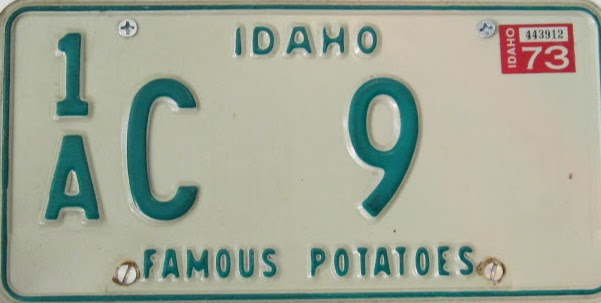
I acquired a number 9 auto license plate in 1972. It had nothing to do with passion, and everything to do with luck.

I was registering our old Chevrolet shortly after we moved to Idaho. When my turn came, the clerk looked around at boxes of plates behind him and said, "How'd you like a really nifty number?"

"Sure, why not," I said. With that, my clerk and three others made a dive for one box. My guy came back clutching No. 9, which he promptly issued to me. He explained that Idaho had a license plate pecking order. The governor got No. 1, the lieutenant governor received No. 2, and so on down the political ladder. The line ended at No. 8 with the secretary of state. So by possessing No. 9, I had the lowest plate number a common citizen could get.

My number 9 didn't cost nine million dollars. As I recall, the vehicle registration fee in 1972 was just $12 or so.

We got a lot of comments and questions from folks who noticed our distinctive tag. One was from my supervisor, Ed Maw. Ed had many political contacts, and he was proud of his status in the community. He appeared to be miffed that I had the low number when he believed he deserved any such honor. I played the game. "Ed, it's all in who you know," I told him.
 
My No. 9 currently graces our garage wall.
It was fun while it lasted, but it didn't last long. About four months after my registration Idaho changed to a whole new plate design and numbering system. I got an unimportant replacement number just like the rest of the common people.

I kept Idaho 9 as a souvenir. It now graces my garage wall. Since Mr. Sahani could well afford the gesture, I hope he'll send one of those Rolls my way. I'll be pleased to drive it around displaying No. 9 for all to see.

Thursday, October 20, 2016

No Place Better

We could take a plane or a train to enjoy the magnificent colors this weekend as New England hardwoods prepare for winter. Or, we could hop in our car and take a four hour drive into the heart of Michigan's Upper Peninsula to view similar woodsy splendor.


Or, we could simply look out our living room windows . . . .


Tuesday, October 11, 2016

Gd Gd Almighty, It Is Grand

Four summers ago, the Geezer posted the following lament with the full expectation that words here would have no impact on the highway gurus in Lansing.  Does the restoration of Grand to our signage signify the power of this blog to carry a message, or simply the dawn of common sense? I think the latter.


Thursday, August 09, 2012


Were I in charge of the Grand Rapids Chamber of Commerce, I would be irate and demanding change in the way the name of my city is routinely butchered by the Michigan Department of Transportation. MDOT consistently replaces Grand with Gd.

Yes, they could sneak "ran" in
Grand Rapids deserves a full ID.  It is known for several, admittedly not overly important, things.  Grand Rapids is Michigan’s second largest city.  Grand Rapids is the birthplace of former President Gerald Ford. Grand Rapids is a leading producer of office furniture.  More important to me, the city has two really good Mexican restaurants. 

How demeaning is a contrived Grand abbreviation? Can you imagine a sign saying: Gd Canyon--27 miles? 

Could MDOT put the “ran” back in Grand as a practical matter? Of course it could.  Possibilities include compressing the type, enlarging signs a bit, moving arrows, and changing the shape of arrows.

Because I am not the head honcho at the Grand Rapids Chamber of Commerce, the strange signage is of no personal concern. Anyway, it is starting to pop up all over, so Gd may be making a move toward supplanting Grand in common usage. A recent Google travel search yielded this instruction: Turn right to merge onto US-131 N toward Gd Rapids.”

                                           * * * * * * * * * * * * * * * * 

Lo and behold . . . This summer MDOT decided to make things right. At least a dozen signs in our area suddenly pointed the way to GRAND Rapids!  Included was the one I photographed back in 2012. Here it is today. The picture was snapped from a slightly different angle because a tree limb had grown to block part of the sign from the original camera viewing point.


Isn't it grand?

Friday, September 30, 2016

A True Spartan Sportsman

Amid all the sordid news about bad conduct by athletes and coaches throughout the sporting world, it is good to note there have been many instances of true sportsmanship. Two recent unrelated events caused me to recall one of my favorite positive sports stories.

Last Saturday, I watched the Michigan State University football team in action because they were hosting my Wisconsin Badgers. The next day, Arnold Palmer died. Palmer dominated professional golf for years, first on the regular tour and later as a participant with other older stars in the Legends of Golf tournament and similar events.

Throughout the 1980s and 90s I played golf many Saturday mornings at a course near our home in  Ogden, Utah, with a group of men who jokingly referred to themselves as the "Local Legends." Some of us were as old as Palmer and the rest of the real "legends," but none of us came anywhere close to their skill level. It was easy to join our group; anyone who wanted to play could.

By the luck of the draw, one Saturday I wound up in a foursome with a newcomer named Jones who was a professor at Weber State University. Dr. Jones was a big man who hit golf balls a long way, but not terribly accurately.

It was fall, and the chit-chat in our foursome naturally turned to football. "Did you ever play?" Jones was asked.

"Oh yeah," he replied, I was a  defensive tackle for a couple of years at a small west coast school."

"Which small school?"

"Stanford."

That exchange got some laughs, and also led to a question about Jones' experiences on the gridiron. He said only one was memorable.

"We played Michigan State. They had a lot of talent that year; we were pretty lousy. They beat up on us every which way.

"After we took our licking, we were sulking in our locker room when the Spartan coach knocked on the door. He asked our coach if he could speak to us. No one I know ever heard of an opposing coach doing that.
 
Daugherty earned many well-deserved honors
"Duffy Daugherty stood in the middle of the room and told us we had nothing to be ashamed of. He said even though we were over-matched, we had played our best to the very end, and he was impressed. He told us it had been an honor to coach against us that day. He said if we lived the rest of our lives with the perseverance we had shown, we would always have reason to be proud of ourselves."

Although he didn't specify the contest, Jones probably was referring to a game in 1961 when the Spartans beat Stanford 31-3. That year MSU's record was 7-2; Stanford went 4-6.

Several years later, Daugherty's Michigan State team was named national champions in a poll of coaches. Dr. Jones' story led me to believe coach Daugherty was one of the true champions we sorely need today in sports.  

Tuesday, September 13, 2016

Back to Blogging

It’s that time of year—back to school, back to work, back to leaf raking. So why not back to blogging? On June 14, I started a summer break from posting stories here. My thoughts at the time included the possibility of never returning.

Serious writers know that the act of frequently coming up with a new thought and developing it into a coherent story is mildly stressful at best and difficult most of the time. The reward for writing is not found in the act itself, it is in the good feelings authors experience when readers make their presence  known. And readers generate great pleasure for writers when they say they liked what was written.


In my 80th year, it was becoming harder to come up with new material, and anything that smacked of “work” was increasingly distasteful. Although my blog readership statistics continued to increase, the number of comments had been static for some time.

Reader reactions were bittersweet during the first weeks of my hiatus from blogging. It was gratifying to hear from friends old and new who said they hoped my summer would be enjoyable and they looked forward to my return. On the negative side, some people who I care greatly about showed they care very little about my work by not even noticing the absence of posts. Happily, the positive reactions were much more numerous than the negative.

Two anniversaries played the biggest parts in convincing me to return. The most important happened less than two weeks ago. Beautiful wife Sandy wrote on Facebook: “55 years ago today on September 2, Dick and I were married. WOW! It doesn’t feel like that long ago. It’s been a fun and adventuresome ride. . . looking forward to many more!”

Presiding over this blog has been part of the “fun and adventure” for me for a long time. The blog's tenth anniversary was July 11. During our traditional anniversary dinner, Sandy and I agreed that ten more anniversaries are quite likely in our future.

So how is an octogenarian to spend another decade? Embark on entirely new activities? Minimize all activity and concentrate on pure rest and relaxation? Stick with the activities that were part of the fun and adventure of the previous half century? 

I crossed the last item off my bucket list last year. New adventures are not on my horizon. I'm still feeling good, mentally and physically, so doing nothing at all would drive me batty. So, it's back to blogging with no guarantees about frequency or quality. Seeing how that works out should serve to generate some fun while continuing to pursue an old adventure

Friday, June 03, 2016

Graduation Gifts to the Unworthy

It's graduation time once more accompanied by a spate of news stories on various aspects of the educational rituals. A few focus on the costs of speakers. The Associated Press did that on May 25, just as the commencement ceremony season was getting under way.

We did a brief survey within our small family. Not a single person could remember who was the featured speaker at their high school or college graduation ceremonies. To be definitive, a broader survey surely would be needed, but our little sampling seems to question the truth of statements by college leaders that paying for celebrity speakers serves to impress alumni who make donations and causes potential students to take an interest in their campus.

A representative of Kean, a small public university in New Jersey that paid two speakers $80,000, claimed it was a reward for the graduates: "It makes their commencement just that much more memorable." Well, not if the grads don't even remember who the speaker was, much less what was said.

Do you remember who spoke and what they said at a graduation ceremony honoring your class?

Regardless of the validity for doing it, paying stars to perform at college graduations has come under some heavy fire in recent years. Of course, private colleges and universities can do what they please. The questions involve public institutions, whose leaders constantly complain that they are receiving inadequate taxpayer funding. If they speak truth, why are taxpayer dollars being devoted to activities that are not directly related to educating students or performing important research?

The good news is that the practice seems to be declining, according to AP data from 20 public universities that were asked about paying notable speakers to perform, including providing travel expenses. As part of the study, a large speaker booking agency was questioned. A representative said the firm was getting fewer requests for paid graduation speakers. Growing criticism of the practice was thought to be the cause. Of the 20 universities responding to AP's request, 16 said they aren't paying speaking fees this year.

The bad news is some universities have joined the payola group in recent years, and some fees are a bit startling. Rutgers made its first payment in 2011, rewarding author Toni Morrison with $30,000 for her talk. The University of Houston paid astronaut Scott Kelly $35,000. The University of Oklahoma paid television personality Katie Couric a whopping $110,000 back in 2006.

Last year, my school, the University of Wisconsin, paid Ms. Couric $3,100 for first-class flights from New York to Madison to speak at commencement. I don't object to paying travel costs, but couldn't she have flown coach or business class? And why not travel on her own dime? Wikipedia says Katie Couric is worth about 75 million dollars.

The Couric engagement brings up another concern. She certainly is a successful person, and therefore qualified to deliver in inspirational message. But she is a graduate of the University of Virginia, not Wisconsin. Every issue of the Wisconsin alumni magazine carries stories about highly successful graduates in many fields. One would think the school could sign up any number of graduation speakers without any cost simply by offering an honorary degree, or perhaps even without the degree offer. Most grads would consider it a high honor. Wouldn't you?

There was no problem this year finding a Wisconsin grad who is both famous and successful. Russell Wilson did the honors. He graduated six years ago with a liberal arts degree after quarterbacking the Wisconsin football team for two outstanding seasons. He has gone on to a successful professional career with the Seattle Seahawks.

Some, of course, would question the selection of an athlete when successful graduates in more important venues were available. However, I listened to Wilson's speech and it was terrific. He did a marvelous job of relating how he overcame serious obstacles to succeed at what he chose to do, and linked those experiences to some good advice to the grads. The selection committee must have strongly considered the message and the speaker's ability to deliver it.

Perhaps members of the UW Class of 2016 won't long remember who spoke or what he said, but if some do, the memory will be of a message from a fellow Badger. And the taxpayers didn't have to pick up a hefty tab to make it happen.