Showing posts with label Green Bay Packers. Show all posts

Friday, July 21, 2017

Way Too Much Pay For Play

My how salaries of American professional  football players have changed.

Washington Redskins quarterback Kirk Cousins recently turned down a long-term contract offer of $53 million. In 1924, the Green Bay Packers payroll for the entire team was $12,000. The 1924 team consisted of 18 players.

Ah, but inflation changes the picture. Yes, but the 1924 dollars are equivalent to only $171,530 in 2016 dollars. That would be about $9,530 per player, hardly a living wage. Of course, the 1924 salary money was not divided equally. Curly Lambeau was the Packers' player-coach that year, and he certainly got a bigger share than most, of not all, of the other players. Players in those days had to have other sources of income to survive.

We don't know the details of Cousins' $53 million contract offer, except that both he and the team have said the money was guaranteed, and not dependent upon performance or other factors.  We do know that top star quarterbacks in the National Football League are paid in the $10 million to $15 million per year range. Although Cousins has shown considerable potential, he is not yet an established top star. So let's assume his offer was for 5 years.

Is Cousins, or any athlete, worth $10.6 million per year?

Those who contend that professional football players are worth their huge compensation packages point out that careers can be cut short by injury at any time and the players cause teams to make the huge profits that enable them to pay top dollars to compete for talent.

Hogwash. Pay for professional football players has become ridiculous. Although some top surgeons in the U.S. can earn $1 million per year, average earnings for doctors in family practices, who strive to help rather than hurt others, are in the $200,000 per year area. The salary of the president of the United States is $400,000 per year.
Racing toward self-destruction?

A large share of the income of professional football teams is revenue from television contracts. Nevertheless, game ticket prices have soared to levels as exorbitant as player salaries and costs for food and drink in stadiums are likewise elevated.

There is mounting concern in this country about inequality in incomes between the rich and all others. A start at correcting the situation could be made in pro sports by winding down salaries of wealthy players and using the savings to reduce the costs for Joe Fan by lowering outrageous prices for tickets, hot dogs, and beer.

The current salary situation is well on the way to making me an ex-fan, and declining attendance figures for some teams indicate many already have become former supporters. Pro football is on a path of self-destruction if  drastic changes are not made .

Thursday, September 04, 2014

It's That Time Again


'Tis the season when footballs and banners of avid team followers fill the air.

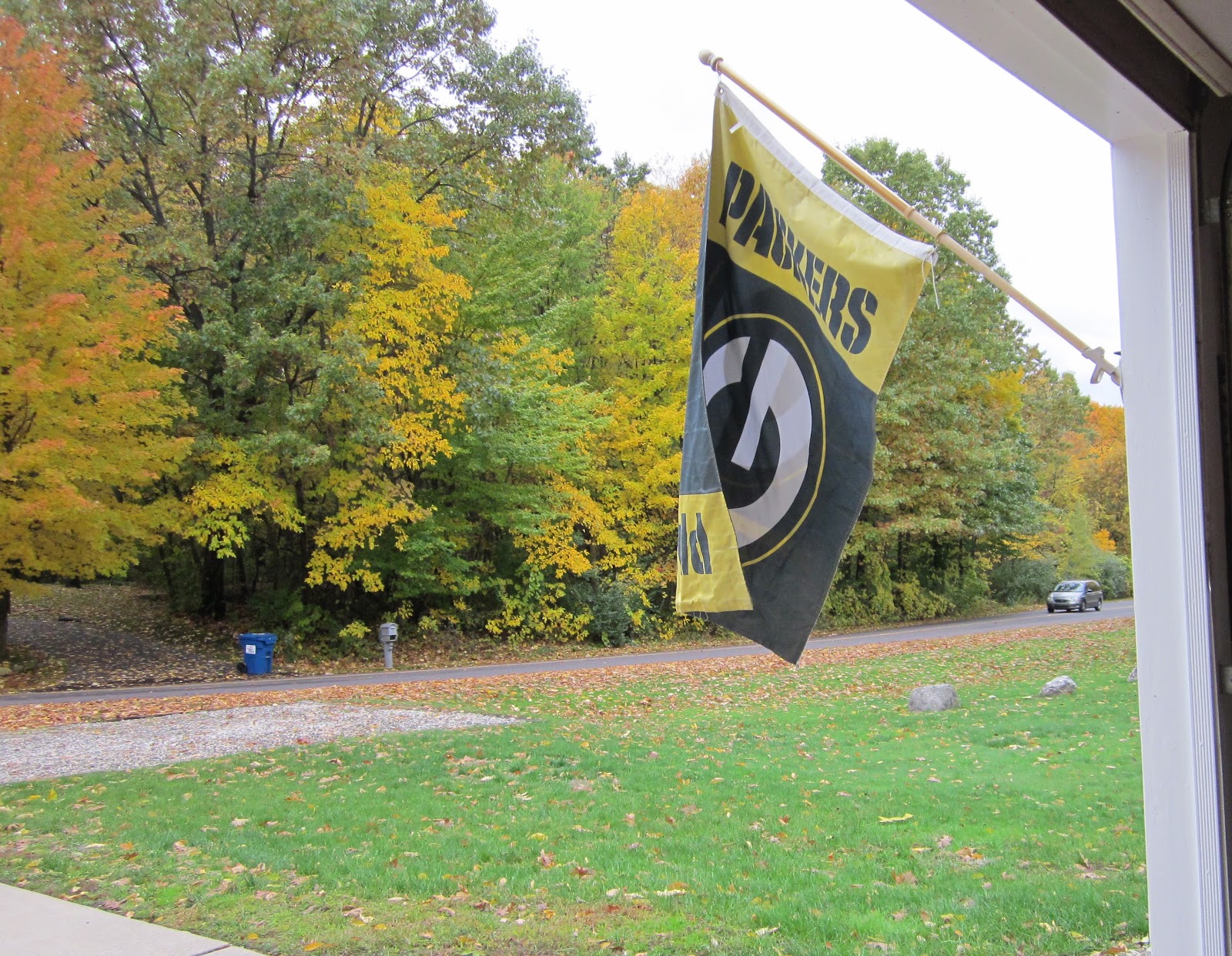
Some who pass our home wonder why my Packers flag flies only intermittently. That's because ancient family tradition dictates the flag is unfurled only after a victory. The first game of the season is tonight. At dawn's early light tomorrow my flag may, or may not, be there.

At the moment, a very few leaves in our Lake Doster area have begun to turn color. Mom Nature is more consistent than the Packers--all the  leaves will change and fall to the ground in a few weeks. You can depend on it.

Wednesday, January 22, 2014

NFL Champs: Seattle Never, Denver Hardly Ever

The geezer is trying to whip up enthusiasm for this year's Super Bowl despite the fact that a couple of expansion teams are vying for the Lombardi Trophy. Denver wasn't admitted to the National Football League until 1970. The Seattle franchise is even younger; it didn't sign on until 1976.

Oh well, backers of teams that have been playing the game since the 1920s and 30s can afford to be charitable. My guys, the Green Bay Packers, have won the championship 13 times. Seattle? Never. Denver  only twice.

Back next year? Maybe.
NFL clubs with some history--da Bears, Cardinals, Giants, Lions, Eagles, Redskins, and Packers--can only hope to add to their laurels in the future. The usual cry of "Wait Until Next Year" is already reverberating around the league.

If it doesn't happen for your favorites right away, don't give up. The geezer once waited nearly 30 years for the Pack to get back. A long drought just makes savoring a new title all the sweeter.

The geezer's Super Sunday pick: Seattle by 3. That will give them one.

Thursday, November 21, 2013

Cheered by an Outage

“Look on the bright side,” Mom used to say when things seemed particularly bleak. Sometimes that positive ray can be hard to find.

Sunday at 6:30 p.m., electricity vanished at more than 300,000 homes, including ours, in southwestern Michigan.  A huge storm with 70 m.p.h. winds was the cause. The power company estimated service restoration in five or six days. The weather forecast said low temperatures likely would be below freezing the next night. 


--Kalamazoo Gazette Photo                                                                            

We started our gas log fireplace, but without an electric fan to circulate the warmed air it wasn't a big help. Our son performed a partial rescue with a small portable generator. He hooked it up to our refrigerator and freezer to save several hundred dollars worth of food.

Monday was unpleasant at our place. No computing. No reading early in the morning or when evening darkness fell. No television. No hot meals. Barely adequate warmth. It is amazing how much we've come to depend upon electricity.

Then I remembered Mom’s advice and thought about a bright side. One appeared. The power went out half way through the Packers’ televised football game. The few players not on the injured list were being crushed by yet another mediocre team. True Packers fans never leave a game until the bitter end. I was saved from another hour or two of intense suffering when the power went off.

Almost as positive as the early end of the Green Bay game for me was  the cautious restoration estimate by our electric company. Our power came on one day after it went out, not five or six. However, several thousand others remain without electricity today. Probably only a few are hoping to stay in the dark until Sunday night so they can miss another Packers defeat. Most people around here are Lions fans.

Friday, May 04, 2012

Gro Carting

Conventional wisdom says the melting pot is working--we’re becoming homogenized Americans. 

We’ve gone through a half-century of population mobility, regardless of race, ethnicity, or religion.  Few stayed were they were born.  The young went off to pursue advanced education, promising jobs, or both. The old sold the family home and moved to enjoy final years in kinder climates and with other oldsters in communities built just for them. 

In the process, we’ve been losing those charming regional accents along with differences in manners and traditions.  We increasingly find the same big-box stores in every state.  The Golden Arches loom everywhere, and their proprietors go to great lengths to fry the stuff the same way at every location.

Knowing all this, we were surprised to spot a cultural difference the first time we made an extended visit to southwestern Michigan in 2006.  It was no fluke.  We’ve verified it hundreds of times since we moved here from Utah three years ago.

People in southwestern Michigan put shopping carts in the racks after they unload the groceries. Empty carts are rarely seen scattered about in parking lots.

In Utah, carts are left all over the place, and some abandoned ones are spotted blocks and even miles away from the store. 

Place in rack, please.
The signs imploring customers to put the empty carts in the racks are the same. Literacy rates are equal. The weather is similar, and thus not a factor.  We’d even give Utah an edge in that department.  The stores and lots are virtually identical.  So why do almost all the people here pay attention to the cart-return signs, while so many in Utah do not?

We’ve pondered the cart corral question at length without developing a glimmer of a theory for the cause.  Any ideas out there?

We do know that if you’re a parking lot neatnik, southwestern Michigan is the place for you.  You may get the bonus of seeing a gray haired geezer wearing a Packers shirt launch his empty cart at the rack and raise his hands to signify three points whenever his cart splits the uprights. It causes a lot of laughs in Michigan parking lots.  Bet you won’t see that elsewhere in the U.S.A.

Thursday, February 02, 2012

Look Out, Here Comes Tony!

The death of legendary Penn State football coach Joe Paterno produced a sports trivia story that brought back a memory of another gridiron hero and his relationship with Paterno.

The news story, in the Green Bay Press-Gazette, described a small chapter in Packers history new to me.  It seems Paterno almost was hired as the Packers head coach in 1970.  A dozen years earlier, I met one of the men who tried hard to make it happen.

A gentle man . . . most of the time.
Tony Canadeo was an outstanding halfback for the Packers, 1941-52, with a year off for military service. He was the first Packers runner to gain 1,000 yards in a season (1949), and is one of only five Green Bay players to have their jersey number retired.  Canadeo was voted into the pro football hall of fame in 1974. After his playing days ended, he was a popular TV announcer.  He also served on the Packers’ executive committee, which makes the big decisions for the team.

In 1958, because of my first professional job as editor of the weekly paper in De Pere, Wisconsin, I got an invitation to attend a banquet at St. Norbert College.  The college is in De Pere, which is only five miles from Green Bay. Although I didn’t have time to attend all the St. Norbert football games, I ran stories and photos provided by their public relations director.  That year, the Green Knights were undefeated, and my contact said the banquet was a special reward for the players, coaches, and media supporters.  The Press-Gazette sports editor also was invited in appreciation of the paper’s coverage of the team.  Tony Canadeo was to be the banquet speaker.

The PR man said I should come an hour early to a cocktail party hosted by the college president for Canadeo, the Press-Gazette man, and me.  Wow!  Every sports fan in the state knew who Tony Canadeo was, and as a 21-year-old novice small-time newsman I was awed at the prospect of conversing with the great man, a college president, and the leading sports journalist in the area.  It turned out to be an even more intimate gathering.  The Press-Gazette editor bowed out because of a last-minute emergency.

You never know what to expect from a sports star.  A good share of them can be pompous asses.  Others, including some of the most skilled athletes, are regular guys and gals. Tony Canadeo turned out to be one of the latter.  He quickly made me feel comfortable at the little party.  There didn’t seem to be a bit of super-ego in the man.  Far from the tough guy I half-expected, Canadeo was soft-spoken and polite. Ever since that meeting I’ve described him as a good-natured gentleman in discussions of the personalities of sports super stars.

In 1970, according to a story made public only after his death in 2003, Canadeo proved he could drop the calm demeanor and work up a rage with the best of them.

The Packers’ executive committee had fired the coach after a poor season.  When George Allen, their first choice as a replacement, declined the job, the committee interviewed several others and narrowed the choices to successful University of Missouri coach Dan Devine and Paterno, who was building an outstanding record at Penn State.

Paterno had turned down the coaching job with the Pittsburgh Steelers the previous year, but the Packers offered a combination coach-general manager situation.  Paterno apparently liked the idea of that kind of control.  Two reputable people later said Paterno would have taken the Packers job if it was offered, and one public statement he made indicated he was very interested.

The recent Press-Gazette story says Canadeo and another member of the executive committee strongly favored Paterno because the Penn State coach reminded them of Vince Lombardi, the iconic Packers coach.  Paterno and Lombardi both grew up in Brooklyn and were Catholics of Italian descent.  They knew each other dating to the 1940s when they were rival high school coaches.  In the 1960s, Lombardi often consulted Paterno about the abilities of college players.

Despite the Lombardi connection, Canadeo and his associate did not prevail.  The committee voted 5-2 to hire Devine.

When Canadeo heard the news, he became livid, the story goes.  As he left home for the next day’s executive committee meeting, he was so distraught he smashed through the garage door when he backed his car out into the driveway.  A daughter had used the car earlier and left the door up when she came home.  As Canadeo stormed out of the house, he didn’t notice and he hit the garage door opener button, closing the door just before he drove through it.

Devine compiled a dismal record at Green Bay.  Paterno became the top winning coach in college football history.  Perhaps the Packers’ executive board members should have listened to their old halfback who could destroy garage doors with a single mighty burst.

Thursday, January 19, 2012

Oh, Brother!

Reading the latest Sigma Nu national magazine, I learned that Eli Manning and I are fraternity brothers.  That should have taken some of the sting out of what he did to my beloved Green Bay Packers on Sunday.

But it didn't. 

Go, Niners!

Friday, January 13, 2012

They Pack 'Em In


Perhaps still basking in the glory of last years' Super Bowl title, the Green Bay Packers seem to be moving slightly upscale.  While preparing for Sunday’s playoff game, management announced that volunteers who show up with their shovels to clear the snow away from seating areas will be paid $10 per hour rather than the customary $8.

Not Plush
Lambeau Field is a very nice stadium, but in some cases tradition continues to trump luxury.  The team spent several hundred million dollars on improvements in 1998.  Knowing that, one of my golfing buddies, a Raiders fan, was amazed to learn that most of the Packers faithful are assigned bleacher-type plank seats.  Only relatively small areas of the stadium are equipped with comfortable individual seats with arm rests and backs, such as those found throughout most big-time sports venues.

My friend observed that it might get pretty crowded at Lambeau when the weather dictated wearing heavy coats over multi-layers of clothing.  “What happens if they all sit down at once?” he asked.

“I don’t know,” I said. “They never have.”

When I attended the first game at Lambeau Field in 1957, the uncomfortable seats didn't matter to me.  I went solo.  Because of the unused ticket for the seat next to me, I had plenty of room.

For the second game I attended, I had a date with a pretty little Dutch gal.  That was nothing unusual.  At the time, the biggest section in the Green Bay phone book started with V.  The bench seating was just great for snuggling up in the cold weather.  It didn't help, though.  She ditched me a week or so later for a local baseball star.

You can be sure of one thing on Sunday.  Every seat in Lambeau Field, in a luxury box or on a plank, will be filled.  They always are.
No, it's not me. Just a typical geezer warming up for the playoffs.


Monday, January 02, 2012

Recent Results

Green Bay Packers junior varsity 45, Detroit Lions 41. (Aw shucks, I just couldn't resist)

Sunday, November 27, 2011

Santa Scores


About ten years ago, beautiful wife Sandy came up with a surprise holiday gift—a large Green Bay Packers flag.  Flagpoles weren’t allowed in yards in the planned community where we lived in Utah.  I often flew Old Glory from a standard attached to the building adjacent to our garage door, which was in keeping with community rules.
What so proudly I once hailed.


The second flag posed a bit of a problem during football season.  So we devised a sharing system that became an amusement for most (but not all) of our neighbors.  A Bears fan down the street definitely was not amused.  Neither was a Cowboys fan across the street, but he launched a counter attack by displaying his own team colors.  The Bears fan merely seethed.

The sharing plan was simple.  If the Packers won their weekly game, their flag was displayed soon after the contest ended.  It flew until Wednesday, when it was displaced by the Stars and Stripes.  The national flag stayed up until the Pack won again.

When we moved three years ago, our new place had a regulation flagpole installed by the previous owners in the lawn beside the house.  There also was a standard beside the garage door, almost exactly like the one in Utah.  No rotation problem here.  But as one who fancies tradition, the Geezer continued to display the Packers banner in the old way—up after a win, down on Wednesday until the next win. 

For almost two years, the rotation worked well.  Toward the end of last year, however, it got a little old.  The Packers ended the season with six consecutive victories.  It became drudgery to take the banner down and reinstall it every week.

Prospects were even better for the team this season, so the Geezer devised a labor-saving strategy—leave the flag up until the Packers lost.  The new plan seemed a stroke of genius as the Packers won 11 straight games.

This week, Sandy devised a new strategy for our annual holiday lighting display.  Lights were strung most of the way around the garage.  The design placed lights perilously close to the Packers flag.  With any sort of breeze, the flapping banner threatened to destroy a key part of Sandy’s display.  Something had to give.  Guess what won out.


Ho, Ho, Ho . . . . Packers, you’re on your own now, you know.

Thursday, November 17, 2011

Taking Stock

My favorite pro sports team, the Green Bay Packers, once again is gearing up to sell stock to the public.  Nothing new about that. The club has held numerous sales of shares since the 1920s when it was organized as a nonprofit corporation with backing from several local business leaders.

In the early years, sales of shares kept the team alive, often just barely.  Recent sales financed major improvements at Lambeau Field, allowing the Pack to pick up considerable extra revenue from home-game crowds and special events. That money has helped the franchise compete with those owned by billionaires in big cities.

Hanging on a wall of my office is one framed share of stock issued in 1997 by Green Bay Packers, Inc.  I bought it for $200.  It has proved to be a horrible or great investment, depending on how you view such things.  The dollar value is zero.  The value of the bragging rights is immense.
Not for profit; for bragging rights
Much has been written and said about Packers history since the big team representing the little city burst upon the national stage back in the 1960s. Championship years arrived just as color television came into millions of American homes and professional football emerged from the shadows of sports to become somewhat of a national mania.

I’m not an expert on Packers' lore, but I’ve read much of what has been written about club history, attended the first game in Lambeau Field in 1957 (we beat "da Bears" 21-17), and have followed the team’s fortunes more or less closely for nearly 65 years. Here are some of my favorite trivia, some factual, some based on rumor and questionable recollections. A few items correct erroneous statements by current news people, mostly television announcers:

  • Television talking heads frequently state the Packers are the “only professional sports franchise owned by the community.”  Wikipedia makes the same statement. The statement is incorrect.  I am one of 112,158 shareholders, living all over the world, who own the team.  Obviously, all the owners do not live in Green Bay.  This relatively unimportant error may be caused by confusion between team and home field ownership. The City of Green Bay, not the Packers, owns Lambeau Field, which has become somewhat famous in its own right.
  • Accounts of the dire financial straits faced often by the team in early days are not exaggerations.  Perhaps the most desperate situation occurred when a section of the wooden grandstand in old City Stadium collapsed during a game. (at its largest, old City Stadium seated 25,000 when all stands were upright). The collapse caused many injuries.  The Packers’ insurance company couldn’t handle the volume, went bankrupt, and thus defaulted on many claim payments.  A stock issue raised enough money to pay the claims and save the franchise.
  • It often has been said that if the corporation was to be liquidated, an unlikely event, all proceeds would go to an American Legion Post in Green Bay, because the post bought a block of preferred stock many years ago that gave it special ownership rights. The legality of that assertion never will be tested, because Packers’ management a few years ago changed the charter to clarify things.  If the Packers went out of business, all assets remaining after creditors were paid would go to a charitable foundation.  That would be a rather nice deal for charitable causes, because the franchise today is valued at a bit more than $1 billion, and debt is minimal.
  • My $200 investment in reality was a donation. The share has no cash value and cannot be sold.  It can only be transferred to members of my immediate family.  I can attend the annual stockholders’ meeting with about 30,000 other fans, listen to the head coach, general manager, and finance officer field questions, and vote for the board of directors.  The board mostly is a figurehead body that includes Wisconsin business leaders and heads of sports organizations, plus a few former Packers players. They select an executive committee. The committee appoints a club president and approves the president’s choice of a general manager who runs the show. Because of the large number of interested shareholders, the annual meeting is held in Lambeau Field.
  • When a hands-on billionaire owner such as  Jerry Jones of the Dallas Cowboys jumps up from his front-row perch in a luxury box and yells, “Run a damn screen,” an attempt at a screen pass is likely to occur soon on the field.  When I leap from my stool at Rhino’s Sports Bar with a similar demand, the message goes no further.  We little Packers owners have no power to influence policy or play.  A provision in stock offerings limits the number of shares a single entity can own; assuring the present limits on stockholder power will be permanent.
  • Many current histories state or at least imply that E. L. (Curly) Lambeau, Packers co-founder and coach and general manager for 32 years, was a wonderful guy revered by all who knew him, and area residents rushed to name their new stadium for him in 1957. The facts, and the rumor mill when I lived in the Green Bay area, say otherwise.
  • Lambeau, without question, was an important       figure in the early development of what now is the National Football League.  His teams pioneered the passing attack. He led the Packers into post-season exhibition games in the South and on the West Coast, often against the arch-rival Chicago Bears. The teams often traveled together. These contests created interest in pro football and helped pave the way for expansion teams some years later.  The rumor mill said a side benefit of the excursions to the coast were close encounters between Lambeau and several Hollywood starlets.  Giving credence to that story is the fact that one of Lambeau’s three wives was a former Miss California.  A personal history that included a couple of divorces probably was not exactly endearing to many football fans in Green Bay, most of whom were Roman Catholics who at that time considered divorce a serious no-no.
  • Rumors abounded that Lambeau was notorious for late or no repayments of debts. Several times when I asked older De Pere residents (I edited the weekly newspaper there) if they knew Curly Lambeau, they smiled and pulled from their wallets scraps of paper that said, “IOU $10” (or $15 or $20).  Each was signed, “Earl Lambeau, or simply, "Curly.” None was marked paid.
  • The famous founder-coach became somewhat of a traitor in local eyes when he abruptly left Green Bay in 1949 to coach the rival Chicago Cardinals.   The rumor mill maintained that whatever was in a depleted Packers treasury left town at about the same time.  Whether that is true or not, the Green Bay club was forced to make a major stock sale in 1950 to continue operations.
  • What is now called an “historic playing field” was not named for Lambeau at the start.  When I attended the 1957 opener I was seated in City Stadium.  Some locals called it “new City Stadium” to make the distinction between it and the old arena near Green Bay East High School where the Packers played for years.  I heard of no one campaigning to name the new field for Lambeau. That did not happen for eight years, until after Lambeau died in 1965. 
  • Both Lambeau and the other legendary Packers coach/general manager, Vince Lombardi, were known as stern taskmasters who often emphasized their instructions with profanity.  There the resemblance pretty much ended.  Lombardi did not earn the nickname “Saint Vincent” entirely because his teams won a lot of games. Unlike Lambeau who enjoyed lavish living in his spare time, Lombardi was known to be a workaholic and a devoted family man in what off-duty time he allowed himself. He attended a Catholic Mass every working day before heading to the office or the practice field, a ritual that considerably enhanced his standing with many Green Bay residents.
  • When Lombardi came out of retirement to lead the Washington Redskins, there was none of the animosity among Packers fans that was kindled by Lambeau’s defection to Chicago.  The Green Bay fans were only disappointed that “Saint Vincent” chose did not return to the Packers.
  • Lombardi often is portrayed as a ruthless bad guy by fans of rival teams, and other critics have contributed to that notion.  However, in memoirs published by former players, all speak of a healthy respect for the coach’s work ethic and demands that they follow suit.  Few disliked him.  Perhaps the most famous quote attributed to him, often by critics, was “Winning isn’t everything, it’s the only thing.”  Historians now doubt Lombardi ever said that.
  • It is often said that the club shareholders and citizens of Green Bay are hidebound traditionalists who have prevented Packers management from selling naming rights to the stadium to a commercial enterprise, as other pro clubs have done. The truth is that Green Bay area voters approved a name sale in a referendum on the question.  Packers’ executives are the traditionalists. They have ignored the will of the voters, preferring to give up millions of dollars of income in favor of maintaining the Lambeau Field name.
  • The bitterness of the Packers-Chicago Bears rivalry is real, but historically there has been perhaps more of a love-hate relationship between the organizations' leaders than we are led to believe.  Many old Packers fans think that Bears’ long-time owner-coach George Halas actually was an ally who stood firmly against other big-city owners when frequent calls were made to move the Packers franchise to Milwaukee or some other more-lucrative market than the small city (population 50,000 in 1957, about 100,000 now) on the bay (others say Halas backed a move to Milwaukee, at least once).
  • My rumor mill said that when Halas retired, Packers fans threw a bigger party for him in Green Bay than his friends did in Chicago.  It is a fact that Halas served as a pall bearer at Lambeau’s funeral. Some Packers fans were said to be offended, which seems silly indeed.
  • Apparently, it is true that Lambeau and Halas refused to engage in the traditional post-game handshake during all or most of the 30 years when they were opposing coaches. One observer reports seeing “Papa Bear” shake his fist at Lambeau after a particularly hard-fought contest. Nevertheless, when the Bears faced serious financial difficulties in 1933, Lambeau loaned Halas half the Packers’ share of gate receipts ($1,500) from a game in Chicago. The act is said to have been a big factor in keeping Halas and the Bears solvent during that Depression time.
  • Was some of the public inter-coach dislike displayed as part of a shrewd show by two skilled promoters seeking to increase interest in their struggling sport?  I think so.  If that is true, Halas and Lambeau were successful.  Packers-Bears games continue to draw big crowds and lots of attention from national television viewers.
  • The cost of the coming Packers’ stock sale is rumored to be $250 per share.  The goal is to raise millions to pay for 7,000 additional seats at Lambeau Field, plus a new scoreboard and complete new electronic communication system.  Buyers will be making a donation just as I did in 1997.  Will the “worthless” shares sell? No doubt they will.  Some current stockholders already have said they’ll buy shares as gifts to their grandchildren.  They can’t very well buy their descendents a couple of season tickets, because the waiting list for tickets now stands at 81,000. Although Packers fans suffered through 27 years of mediocre play between the Lambeau and Lombardi eras, every game since the present stadium was built has been a sellout.
  • Some fans have been waiting for years to become “owners” for the first time. Why?  That’s the “bragging rights” part of it, I guess. There is a certain family feeling about the whole thing. The letter signed by the  club president that arrived with my share of stock didn’t end with a standard line such as, “Thanks for your contribution.”  It said, Thank you for joining the Green Bay Packers.”
  • Of course, any pro football fan with even a touch of rationality realizes the games are between one group of hired athletes and another. Nevertheless, Packers fans are notorious for saying, “We scored twice in the second quarter,” or, ”We blew the coverage on that play.”  There seems to be a personal feeling that “we” always  are part of the team of little guys going up against the big city slickers, even though that attitude is unrealistic.
  • Packers fans seem to have a little special streak of dedication that sometimes borders on craziness.  After I had shown off my share of stock as much as possible, I told my son I was going to transfer the certificate to him so he could take a turn at bragging about being a pro team owner.  He said, “Don’t bother, Dad.  I bought one for myself.”
  • Myths and facts pertaining to the career of Packers’ old-time pass catcher Don Hutson deserve mention in any discussion of Green Bay history, but this treatise is getting too lengthy for that. Television reporters who would know better if they did their homework, and show business personalities who can’t be expected to have a clue, routinely state that San Francisco 49ers’ receiver Jerry Rice was the greatest pass receiver of all time.  As sometimes is said in locker-room comparisons of talented players, “Rice was a great receiver, but he couldn’t carry Hutson’s jock.”
  • Don Hutson not only was the greatest receiver ever to play the game, but he probably was the greatest player in pro football history.  I’ll try to prove that point with a post later in this season when the stars are right.

Friday, August 12, 2011

Great Start

After a lengthy strike and lockout that angered fans whether they supported the rich players or the even richer owners (except for the Green Bay Packers, who have 110,000 stockholder owners, most of whom are decidedly not rich), one could be pretty sure the start of the National Football League season would be screwed up.

I watched part of the first exhibition game last night on the tube. Not unusual, eh? Well, the show was titled “Monday Night Football.” Last night, of course, was an integral part of Thursday.

Another exhibition game will air this evening. Wonder if  the presentation will be called “Tuesday Night Football?”

Thursday, June 30, 2011


“The Fridge” (left) and the kitchen variety both can inflict considerable pain. Encountering either one should be a young man's game.

 Refrigerators. . . Ouch!

I used to shudder while watching William “The Refrigerator” Perry run over pro football opponents when he was among the stars on some great Chicago Bears teams. Probably part of my horror was because “The Fridge” seemed to save his most ferocious attacks for my favorites, the Green Bay Packers, who were suffering through some bad years at the time.

The Bears added insult to the Packers’ injuries in one memorable game when they placed Perry, a defensive tackle, at running back. He promptly plowed over and through a couple of Packers on his way into the end zone for a touchdown. I remember wondering at the time how it might feel to be hit by “The Fridge” when he was traveling under a full head of steam. I got a pretty good idea a couple of weeks ago.

Perry claimed he weighed 382 pounds at his physical peak. That was in 1985 when Da Bears won the Super Bowl. The average weight of refrigerators in American homes nowadays is 400 pounds. As part of our ongoing home remodeling project, I was on a two-man team moving a slightly below-average-sized fridge down a flight of stairs. It and Perry probably would have been a match on the scales.

We were not novices at appliance moving. Equipped with a rented professional-model dolly, we securely attached the refrigerator and worked it into position at the head of the stairs. Being the oldest team member (by far!), I took the easy position below the unit. All went well for a while.

Then, about halfway down, we loused up our procedure somehow. The fridge started thundering down the stairs right on top of me. There was nowhere to go but down as fast as I could, and that wasn’t fast enough. The refrigerator bashed me against the wall at the bottom and pinned one arm and both legs to the floor.

I suffered a gash on one leg, a cut elbow, a slice on a hand, a terribly painful knee on the other leg, and assorted scrapes and bruises. When my moving team pal managed to crawl over the fridge and pry it up so I could escape, he asked, “Did you hit your head?”

“Are there any dents in the wall?” I asked.

“None that I can see.”

“Then I didn’t.”

For two days I could hobble about 15 feet from my bed to the bathroom with painful effort and help from a walking stick and anything else I could grab to take pressure off my knee. Two weeks later I could walk fairly normally, and most of the cuts and bruises had healed quite well. Today, everything is back to normal.

I’ve decided fooling around with refrigerators is a young man’s game. In a way I was lucky my encounter with a runaway 380-pound object happened late in life on a stairway rather than as a youth on a football field. Granted, those Packers “Refrigerator” Perry plowed through wore protective helmets and pads, but they didn’t have several weeks to heal up before their next game.

Tuesday, February 08, 2011

Last on the List


Everybody, except me, thought it was a joke. All who asked were told the very last item on my “Bucket List” was to watch the Green Bay Packers win one more Super Bowl.


Ridiculous? No. A careful assessment after watching the movie about the two old codgers who wanted to do many things before they cashed in, plus several reassessments later, showed about three years ago I had done the next-to-last specific thing I wanted to do in my lifetime. The Packers gave me the opportunity to take care of the last one. I was content as I tore up the old bucket list Sunday night.


However, even before the old list hit the bottom of the recycling bin, a successor called my “dream list” started developing. It includes three items at the moment. Only two are likely to happen.


The first really is a “targets of opportunity” generality. Now that my bucket is empty, I want to concentrate more on doing things that benefit other people. This one is sort of like a New Years' resolution. Maybe I’ll make it happen; maybe not. Chances of success: 70-30.


My second dream is that those idiotic wars in the Mideast will come to an end during my lifetime and not be replaced by other unjustified military adventures. Chances of success: near zero. When will we ever learn?


Once again, the last item on my list depends on the Packers. To fulfill my dream, they need to build on this year’s improbable Super Bowl win to put the franchise where it rightfully belongs—atop the football world.


The Packers and Chicago Bears have played 182 times, and it is galling that Da Bears are eight games ahead of the Packers in the series. That needs to be corrected.


Although the Packers have won the most professional football championships—thirteen—The Steelers have won six Super Bowls and the Dallas Cowboys and San Francisco Forty Niners each have triumphed five times. This is an intolerable situation for Packers fans. Our heroes only have four wins. We need three more to make things right in the record books.


I wrote this year’s team off after the fourth game as the number of players out for the season with injuries was growing faster than a snow drift on the east shore of Lake Michigan in January. I was wrong. I underestimated the depth and talent of the squad. The coach and general manager turned out to be far smarter than some of their public appearances led me to believe they were.


Sunday’s achievement, events in the weeks leading up to it, and the age, contract status, and ability of the entire complement of players foretell a bright future. Barring serious injury to the quarterback, Green Bay is going to be a powerhouse for eight to ten years. That’s plenty of time for them to take care of their responsibilities on my “dream list.” And I’m expecting to spend at least that many years working on the other items and anything else that seems important.

Friday, February 04, 2011

Then, Spin Dry


It’s impossible to work up the kind of intense dislike for the Pittsburgh Steelers that true Packers fans have for the Chicago Bears. Really, it’s hard to work up any sort of bad feelings for the Super Bowl opponents, so this will have to do for a pre-game razz:

The wife of a Pennsylvania man was ill, and he gallantly offered to do the laundry, a task he never had undertaken before.


Soon after he entered the laundry room, he yelled to his spouse, who grew up in Wisconsin, “How do you wash a sweatshirt?”


“It depends,” she answered. “What does it say on the shirt?”

“Go STEELERS,” he yelled.


“Use hot water, a full box of Tide, and four cups of bleach.”

Monday, January 24, 2011

Staying Power

I watched in disbelief as Chicago Bears quarterback Jay Cutler stood on the sidelines nursing a sore leg while his team dropped the National Football Conference title game to the Packers yesterday.


Like Cutler, I suffered a leg injury just before the end of the first half. My left ankle cramped up as I jumped off the sofa when the Packers made a key defensive stop.


Nevertheless, I managed to hobble to the kitchen for another glass of wine to sustain me through the second half. A little leg injury wasn’t going to keep me out of a title game.

Thursday, January 20, 2011

A Sort-of Hometown Hero


I should have puffed up with pride when a photo of a ferocious-looking footballer appeared in the University of Wisconsin alumni magazine with this caption: “Mike Webster as a Badger: the Tomahawk, Wisconsin, native was drafted by the Pittsburgh Steelers in 1974 and played seventeen seasons in the NFL . . .”


Like all small communities, my hometown hasn’t produced a big crop of famous people, so a legitimate hero means a lot. The trouble here is that referring to the man who became known as “Iron Mike” for stellar play that took him to four Super Bowl victories and a berth in the NFL Hall of Fame as a “Tomahawk native” is stretching things.


Webster’s parents were potato farmers north of Tomahawk, but Mike went to school and played high school football at Rhinelander, which is about 18 miles from my hometown. The Rhinelander High School stadium is named for him.


Although he ranks right at the top in discussions of the best center ever to play pro football, the sport did not treat Webster well. He suffered numerous head traumas, was hooked on painkillers by the time he retired, had bouts of amnesia, depression, and dementia, and died while still a young man. His family sued the NFL for disability payments in 2006 and won a $1 million judgment.

The lawsuit and attendant news stories did much to raise the level of concern about effects of concussions on athletes. The topic is on the front-burner today throughout the sports world.


The Webster family saw to it that Mike made a contribution to the cause of better protection for athletes. After he died, his brain was sent to the University of Pittsburgh. There, a pathologist did an autopsy resulting in the first diagnosis of CTE, a condition caused by years of absorbing blows to the head. That made Webster the first NFL player to receive that diagnosis, a research breakthrough upon which others are building as they study effects of repeated jolts to the head and how to prevent the damage.


Webster’s posthumous contribution may turn out to be his finest. He became a hero, hometown or not, once again after he died.


The pro football anti-heroes right now are the greedy owners trying to convince the players’ union to agree to expand the schedule by two for a total of 18 games. This is unconscionable with ample scientific evidence in hand that damage from repeated head-knocking is cumulative.


My favorite club, the Green Bay Packers, is a nonprofit corporation and thus has no greedy owner. We small-fry shareholders should be watching closely on this one to see what position our representatives take. Clearly, the players’ health should be the top priority.

Thursday, November 25, 2010

Look Out, Turkey

In Jerry Kramer’s Farewell to Football, the author describes a gridiron invention claimed by his fellow guard Fuzzy Thurston. The Green Bay Packers were thrashed by the Detroit Lions in a contest on Thanksgiving Day, 1962. One reason for the beating was a lack of effective pass blocking, especially by guards Kramer and Thurston.

The Lions sacked quarterback Bart Starr 11 times, a league record. After the debacle, Thurston joked that he and Kramer had invented the “lookout” block. He said throughout the game the guards would make unsuccessful attempts to block charging opponents, and then yell, “Look out, Bart.”

Well, maybe Thurston and Kramer launched the first lookout blocks in the National Football League, but they certainly were not the first players to use the term. A pair of high school gridders practiced a version of the “lookout” 10 years earlier.

In 1952, I played right guard and my pal Gordy Newborg was the right tackle for the Tomahawk Hatchets, a Wisconsin high school team somewhat less renowned than the Packers, and not nearly as fearsome as its name implies. Newborg intensely disliked one of our halfbacks. I wasn’t too fond of the guy, either. During most practice scrimmages, the back usually managed to infuriate Newborg and antagonize me in one way or another.

When that happened, Newborg nudged me as we broke the huddle after the halfback’s number was called. He whispered, “Let “em in.” We would fake blocks, turn, and yell, “Lookout.” The “play” usually resulted in two hefty defensemen bashing our mouthy halfback before he could get under way.

Hair-splitters may claim that the ineffective Klade-Newborg blocks were intentional, and therefore not the same as the Kramer-Thurston “lookouts.” That’s true. If the Packers had known of the Tomahawk play, perhaps they would have yelled, “Sorry, Bart; Lookout,” to better define their modification of our invention.

One thing’s for sure, they didn’t yell, “Happy Thanksgiving,” but that’s my shout to you today.

Monday, November 08, 2010

Who’s Team?

Claims by Dallas Cowboys’ fans supported by many television announcers that the Texas club is “America’s Team” long have rankled Green Bay Packers’ fans.

We think our 100,000 stockholders spread across the nation entitle us to that title. We also think many more people in many places without an ownership stake root for the Green and Gold week after week, seeing our heros as the classic small-town guys up against the big-city slickers.

The fact that the Cowboys have notched so many victories against the Packers rankles even more. It just didn’t seem fair that our hired guns were out maneuvered so often by theirs, and it happened more than once in recent years when playoff advancement was at stake.

Sandy and I have not been south of the border for some time, but we once were frequent visitors. Cowboys’ uniform replica shirts and t-shirts were everywhere. Mexican youths seldom were seen in clothing featuring Packers’ insignia. We never met a Packers’ stockholder in Mexico, except for fellow tourists.

It’s doubtful the situation has changed much, although there probably are some residual green and gold number 4’s still hanging around in Cabo, Cozumel, and points in between. Most Packers’ fans have disowned that guy, anyway, so shirts honoring Old No. 4 shouldn't count.

After Sunday night’s 45-7 thrashing in Green Bay of the boys from Texas is it fair to say “America’s Team” finally crushed “Mexico’s Team?”

How sweet it was.

Monday, September 27, 2010

Sideline Humor

In 1964, I assumed much good humor was to be found in sports.

When my publisher at the Wisconsin Rapids Tribune decreed I would write a weekly column on subjects of my choice, I decided to end each offering with a sports joke. Some national stories were available from a news service we subscribed to. I was sure I could find enough humor in and around local sporting events to fill in any blanks and end my column with a rib-tickler every Wednesday.

I was overly optimistic. Despite efforts by many comics and writers, there really weren’t all that many good sports jokes around. After a couple of months, I dropped the “leave ‘em laughing every Wednesday” strategy for want of material. That dearth of sports witticisms hasn’t changed much in the ensuing 45 years. But on Sunday morning, I think I “heard a good one lately.”

I was telling a dedicated Detroit Lions fan of my intent to root hard for the local favorites that day, for two reasons: (1) my beloved Packers were idle, and (2) the Lions were playing the Vikings. Minnesota would be led by an aged quarterback named Favre, who readers of this blog may know is not one of my favorite guys.

“Didn’t you hear the news this morning?” the Lions’ booster asked. “They’ve renamed the team. From now on, the Lions will be known as the Detroit Possums. It makes sense. They play dead at home, and get killed on the road.”

He said it; I didn’t. The “Possums” played true to form that afternoon. They suffered their 22nd consecutive loss on the road, which ran their record to 40 losses against just 3 wins since the midpoint of the 2007 season.

Even a joke at the Lions’ expense eases the pro football pain around here.