Showing posts with label World War I. Show all posts

Tuesday, November 18, 2014

Santa Takes Back Seat to Vets

Santa Claus arrived in Kalamazoo on Saturday (much too early to suit me and many others) as thousands attended the annual Holiday Parade. The jolly one got lots of appreciative oohs and aahs as he was escorted by 11 marching bands and a variety of floats, but he was not the star of the show in southwestern Michigan last week.

Santa clearly lost the appreciation contest to the U.S. military. Active G.I.s and veterans were showered with gifts starting the weekend before Veterans Day (Tuesday).  Free meals and discounts on all sorts of goods and services continued in some cases right up until Santa grabbed the next weekend spotlight.

November 11 observances have undergone a transformation during my lifetime. Originally,  "Armistice Day'" marked the end of World War I. It was a day of reflection and a time to honor those who gave their lives or were crippled in the conflict.

When I was a youngster, people observed a moment of silence at 11 a.m., when the treaty ending the war was signed. Everyone was encouraged to make a donation to the American Legion Auxiliary in return for a red "remembrance poppy," a paper creation we wore all day in honor of the dead soldiers buried in France. The Legion ladies used poppy donations to benefit disabled veterans or other vets or their families known to be in need. I remember my Dad encouraging me to drop a nickel or dime in the collection can as he explained the significance of the poppies.

Armistice day was important in my family. Dad, his two brothers, and my Mom's brother all served in WWI. One of my uncles came home from France permanently disabled from effects of a gas attack. Another returned with a Croix de Guerre medal awarded by the French government for bravery.
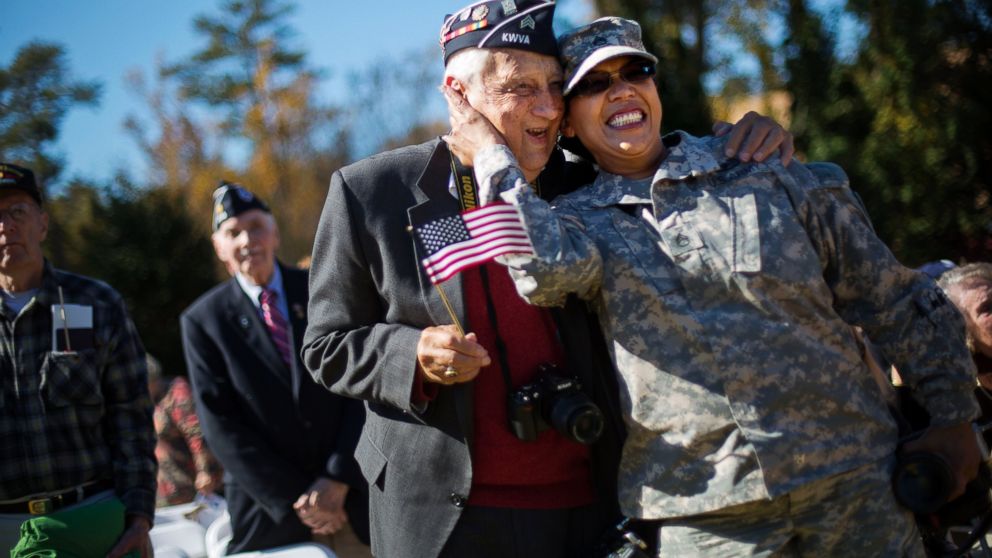
As fewer World War II vets remain alive, they get lots of love. (Associated Press photo)
All died years ago. There are no veterans of World War I  alive today in the U.S. The old Armistice Day customs, however, continue to some extent. Church bells still ring at 11 a.m. on Nov. 11 in a small town near us. Veteran firing squads still launch volleys marking the time. Although I've not seen a remembrance poppy worn for several years, there may be places where they are available.

Wikipedia tells us that remembrance poppies remain common in other nations, especially the UK, and there the day to honor those who gave their lives in battle is titled Remembrance Day. That seems appropriate because the U.S. played a relatively small role in World War I, where trench warfare produced wholesale slaughter.

The U.S. didn't enter the five-year conflict until almost the final year. Casualties totaled 320,000. That seems like a lot, but consider that British Empire dead and wounded totaled more than 3 million and French casualties topped 6 million. Some 37 million people from all participating countries were killed or wounded in the horrific struggle. The U.S. military casualty total was much higher in World War II--more than a million.

During World War II, Armistice Day began to morph into Veterans Day. Informal observances using the new name started in 1947. In 1954, Congress officially recognized Veterans Day, declaring it a national holiday and a time to honor all veterans.

I was discharged from the Army in 1960, and don't recall any wholesale changes in observances until fairly recently. The old Armistice Day traditions simply continued under a new name. Veterans usually were respected, but not always. Many Vietnam War vets complained about shabby treatment when they came home from the killing fields in Indochina.

If anything, recognition and tangible rewards for veterans declined. My brother-in-law and other Korean War vets pointed out that monuments in city squares omitted them. Supposedly, that was because Korea officially was a "police action," not a war. The nation's biggest veterans' organization, the American Legion, refused membership to thousands of veterans of my era, a practice continuing today. An ungrateful government reduced or eliminated some veterans' benefits for us as well. On Veterans Day, a vet might be thanked for service with a fee doughnut or cup of coffee in a few places, but those were about the only tangible gifts from private people that I remember.

Everything seemed to start changing after the 9/11 attacks. Suddenly, those cups of coffee became free meals.  A huge variety of businesses began to offer 10 percent or more price reductions to veterans. Because some hotels and motels gave room discounts, the proverbial "three hots and a cot" provided to active duty G.I.s could once again be enjoyed by veterans. Offering gifts to vets seemed to take on a snowball effect, and it hasn't stopped yet.
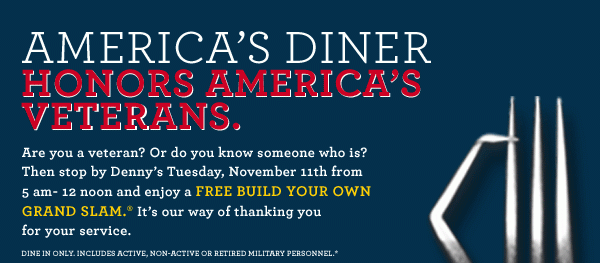
I think this Denny's ad deserves an award for salute creativity.

This year lists of free or cut-rate offerings on Nov. 11, and sometimes throughout the week, were easy to find. It was a "take your pick" situation.

I was right there picking. With our continuing home remodeling project far from completion, it was a great time to get needed items available at leading big box stores for 10 percent off. While on the track of some special items, my son and I were near a Denny's restaurant, so I claimed one of my favorite things--a free "build your own breakfast." In the evening after more discount shopping, beautiful wife Sandy and I visited Applebee's where I enjoyed a free steak dinner.

Just for fun, I added up the total value of my Nov. 11 discounts and freebies. The gifts were worth $111.30. And I didn't even have time to get the free haircut or car wash offered by businesses near my home.

By coincidence, my biggest paycheck in the U.S. Army was $111.00 a month. It usually lasted about two weeks. Maybe payback time finally has arrived? Thanks to all the "thankers" who back up their words of gratitude with material gifts. You, too, deserve a salute.

Thursday, May 20, 2010

Just Say the Words


At an age when I probably won’t make the effort to do so, I still harbor yearnings to master a second language. Maybe that’s because I missed out on a perfect opportunity to become bilingual as a boy.

My father’s parents were German immigrants, and their native tongue was their household language of choice. Grandma never truly mastered English, despite living to a ripe old age. In her later years, when infirmities confined her to her home, the Evangelical Lutheran minister made house calls to read to her from a Deutsch Bible. My father’s early school days had been split between classes taught in English and German. He often served as a translator for immigrant farmers who lived in our area in northern Wisconsin.


Yet German was not spoken in our home. Now, I think that was a pity. I believe people who can speak two, or several, languages have richer lives than the rest of us. However, American society was quite different when I was growing up than it is today.


Mom and Dad had witnessed strident, sometimes violent, expressions of anti-German sentiment in World War I years. Mom told us of her horror the day a mob stripped every German book out of the high school library and destroyed them in a bonfire. Dad described the time an immigrant farmer jumped out from a crowd of observers as the local machine gun company recruits marched somewhat inexpertly up Main Street. The farmer, once a Prussian soldier, demonstrated a precise goose step. “That’s how real soldiers march,” Dad said the man yelled. Others knew how to translate. The farmer was thrown in jail.


Dad sang snatches of little German songs now and then when he was in especially good spirits. I still remember a few, although I never did get the pronunciations right. Dad would tell my sister and me what a German word or phrase meant if we asked, but offered nothing beyond that. He did teach me to count in Deutsch, probably because I pestered him so much about it. I practiced by reciting the numbers to myself.


I still can count in German. That’s about it. My sister couldn’t even understand the German numbers I enjoyed spouting. My parents, like many others in second-generation American families, didn’t want us developing skills that might lead anybody to think we were anything but patriotic citizens of the USA.

Lately, my only linguistic development has been picking up a few German words during two trips to Europe. The icon that would instantly lead me to free German lessons stares at me from my computer screen every morning. I never quite work up the gumption to click on it.


On our most recent trip to Deutschland, I got up before sunrise one day in the farmhouse where we were guests. I had decided it was about time we brought something to our hosts’ table besides our appetites. We had learned to love freshly baked pretzels at breakfast time, and we also needed lunch and snacks during a road trip that day. I trudged in the semi-darkness down the cobblestone street to the bakery.


The baker, a stocky woman with a no-nonsense air about her, was chattering with the only customer in the place, a big man occupying a small table. I interrupted them by pointing to the large replication of a pretzel on the wall. I started showing off my German numerical skills, but the baker’s fierce stare somehow erased my ability to remember which number went where. Nothing intelligible came out of my mouth. I finally held up all ten fingers, and then three.


“Oh, you want thirteen pretzels. Why didn’t you just say so?” she said. Her English was very good. I took the sack and, still a little shaken, held out all the Euros I had in my pocket. She selected what she wanted, and I became the owner of perhaps the most expensive pretzels in the region. I thought to myself that working a little bit to learn German could have definite economic benefits.


When our hostess, Dorothee, emerged from the kitchen with the coffee pot she was surprised by the mound of pretzels on the family table. “Who got those?”


Wife Sandy pointed to me. “You mean Dick went to the bakery all by himself?” Dorothee asked with a tinge of doubt in her tone.


I shrugged and said, “Ja, ja.”

Monday, November 16, 2009

Upon Further Review

The previous post dealing with “second-class veterans” generated a flurry of reaction, through e-mails and personal observations in addition to the direct comments. One reader questioned the assertion that the American Legion would exclude a two-year vet who was honorably discharged. She said this is so preposterous that I must be wrong.

I rechecked at
www.legion.org. I was right. Had I served from June 25, 1950 through January 31, 1955 (Korea) I could join. Ditto for February 28, 1961 through May 7, 1975 (Vietnam). But my service from May 20, 1958 through May 19, 1960 doesn’t count. I would qualify, however, had I served for about five weeks starting December 20, 1989, when we attacked a mighty adversary . . . Panama!

American Legion membership runs in my family. Two of my uncles served overseas in World War I and became legionnaires. Another uncle was awarded a Croix de Guere medal by the French government for bravery in battle. He would have had no trouble joining the American Legion, but I don't know that he did.


My father was drafted in the last days of WWI, and was discharged while still in training in North Carolina. He was in the U.S. Army barely long enough to have his picture taken in uniform. That minimal and hardly dangerous service qualified Dad for American Legion membership. He joined and participated in activities of the local post for nearly 50 years.


We had other connections. I played American Legion baseball for two years, and one of my proudest possessions is a trophy given to me by the post in my hometown as the "Outstanding Senior--1953" in my high school class.

Strangely, although the Legion obviously doesn’t want me as a brother vet, I could participate in some of the organization’s activities. I qualify to sign on as one of the “Sons of the American Legion” because of Dad’s brief service back in 1918.

I’ll be damned if I’ll walk through that loophole!