Wednesday, October 03, 2012

Niagara Falls--Pretty, Pricey, and Wonderful


We heard it time after time at Niagara Falls—“People who haven’t visited for 11 or 12 years say they hardly recognize the place.” 

The transformation on the Canadian side of falls occurred, we were told, when the government issued a permit for a casino. Upon learning that, major hotel chains bought up every available foot of property in the prime area for viewing both the Horseshoe and American Falls and launched a building boom. 

The concentration of high-rise hotels brought with it $30-a-night valet parking with few alternatives and outrageous pricing in hotel restaurants. There are ways to beat the system, but we were celebrating, not economizing, so we didn’t hold back very much.

Our anniversary observances usually include casino visits and the best steak dinner we can find. So we set aside some cash we could afford to lose if lady luck was unkind and planned to dine in our hotel’s upper level restaurant, which featured first-class views of the falls at night when lights provide a fantastic spectacle.

“The view is everything,” our trusted advisers said. We thus blew a good part of the budget on a “falls view” mini-suite at the Embassy Hilton. It was well worth it. One local resident said he and his wife once a year book a room at the Embassy and spend a day and a night doing nothing but looking out their window at the falls.

We intended to conserve some cash by visiting only two of the best attractions—a voyage on the “Maid of the Mist” and a trip through the tunnels that takes you behind the falls. Well, that’s what we intended.

What we did was sign up for a very expensive tour of the whole area that included our top-two attractions and just about everything else worth experiencing. That turned out to be a good decision.  We had a great tour guide who presented the history of the area in detail, emphasizing intriguing stories about the various daredevils who have walked high wires and performed other death-defying acts at the falls.
 

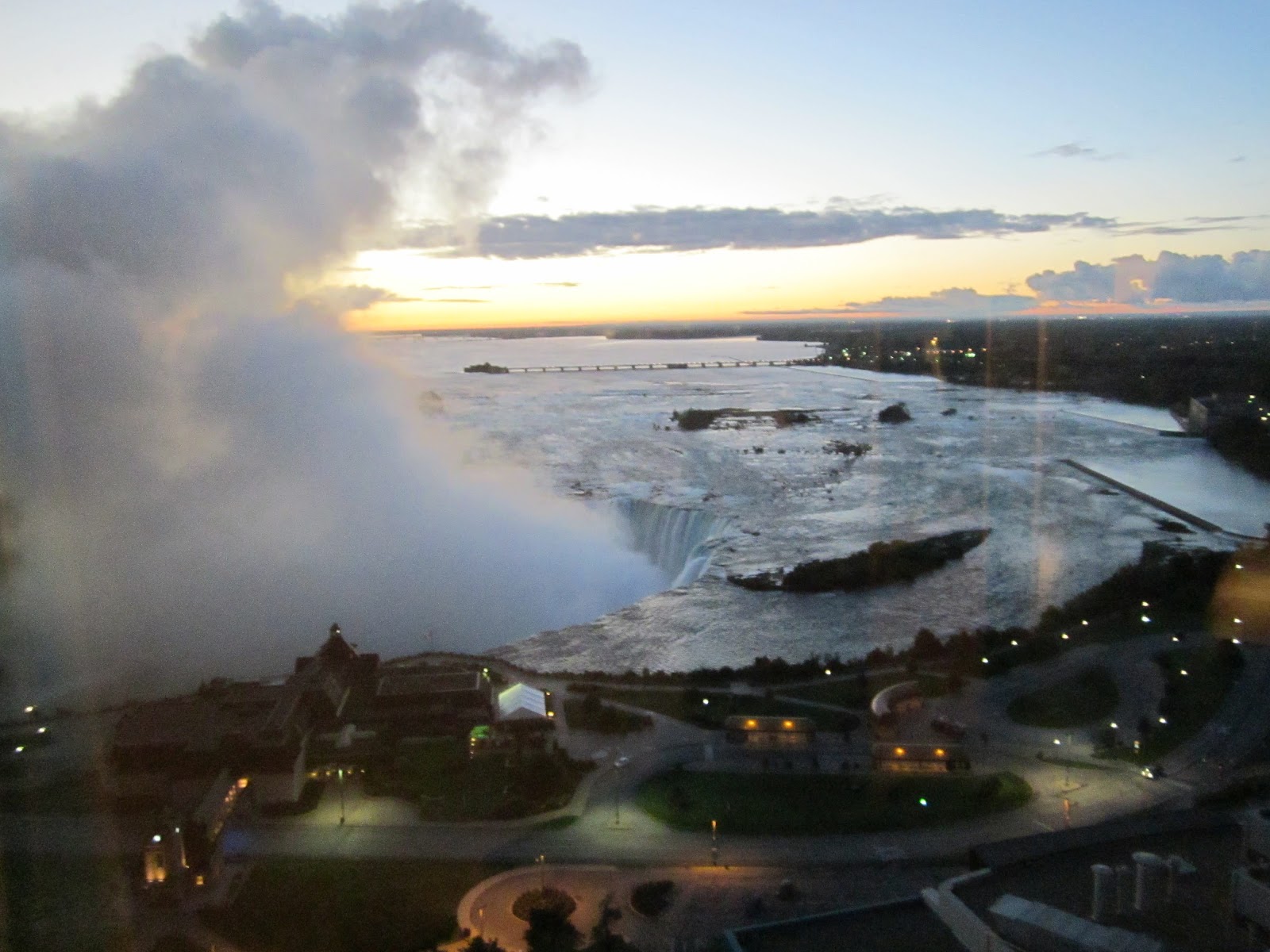
The morning view from our room.


You can get closer on an observation deck.

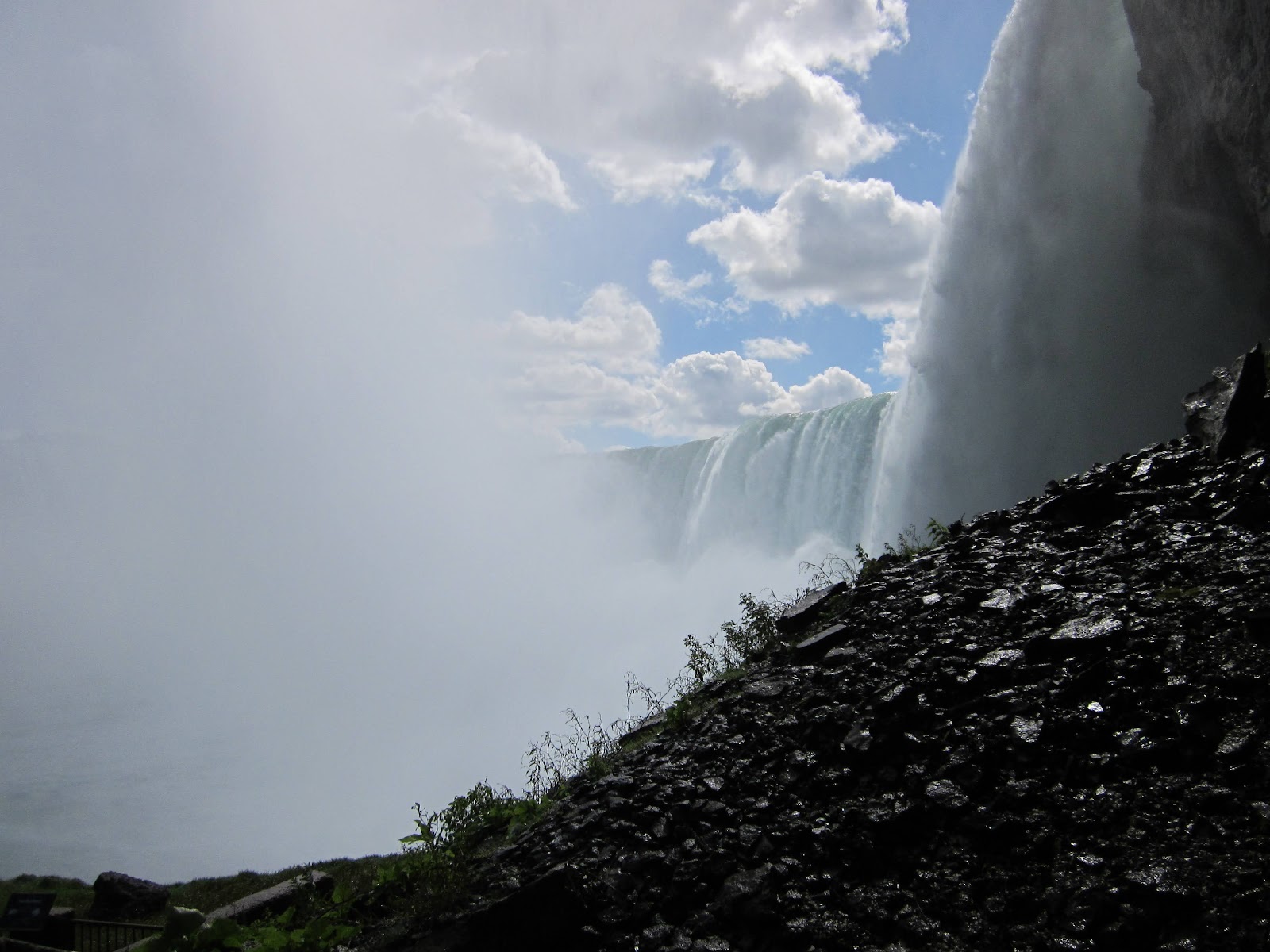
Or, you can walk through a tunnel behind the falls.

The Maid of the Mist can hold 600 people, but it looks pretty puny going past American Falls.
Whirlpool rapids are among the wildest and most dangerous in the world--we looked, but didn't boat there.


The floral clock is a place to make a wish. We did.

Just as our Maid of the Mist voyage was ending, the sun came out and a rainbow signaled the end of a terrific tour.

Our guide wasn’t exaggerating when he said his tour packed two days of activities into one. We topped off a great day with the most expensive restaurant meal we’ve ever eaten.  Beautiful wife Sandy said it also was the best. Our server rewarded our appreciation with a huge, delicious dessert in honor of our 51st year together.

We took one last look out of our hotel window.

We were 50 miles into our trip home when Sandy said, “It seems strange, but we have some money left.”

We were enjoying the falls and nearby attractions so much, we forgot to visit the casino!


Wednesday, September 26, 2012

A Canadian Jaunt to the Falls


We owed Ontario a visit, and we had a good excuse. 

Pleasant memories abound of trips to Canada’s West Coast—shipping out of Vancouver for a voyage through the inland passage to Alaska and an excellent land tour in the Victoria area.  But, although the Geezer has a family tie to Ontario, until last week I’d only set foot in the province once, and that was a very brief visit.

My great-grandfather, Joseph Coey, whose ancestors are buried in Ireland and Scotland, served in the Canadian Army during what is known as the Fenian War. The Fenian Society was a group of Irish-Americans dedicated to seizing Canada as a way of forcing the British to leave Ireland.  That didn’t work out. Although the Fenians mounted attacks for four years starting in 1866, the Canadians prevailed and the Fenians finally gave it up.

For his part in repulsing the invaders, Joseph Coey received a 160-acre land grant in Ontario from a grateful Canadian government. My mother inherited the land. It later returned to governmental control, but that is another story.

All things considered, why not plan a trip to Ontario as a special 51st wedding anniversary gift to ourselves? And what better destination than Niagara Falls, long a symbol of romance in North America?
Our destination--26 stories up overlooking the Canadian falls in the hotel in the center of this photo topped by the red sign. Does the high-rise to the left resemble a shot glass? A local said it was built that way because the first owner was Seagram's, a famous Canadian distiller of tasty stuff often served in shot glasses.

So off we went, bolstered by sound information and suggestions from son Lee and his fiancée Karen, who had visited the falls several times. The drive from our home covers 400 miles. Half of it is on U.S. interstate highways and half on multi-lane Canadian highways of similar design. Several important things about the roads, however, were far from similar.

About half the Michigan highways leading to the northern border crossing at Sarnia were riddled with cracks, potholes, and ridges.  Improvement work was evident on only one fairly brief stretch of interstate. Much of the time, we bounced along cursing the jolts and hoping the front end of beautiful wife Sandy’s car would arrive in Canada still connected to the rest of the vehicle.

It took five minutes to clear customs and get on the bridge to Ontario. The return trip included a half-hour wait at customs. Questions were more pointed and vehicles were being waved aside for searches. Perhaps the difference could be attributed to one-way terrorism fears?

The scenery, mostly farmland interspersed in hardwood forests, is remarkably similar when driving nearly straight east from Grand Rapids, Michigan, to Niagara Falls. We caught some glimpses of foliage color along the way, but we were a bit early to experience the full effect. Although unable to be awed by fall color, we were impressed by the condition of the Canadian highways we traveled.

The going was smooth. At least 90 percent of the highways were newly paved or had been in recent years. Improvement projects were under way on most of the other 10 percent.  It was a night-and-day comparison of highway quality between the two friendly countries where much is the same, including restaurant chains and building architecture. Driving on Canadian highways was a pleasure, and not just because of the lack of bumps in the road. Several characteristics were positive.

Canada has one basic highway speed limit for all vehicles--100 kilometers per hour-- not different rates for cars and trucks. That translates roughly to 62 miles per hour versus the 70 m.p.h. top limit on U.S. interstates. On the way to the falls, almost all big trucks were driving close to the speed limit in the right lanes where they are supposed to be.  All other vehicles were traveling about 5 m.p.h over the limit. There weren’t any hangups at all. I think that was because the trucks were traveling at a reasonable and consistent speed in the proper lanes and they were easy to pass and thus didn’t impede smaller vehicles.

We returned on a Friday.  All the vehicles were going about five m.p.h. faster.  The result was the same—no hang-ups. We drove out on a Tuesday. I don’t have a clue as to why everyone was in a bigger hurry on Friday than on Tuesday. We traveled during the same hours both days. An approaching weekend, perhaps?

The net result of the lower speed limit in Canada was an improvement in gas mileage for us.  We joined the crowd and drove about five m.p.h. over the limit in both countries. We got 29 miles per gallon over the 200 U.S. miles and slightly better than 31 m.p.g. for the 200 Canadian miles.

It may be unique to Ontario, but we noticed far more Ford, General Motors, and Chrysler vehicles on the road than foreign makes. The U.S. brands were more prevalent than they are even in Michigan, home of “Motown.”

The American companies have large manufacturing facilities in Ontario. Their Canadian workers were threatening to strike during our trip. Part of the reason was the manufacturers demanded new salary controls and cuts in benefits. They did that because, after many years of lower costs in Canada, it now is cheaper to build cars in the U.S. This fact was mentioned in most U.S. media accounts of the strike negotiations. It was not included in any of the Canadian news reports I saw.

That’s the good news—Canadian highways were in vastly better condition, speed limits were more environmentally friendly, “the knights of the road” exhibited better behavior that minimized congestion, and Ontario car buyers are loyal to local brands. But the news is not all good. Those responsible for considering fundamental motorist comfort apparently had king-sized bladders and a disregard of the utility of some basic information.

On the Michigan leg of our journey we pulled into three rest areas. A few more might have been welcome considering the jolts to our kidneys from the poor road surfaces, but three did the job. Canada provided no highway rest areas whatever. An uncomfortable motorist had to take an exit to a gas station or eatery to use their rest rooms. Two we visited were in small cities.

Adding distress to the inconvenience, the Canadian signs indicating exits for small cities give the city name, but not the distance to the city. Thus, when we took an exit for Paris, Ontario, expecting nearly instant relief, we were aghast to discover that Paris was six miles away, something one learns only by driving there.  It was a near thing, but we made it to a Paris gas station! The gas was a dollar a gallon more expensive than in the U.S., but the relief was worth it.

Much of the big difference in gas prices is due to higher Canadian excise taxes. Does that explain the better road surface maintenance? Probably. Eliminating costs for roadside rest areas might also be a factor.

Although Canadian signage was delinquent regarding bladder relief, it was wonderful for tourist attractions. After about 50 miles driving through relatively sign-less rural landscapes, a golf course sign seemed to pop up beside the highway every mile or two. As we neared Niagara Falls the golf course indicators gave way to winery signs at about the same intervals.
Unlike some of the newlywed visitors, we fully mature marrieds actually spent some time looking at the falls. In fact, we went behind them and as close as you safely can get in front of them. Doing that requires proper rain gear to prevent a serious drenching by falls mist. Scenes from those and other Niagara Falls adventures will be featured in the next post.

Our route led to the good stuff.  Our stay at the falls was delightful. The next post will provide some scenes and comments. We enjoyed the whole experience. Ah, Canada! All things considered, great-grandpa would be proud.
Thursday, September 13, 2012

Luring Fatties to Fast Food

A new analysis of mountains of data from the Centers for Disease Control and Prevention revealed Michigan is one of the fattest states in the nation.

Nearly one-third of Michigan adults are obese. We ranked fifth worst in the U.S., behind only Mississippi, Louisiana, West Virginia, and Alabama. Such rankings are not precise, of course, but this one used body mass index data, a fairly good general obesity guideline.

It matters not.  Scientific studies are unnecessary. One need only look around at the hefty bodies waddling around the area.   But we ought to rate a little forgiveness.  Temptations to stray off the healthy eating path are many and powerful.

A "Hot and Juicy."
Last month, resistance to junk food was especially tough to maintain.  The local Wendy’s mailed an ad with seven coupons offering free or cut-rate goodies such as “The Baconator,” chili cheese fries, and a “hot and juicy” cheeseburger. Beautiful wife Sandy was across the little pond visiting relatives in Wisconsin, and I admit to succumbing to the lure of the Wendy’s ad (actually, more than once.) while her cooking expertise was elsewhere.

Cost-conscious diners could hardly do better.  Wendy’s served me a cheeseburger, fries, and a “small” drink for $3.26, including tax.  No tip needed there, either. When I presented my coupon, the clerk said, “Just keep it, you can use it as often as you want for the whole month.”

At about the same time, Rhino’s, my favorite tavern, entered the high-calorie, low-cost fray by announcing it would serve quarter-pound burgers for $1.50 as long as road construction nearby continued. The construction is planned to last two years! 

Wendy’s burgers are good; Rhino’s burgers are great.  No frozen patties at Rhino’s; each burger is “freshly made and hand-crafted” and cooked to order—rare, medium, or well-done, whatever you specify.

Until 6 p.m. at Rhino’s you can guzzle all the light beer served in frosted mugs you want for 75 cents a tap.  Combine the cheap beer and cheap burger with a half order of beer-battered fries (few humans can eat a whole order), and you have a lot of stuff.

Sandy and I do that once in a while. It’s a cheap date. Our latest bill for four beers, two burgers, and fries came to $12.35, including tax and tip.  Service at Rhino’s is excellent. Patrons who want to continue to fit into their jeans are wise not to show up to experience it very often.

Fat-food enticements seem to be everywhere in Plainwell, Michigan. Real cheapskate aficionados can walk a block past Rhino’s to the Tenth Street Saloon.  There you can get TWO hotdogs with chips for $1.00. It’s frightening. We’ve only entered the place once. Nothing healthy is served there.

At Wendy’s and Rhino’s, burgers come with a leaf of lettuce and a slice of onion and tomato.  Can we claim that bow to veggies as one small step toward better health for Michiganders?

Saturday, September 08, 2012

In Grateful Memory


Pfc. Shane W. Cantu (U.S. Army), 20, Corunna, Michigan. Died of wounds suffered when hit by shrapnel, Charkh, Afghanistan, August 28, 2012.

                                                    \

Unfortunately, the Geezer doesn’t have the time or resources to honor all Americans and  NATO allies who are dying daily in Afghanistan, so memorials are limited to service members from my home state of Michigan. You can find a record of all American deaths at www.freedomremembered.com.


Tuesday, September 04, 2012

Which Party Will Win the Deceit Contest?


There’s nothing new about politicians making deceptive or downright false statements. And neither Democrats nor Republicans have a corner on deceit.  But when those who traditionally go all out in support of one party or the other publish criticism of their own standard bearers, we’ve come a long way downward.

That happened in the wake of the Republican National Convention.  Not once, but twice.

The Chicago Tribune, our family newspaper while I was growing up, rarely has a good word to say about a Democrat and has staunchly supported Republicans in every election within memory.  Yet, Clarence Page, a member of the Tribune editorial board, took Republican campaign managers to task in a post-convention story titled “Team Romney’s War against Facts.”

The author said, “There’s no excuse for the fantasies repeated by myth-building politicians, like the evening’s star speaker, GOP presidential nominee Mitt Romney, even after nonpartisan media fact checkers have found the statements to be untrue.

“For example, Romney grandly promised, ‘I will begin my presidency with a jobs tour. President Obama began with an apology tour.’ Ah there goes the ‘apology tour’ again. The line lives in Republican stump speeches, despite its winning ‘four Pinocchios’ months ago from the Washington Post’s fact checker Glenn Kessler, among others.

“In fact, the president has never apologized for anything on his foreign trips, although previous presidents have.”
Both parties are being watched. Washington Post fact checker Glenn Kessler recently gave the Obama campaign four Pinocchios for a 30-second ad attacking Mitt Romney as a "corporate raider" and for outsourcing jobs. Kessler said, "On just about every level, this ad is misleading, unfair, and untrue."

Page also singled out a Republican ad concerning welfare as a particularly blatant lie:

“When the welfare ad,  for example, says the Obama administration has ended the work requirement in the landmark 1996 welfare reform law, that’s simply false. The administration is offering states a chance to apply for more flexibility in determining their own work requirements, if they agree to actually raise the number of people they move from welfare to work.”

Fox News, perhaps the ultimate conservative medium, posted a column by Sally Kohn, a contributor and writer, which came down hard on Rep. Paul Ryan for statements in his speech accepting the vice-presidential nomination.

Kohn said, “To anyone paying the slightest bit of attention to facts, Ryan’s speech was an apparent attempt to set the world record for the greatest number of blatant lies and misrepresentations slipped into a single political speech.

“The good news is that the Romney-Ryan campaign has likely created dozens of new jobs among the legions of additional fact checkers that media outlets are rushing to hire to sift through the mountain of cow dung that flowed from Ryan’s mouth. Said fact checkers have already condemned certain arguments that Ryan still irresponsibly repeated.”

The Fox writer then listed as examples four specific lies Ryan told to the cheering convention audience and millions of television viewers:

1. While Ryan tried to pin the downgrade of the United State’ credit rating on spending under President Obama, the credit rating actually was downgraded because Republicans threatened not to raise the debt ceiling.

2.  While Ryan blamed President Obama for the shut down of a GM plant in Janesville, Wisconsin, the plant actually closed while George W. Bush was in office.

3. Though Ryan insisted that President Obama wants to give all the credit for private sector success to government that is not what the president said on the subject.

4.  Though Ryan accused President Obama of taking $716 billion out of Medicare, the fact is that amount was savings in Medicare reimbursement rates, which should also save Medicare recipients some out-of-pocket costs.

Kohn concluded with a statement that any caring American would endorse:

“Elections should be about competing based on your record in the past and your vision for the future, not competing to see who can get away with the most lies and distortions without voters noticing or bothering to care. Both parties should hold themselves to that standard.”

This week the Democratic National Convention holds the spotlight.  Will the speakers stick to facts, thus raising the bar for discourse during the balance of the campaign?  Or will they try to better the GOP’s convention performances with a barrage of lies and distortions?

We’ll know when the fact checkers issue their analyses after the speechmaking is over.

Thursday, August 30, 2012

Crazy about Guns


When television news announced the recent shooting near the Empire State Building in New York I was waiting for a mechanic to change the oil in beautiful wife Sandy’s car. Several others were in the car dealer’s lounge.

A young man wearing a Notre Dame sweatshirt briefly glanced at the TV, and then continued working at his laptop computer. A 30-something woman and a man in the same age bracket, who had been watching TV intently before the announcement, continued to do so.  No one spoke. I went back to reading my book.

A man in his 60s or early 70s wearing overalls, a flannel shirt, and boots entered as the news flash was ending.  “Another shooting?” he asked.

“Yes,” I said. “An unhappy former employee of a New York firm opened fire (we learned later that the shooter killed his target and the other damage was done by police bullets) near the Empire State Building. A half-dozen or so were wounded. The gunman’s target and the shooter were killed.”

“The liberals are behind these shootings,” the new arrival said. “They’re trying to whip people up so they can take our guns away.”

“Do you really believe that?” I asked. 

“Yes, of course I do,” he said.

The small group in the waiting room lapsed back into silence.

Who is crazier, the shooters or deluded people who believe ridiculous conspiracy theories?

Saturday, August 25, 2012

Grannies Salute Congressman Akin

This YouTube video is just too entertaining not to be passed along.

Watch the Renegade Raging Grannies let Rep. Todd Akin (R-MO) know just what they think of his concepts about how women's bodies work.


Alas! Multiple Tragedies Hit News


The geezer learned of three crushing blows to things he holds sacred in a span of just six days recently.

The Green Bay Packers released photos of the latest addition to Lambeau Field, where the geezer attended the first game ever played in that venerable stadium.  The new seating section actually has SEATS instead of benches to make things comfortable for the fans.  What next? A DOME to shield us from the weather? Never.

Gonzo Gonzalez goofed when he down graded the best-known institution in Plainwell, Michigan
John “Gonzo” Gonzalez, entertainment reporter for the Kalamazoo Gazette announced the winners in a contest he personally conducted to determine the top ten ice cream parlors in Michigan.  He rated the Plainwell Ice Cream Company Number Six.  My god, this man has no taste buds. Doesn’t he know Plainwell quality has not varied one iota since the product was named one of the “Seven Wonders of Michigan” just a couple of years ago?

I was so shocked by the frozen treat miscarriage of justice I drove past Plainwell Ice Cream yesterday before I thought to stop for a serving of blueberry swirl in a waffle cone.  That’s pure ice cream heaven, Gonzalez. You must have been smoking the wrong stuff before you did your sampling.

Then came the annual announcement by the Princeton Review of the top party schools in the U.S. My alma mater, the University of Wisconsin-Madison, was relegated to the No. 13 spot.  Good grief.  We were numero uno for years.  Obviously, those hoity toity Princeton people never visited Langdon or State Streets.

Alumni need to rally and make a return to campus complete with kegs and watermelons full of gin to show the current crop of Badgers how it’s done.  This insult must be corrected.

I stopped reading the news for two days.  I didn’t want to find out about any more desecrations of important institutions in my life.   

Wednesday, August 22, 2012

A Mitt Money Mystery


Issues in the November election are well-defined.  Differences in approaches to solving our problems between Barack Obama and Mitt Romney are large. Voters have a clear choice in this election. I understand the choice. Just one thing about the campaign has me baffled.

Why won’t Romney release his last ten, or even five, years of federal income tax returns?

Why the secrecy?
His father started the practice when he ran for president 45 years ago, and every candidate since has released many years of tax records and been quite willing to discuss them.  We already know Romney is a multimillionaire, so that’s not the issue, and it should not be an election issue in any case.  He did release his 2010 return and has promised to release 2011, so why not just go back a few more years as previous candidates have done?

Senate Majority Leader Harry Reid speculated that Romney might have paid no taxes in one or more of the years in question.  He based that on an anonymous “someone” telling him so.  That’s pretty flimsy, and Romney flatly denies it. I don’t buy what Reid is selling in this case.

Neither Reid’s assertion nor any other reasons for Romney’s reluctance made sense to me until just a few days ago when a friend proposed one in a letter to the Detroit Free Press.

Romney may have been among hundreds of Americans who took advantage of a tax amnesty offer, officially the Offshore Voluntary Disclosure Initiative, made to those who evaded taxes by not reporting income from foreign bank accounts. In return for disclosing the income and paying some pretty hefty IRS penalties, those who were granted amnesty had their records cleansed and became exempt from criminal prosecution.

Admitting criminal conduct to evade taxes would, of course, be a serious negative for a presidential candidate, whether or not he was granted amnesty.

It’s public knowledge that Romney had a Swiss bank account, which he closed in 2010. He also is known to have had accounts in the Cayman Islands. If his earlier tax records would reveal an amnesty settlement that would be a plausible reason for his refusal to release them.

It also is strange that Romney still has not released his 2011 return, although he said some time ago he would.  It’s possible, although not likely because the penalties were lighter for those who declared earlier, that he waited until 2011 to seek amnesty. This could explain the failure to release the 2011 tax report in a timely manner.

The plan might be to delay releasing the return until just before Election Day. Then news of forgiveness for a criminal act probably would be too late to affect the election in a major way. Romney must have a filing extension to have held off this long. The extension deadline is October 15, just three weeks before the election.

One way or another, could the amnesty situation be the reason for Romney’s tax secrecy?  If not, what logical explanation is there? Can you think of one?

Tuesday, August 21, 2012

In Grateful Memory


Petty Officer 2nd Class David J. Warsen (U.S. Navy), 27, Kentwood, Michigan. Died in a helicopter crash northwest of Kandahar, Afghanistan, August 16, 2012.


Unfortunately, the Geezer doesn’t have the time or resources to honor all Americans and  NATO allies who are dying daily in Afghanistan, so memorials are limited to service members from my home state of Michigan. You can find a record of all American deaths at www.freedomremembered.com.
 

Thursday, August 16, 2012

The Postman Goeth


I know that’s not politically correct. But, “the letter carrier goeth,” just didn’t work. I am well-aware that women have been delivering the goods for the U.S. Postal Service for a long time now. The regular on our route and the occasional substitute both are women who do good work.

Unfortunately for the men and women of the postal service they are working for a dying outfit.  The latest pleas to Congress for financial relief cite a $5 billion dollar budget deficit and more of the same in the future if major changes are not made.

Perhaps “neither snow nor rain nor heat nor gloom of night” could stop postal workers from performing their duties, but e-mail, Facebook posts, tweets, twitters, and electronic transfers are doing them in.  Recently, our rural mailbox has been empty on one or more delivery days a week.  That has never happened before.

Going . . . going . . .
No matter what Congress does, the trend to less snail mail will continue.  We now do most of our banking and some purchasing electronically. We rarely write a personal letter to anyone; it’s so much easier and faster to dispatch an e-mail to friends and family. That’s been a monumental switch for some, including me.  My mother and I exchanged hand-written letters almost every week from the time I left home at age 17 until she died at 86.

Although Mom and I pasted three-cent stamps on our letters when we started corresponding, and the cost increased only to a dime or so during the many years we exchanged letters, we were desirable customers for the postal service.  First class mail was the big money maker—easy to sort and deliver in big volumes. It and parcel delivery subsidized other services.

Now, even the junk mailers who get reduced rates have cut down on their postal business as they increase their advertising on web pages.  For many years, my hometown newspaper arrived by mail for a cut-rate second class charge.  A few months ago, I converted the subscription to electronic delivery. My cost was considerably lower, and of course the news arrived more promptly.

Congress delivered a hard blow to the postal service years ago when they deregulated parcel delivery.  As a result, UPS and Fed Ex have skimmed off a lucrative part of the business. That is nice for them, but it helped drive the postal service to the wall.

The postal service recently once again asked Congress to allow it to discontinue Saturday deliveries to save a bundle of money.  The proposal has come up before, only to be met by deaf Congressional ears.  Ditto the idea of closing unneeded post offices in small towns.  The latter refusal is hard to understand, because mail services to urban areas have subsidized rural deliveries since the U.S. Postal Service began, and that was long before every rural resident had a car or truck. 

Some say the postal service needs to be more creative by finding new ways it can serve.  They cite examples such as France, where post offices service small savings accounts.  Fat chance of something like that happening in the U.S., where branch banks and credit unions abound.

Actually, the trend here has been in the opposite direction.  A small post office issued my social security card when a proud father took me there years before I started my first job. Post offices don’t issue social security cards anymore.  In fact, you can apply for one online, in a process said to take about 15 minutes. 

Merely shutting down the postal service won’t do.  Many of our rural areas, including some close to our home, can’t get computer services.  The nation needs big expansions of broadband coverage before the letter carrier becomes extinct.

Letting the postal service bleed to death over the next few years also is not a good solution.  It should be phased out in an orderly manner over a long time.  For starters, eliminating Saturday deliveries would cause no problem for us, and I doubt it would have much impact on others.

We must drive five miles to the nearest post office, but two miles farther down the same road is another one.  One would do nicely for two cities whose combined population is less than 8,000.

Listen up Congress.  Do what the postal service people are asking you to do.  They are in the midst of a lethal decline that is not going to reverse or stop.
 

Saturday, August 11, 2012

In Grateful Memory

lst. Lt. Todd W. Lambka (U.S. Army), 25, Fraser, Michigan. Killed by an improvised bomb in Paktika Province, Afghanistan, August 1, 2012.

               * * * * *  

Unfortunately, the Geezer doesn’t have the time or resources to honor all Americans and  NATO allies who are dying daily in Afghanistan. You can find a record of all American deaths at www.freedomremembered.com.

Thursday, August 09, 2012

Isn't It Grand?

Were I in charge of the Grand Rapids Chamber of Commerce, I would be irate and demanding change in the way the name of my city is routinely butchered by the Michigan Department of Transportation. MDOT consistently replaces Grand with Gd.

Yes, they could sneak "ran" in
Grand Rapids deserves a full ID.  It is known for several, admittedly not overly important, things.  Grand Rapids is Michigan’s second largest city.  Grand Rapids is the birthplace of former President Gerald Ford. Grand Rapids is a leading producer of office furniture.  More important to me, the city has two really good Mexican restaurants. 

How demeaning is a contrived Grand abbreviation? Can you imagine a sign saying: Gd Canyon--27 miles? 

Could MDOT put the “ran” back in Grand as a practical matter? Of course it could.  Possibilities include compressing the type, enlarging signs a bit, moving arrows, and changing the shape of arrows.

Because I am not the head honcho at the Grand Rapids Chamber of Commerce, the strange signage is of no personal concern. Anyway, it is starting to pop up all over, so Gd may be making a move toward supplanting Grand in common usage. A recent Google travel search yielded this instruction: Turn right to merge onto US-131 N toward Gd Rapids.”

Gd provides me with a moment of amusement every time I see it.

Years ago when I started working for the U.S. Forest Service at the Forest Products Laboratory in Madison, Wisconsin, Gordon D. Logan was the Assistant Director in charge of Administration. 

Logan was a good man with a lot of responsibilities.  His subordinates had to say no to questionable personnel practices, budget manipulation, publication of poorly conceived manuscripts, and a host of other attempts to circumvent quality controls built into the system.

Researchers are notorious for considering administrative rules dastardly plots serving only to hinder their important work. Some viewed Logan as the Laboratory’s chief traffic cop. Cops aren’t popular when they’re writing you a ticket.

One day, contemplating his status in the organization, Gordon D. Logan was heard to say: “Well, I’ve got the right initials for it, but I don’t enjoy being known as God Damn Logan.”

I think about that every time the signs point us toward "God damn Rapids."                              

Saturday, August 04, 2012

Where Are They?

Although I enjoyed several of his books, I never was a big fan of noted author and speaker Gore Vidal, who died this week.  However, one of his sayings puts me in LOL land everytime I hear or see it:

"The United States was founded by the brightest people in the country — and we haven't seen them since."

(Thanks for the reminder by Ronni Bennett at www.timegoesby.net)

In Grateful Memory

Gunnery Sgt. Daniel J. Price (U.S. Marine Corps), 27, Holland, Michigan.  Killed during combat operations in Badghis  Province, Afghanistan, July 29, 2012. 

            * * * * * *

Sgt. Kyle B. McClain (Army National Guard), 25, Rochester Hills, Michigan. Killed by a bomb while on patrol in Salim Aka, Afghanistan, Aug. 1, 2012. Sgt. McClain was born in Korea and adopted by an American family as a baby.

                           
                             * * * * * * 

Unfortunately, the Geezer doesn’t have the time or resources to honor all Americans and our NATO allies who are dying daily in Afghanistan, so I show only those from my home state of Michigan. You can find a record of American deaths at www.freedomremembered.com.

Wednesday, August 01, 2012

Back to Olympus

Funny how perspectives change over time.  During several years as a sports reporter and many as a sports fan, the Geezer followed Olympic action closely and rooted hard for Americans to win medals.

This time around, Olympic excitement failed to materialize to the extent I recorded the opening ceremonies and attended a Dixieland jazz concert instead of watching the grand beginning “live.” 

The Dixieland concert, presented with enthusiasm by a group of seven locals donating their time, was free. The Olympic extravaganza, featuring a cast of thousands and high-priced tickets, is going to cost a fortune.

Three of the seven Dixie musicians were top-shelf; the others, frankly, were mediocre.  That’s just about the way I assessed the Olympic opening once I got around to watching it. 

Athens in 2016 and Forevermore
Fashioning the burning rings, some of the fireworks displays, and an emotional ending (even though Sir Paul went on a bit long) appealed to me. A fake parachute entrance by the queen, a horribly boring comic, and other strange events unfortunately occupied a little more time than the good stuff.

Negatives aside, I give all the Dixie musicians and all who obviously worked hard to put together an excellent show in London much credit for their efforts.  Dixie musicians by definition are creative. The Olympic show planners showed plenty of artistry as well, and they deserve accolades for that.

If I heard correctly, the announcers said the Olympic Games this time around are expected to cost $15 billion or more.  The observers frequently talked about depressed conditions in London’s East End, where the stadium was built, and how the Olympics would have a positive affect on the area.

I would think for $15 billion just about all East End real estate needing rejuvenation could be reconstructed with broad avenues and marvelous homes and shops of all kinds, perhaps even a couple of light industrial sections. Of course, some of the $15 billion will be recouped. However, the facts are that most recent Olympics have lost huge amounts of money. 

Because it seems impossible now to return the Olympics to the wholesome amateur competition it once represented, why don’t we try something creative to at least stop the economic blood-lettings?  Let’s give the summer Olympics a permanent home in Greece where the whole thing began.  The International Olympic Committee could coordinate financing, and bankers interested in propping up the Euro probably would lend a hand.

Once the virtues of a permanent summer home are demonstrated, we can get to work providing a home in Switzerland, that most neutral of nations, for the winter games. The Swiss aren’t begging for money, but maybe if we strew enough Olympic gold around their landscapes they’ll stop conniving to cheat fellow governments out of tax dollars with devious banking practices.

A return to Greece forever makes sense in several ways.  It’s no secret the Greeks could use a major infusion of cash.  Absent any large amount of natural resources, the nation must rely on tourism to sustain itself. A periodic dose of Olympic frenzy would be a great advertisement of the glories of the ancient land.

The natives probably could dream up some attractive uses for the Olympic facilities in off-years.  Much wonderful history is available to convert into interesting opening ceremonies. It doesn’t seem many people are gunning for the Greeks, so providing excellent security should be relatively inexpensive.

Security looms large in my changed attitude about the Olympics. I really don’t care if the American contingent comes home with a truckload or a handful of medals, or any at all. My fervent hope these days is that the whole Olympic affair crosses the finish line without a single terrorist attack or other act of violence. 

Sunday, July 29, 2012

In Grateful Memory


Sgt. Justin M.Hansen (U.S. Marine Corps), 26, Kingsley, Michigan.  Killed by a gunshot while checking a house for enemies in Badghis  Province, Afghanistan, July 24, 2012.

Thursday, July 26, 2012

Crimes without Punishment


Of course, we have no guarantee life will be fair, but sometimes distinctions between illegal and merely bad public behavior are ludicrous.

It is illegal to let your pig run free in Detroit unless it has a ring in its nose. That outdated ordinance most likely was enacted because pigs unhampered by ring jobs harmed people other than their owners.  In their ringless state, pigs greedily root around for food in gardens and lawns, causing considerable property damage—enough damage so early Detroiters decided the activity needed to be declared criminal.

In contrast, it is not illegal in Michigan to conspire to fix an election.  One might think such activities do great damage to society, and thus would be unlawful. But Michigan politicians greedily pursuing electoral victories by fraudulent means are breaking no laws.

This sad situation came to light recently when news media publicized activities by Michigan House Speaker Jase Bolger and Representative Roy Schmidt.  Both now are Republicans, but when their well-documented misdeeds began Schmidt was a Democrat and Bolger carried the GOP banner.  This is what they did:

Bolger helped persuade Schmidt, a long-time Grand Rapids Democrat and a four-year member of the House, to change parties.  No problem with that. It is perfectly legal and ethical.

However, the two conspired to withhold the announcement of Schmidt’s conversion until near the deadline for candidates to file for the November election. Then a fake candidate was recruited to file as Schmidt’s Democratic Party opponent.

Schmidt’s son offered to pay an acquaintance, Matt Mojzak, $450 to enter the race.  They agreed that Mojzak would make no effort to campaign.  His job was to merely fill a spot on the ballot, which would limit any competition from serious Democrats to write-in efforts. Mojzak withdrew, even though the fee offer had been increased to $1,000, when he learned state police were investigating the situation.

The investigation resulted in an eight-page report by Kent County Prosecutor Bill Forsyth. Forsyth said, “Incredibly, while it would be illegal to pay a boxer to take a ‘dive” or a basketball player to ‘point shave,’ it is not currently a crime in Michigan to recruit someone to run for public office, place them on the ballot at the ‘eleventh hour’ and essentially pay them to make no effort to win. This scheme by Rep. Schmidt and Speaker Bolger was clearly designed to undermine the election and to perpetrate a fraud.”

“As a Republican elected official, I am embarrassed and offended by what transpired,” Forsyth said.

Schmidt admits he did wrong and regrets his actions.  Bolger doesn’t even do that.  He admits only to “political gamesmanship” and losing sight of the need to focus on serving the people rather than manipulating elections.

What penalty will the two miscreants suffer?  Probably, none. Although political opponents called for their immediate resignations, both men and their supporters said they will stay in office and urged voters to judge them on their total records.

In a display of journalistic cowardice, our local newspaper concluded editorially that the conspirators should be “judged by the voters.” That hardly is likely to result in any punishment at all.

As things stand, Schmidt is running unopposed in the November election. A quickly organized, heavily funded write-in campaign would be needed to defeat him, which probably will not be possible.  Bolger represents a district so safe he would have to commit a really heinous crime to be defeated in future elections.

Couldn’t we at least require them to wear rings in their noses while we hold ours?

Thursday, July 19, 2012

An Incorrect Weather Assessment


When we contemplated moving from our long-time Utah home to southwestern Michigan we of course considered weather among other factors.

In Michigan’s favor, we listed:

1.  Much higher and more frequent rainfall means we won’t have to worry about watering lawns or most plants.

2. Lower summer temperatures will give us more hours to enjoy the outdoors.

Oh, yeah?

From June 1 to the 22nd, a time when frequent rains usually help plants grow vigorously, our total rainfall has been 2.83 inches.  That’s equivalent to one serious day of rain.

From June 22 until last night we’ve had nothing at all that could be classified as rain—just a few drops from occasional little thunderstorms.

Throughout the whole period, temps have consistently reached the high nineties.  Tuesday the high was 101. Humidity around 75 percent made it a truly unpleasant day.

Yesterday, things cooled off to a mere 90 in the shade.  After last night’s light little rain, we’re going to enjoy 80 degree temps for about two days. Then we enter the fearsome Dog Days of Summer, which last until mid-August, traditionally the hottest and driest time of the year.

One consolation: We don’t have to mow the lawn.  The grass stopped growing  three weeks ago.