Friday, July 25, 2014

Leaping the Lake to Lambeau


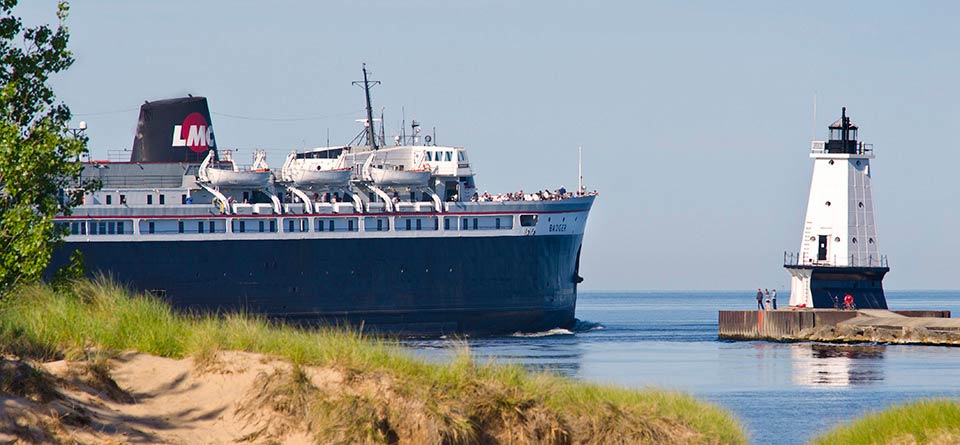
The SS Badger leaving Ludington harbor. (photo from the ship's web page)
Our son Lee and I needed a road trip from our Michigan homes to Wisconsin.

Lee had business to do near Madison with a gallery displaying some of his stained glass art. I had a bucket list item to attend to--a visit to Green Bay to get a look at Lambeau Field after several hundred million dollars in renovations and expansions since I last was there to see a Packers game about 40 years ago. We decided it would be fun to go the old fashioned way, with a 60-mile voyage across Lake Michigan aboard the SS Badger.

A "road trip" on a boat?  Among other SS Badger trivia is the fact that it officially is part of U.S. Highway 10, linking the eastern and western sections of the route. We were amused by the highway sign displayed prominently on the ship, and thought it was a joke--a bit of research proved it wasn't. Another thing sets the Badger apart from other ferries; it is the only vessel registered as a historical site by two states.

 
We used a photo op to give Lee a souvenir.
The Badger is the last large coal-burning steamship in the United States, where many once sailed the Great Lakes and other waterways. It and a sister ship, the SS Spartan, were built in 1952 in a Wisconsin shipyard and launched the next year.

Of course, University of Wisconsin sports teams are "Badgers," so perhaps the sister ship was named just to even things up in cross-lake traffic. "Spartans" represent Michigan State University in athletics. The SS Spartan was retired from service in 1979 and now rests in the harbor at Ludington, Michigan, near the dock used by the Badger, serving only to supply replacement parts for its sister ship. Michigan comes out on top in daily operations, however. The Badger runs on eastern time; Wisconsin is in the central time zone. Michigan also has the upper hand financially, the state collects the sales tax on all tickets.

The Badger, built with a reinforced hull, originally served as an ice breaker as well as a commercial vessel. It traveled between Wisconsin and Michigan year round. It is a big ship. An important use for many years was transporting railroad cars between the two states. We saw the railroad tracks imbedded in the floor of the hold where now only motor vehicles are carried. The Chesapeake and Ohio Railroad owned the ship for many years.

The need for railroad car transfers gradually declined, and in 1983 railroad interests sold the Badger. It was rebuilt and remodeled for service with an emphasis on carrying autos and passengers. However, it still has commercial uses. A huge tanker truck was driven into the hold shortly after our mid-sized sedan went aboard. A crew member said an important business for the ship is transporting oversized trucks carrying blades for giant windmills that generate electricity in new developments.

The Badger can carry 600 passengers and up to 180 vehicles. Nowadays, it runs from May 16 to Oct. 26. It travels slowly. The 60-mile trip from Ludington to Manitowoc, Wisconsin, takes about 4 hours. But driving between those cities via the northern route that crosses the Mackinac Bridge takes about 8 hours. Taking a southern route through Chicago would keep you on the road about 7 hours, but that trip can be much longer during rush hours.
 
The Badger can carry big rigs, such as the Budweiser Clydesdales' truck.
Unless one has a fascination for gazing at unbroken stretches of sky and water, a cross-lake journey can be dull. Badger management tries to make up for this with activities similar to those offered on a grander scale by ocean liners. Food and drink is available in a large cafeteria and a smaller lounge that has a well-stocked bar. A museum room has exhibits tracing the ship's history in detail. A few of the 50 to 60 crew members are hired as entertainers. A bingo game was in progress in one large area throughout most of our trip. Children were being entertained with a variety of games.

Ours was Lee's first voyage on the Badger, and my second. We had a ball exploring the old ship and agreed running our road trip over the waves was a good idea.

The conclusion of the trip was to be another lake crossing, which would be a first for both of us. We planned our return to Michigan via the Lake Express, a much newer ferry than the Badger that sails from Milwaukee to Muskegon and beats the older ship's travel time by about an hour and a half. Beautiful wife Sandy has traveled on the Express many times, and highly recommended it.

The phone call came when we were about five miles from the Milwaukee harbor. "We're sorry, but we have high winds and waves on the lake, and passengers wouldn't be comfortable. Our remaining trip today is cancelled."

Oh yes, several of the various descriptions of the SS Badger claim because of its size and design it seldom cancels a trip due to bad weather. We thought about that several times as we sat motionless on Chicago expressways or in countless construction zones in Indiana.

I phoned the Badger office today to check. "Did you folks cancel any of your trips on Wednesday?"

"Oh, no. We made all crossings on schedule."

Apparently, the grand old lady of The Great Lakes still has some good sailing in her and even can outdo a younger upstart sometimes.

Thursday, July 17, 2014

Winging It Safely


               Oh, they sailed out from England and were not far from shore
               When the rich refused to associate with the poor.
               So they put them down below where they'd be the first to go.
               It was sad when the great ship went down.
                          --from a version of "The Titanic"

Oh yes, the guys with the big bucks have long known how to place themselves in the safest possible positions. And they sometimes did it by making those less fortunate more susceptible to disaster. It therefore is strange that the moneyed classes could have gotten it so wrong when modern airliners became the travel vehicles of choice.

Many years ago, I heard mutterings about relative safety in airliner seating, so the idea is nothing new. The smokers exiled to the rear of the plane sometimes joked about it with observations such as, "The smoke may be doing us in, but if we crash we're in the catbird seats."
 
Be smart, move back
Safety and seating locations, however, never became much of an issue. But now that could change. The question popped up in a latest issue of AARP The Magazine. The AARP publication has huge readership, so we may assume the word will get around, and be relayed to those who can afford to travel in style. Here's the item:

"In 2007, Popular Mechanics published an analysis of 36 years worth of airline seating charts and 20 accidents, back to 1971. The numbers were decisive. Passengers sitting behind the wings had a 69 percent survival rate in an accident. Folks sitting over or in front of the wings had a 56 percent rate (first class was lowest, at 49 percent.)"

Wealthy folks fully understand 20 per cent differences. How long do you think it will be before first class is relocated to the tail sections of planes?


Friday, July 11, 2014

A Blogday Anniversary

Today is the eighth anniversary of this blog. No national, or local, celebrations were held.

Some fairly accurate calculations indicate more than 400 little stories have been posted since July 11, 2006. Some of them have been read. Some very nice people have been met in cyberspace. Those are good enough reasons to continue.


Thursday, July 10, 2014

You Called Me, What?

I thought oldsters were overreacting when they moaned about the way many of today's younger adults address their elders. That was before a recent trip to my credit union.

I may be cute, but I'm not your honey
A clerk I had never met called me "Honey," "Dearie," and "Hon" all in the same brief conversation. I was appalled and amazed, but not amused. In a flash I came to understand the feelings of my fellow fully mature adults who launch rants about having these labels hung on them by strangers. Waitresses seem to be the principal offenders, perhaps mistakenly believing the unjustified familiarity will result in bigger tips. If they think that, they are wrong.

It should not be difficult for juniors to use more respectful tried and true salutations when speaking to older people. "Ma'am" seems acceptable for older women. I feel good about a "Sir" applied to my geezerly presence. A snappy salute also would be nice, but that would be overkill and is not recommended.

While waiting for respect to return to polite discourse, which may be a long wait, I'm planning a counterattack. However, so far it's a tough decision whether to respond to unwanted terms of endearment with "Darling" or with "Sweetheart."

Wednesday, July 02, 2014

One That Got Far Away

We didn't have a separate outdoor page when I was sports editor of the Wisconsin Rapids Daily Tribune, but we had a lot of readers who were dedicated hunters and fishermen.  We tried to work in as many individual outdoors stories and photos as we could.

Early one afternoon a woman phoned to tell me about a big walleye her husband had caught.  It wasn't a record, but it was darn close.  She wondered if we could get a photo of the fish because her husband's birthday was two days away and a story in the paper would be a nice surprise.  I thought it would be an interesting feature item.

Our full-time photographer was busy.  He loaned me an old Speed Graphic, the kind of press camera now seen only in very old movies.  I'd learned to work one in a University of Wisconsin photography course, but had not used one of the ungainly boxes for nearly ten years. Nevertheless, it was the only camera available to me at the moment.

I went to the lady's house. We got the fish out of her freezer and I lined up a nice shot with one of the kids holding it.  I told the lady I couldn't say which day it would appear in the paper, because I never knew in advance how much space would be available.  She said that was OK.

Our photographer developed all film and made all the prints we used. Space for the fish scene was available two days later. I was just penciling a spot for it into a page layout when the photographer appeared with a blank negative.  I had goofed somehow; there was no big fish image.

No problem, I thought.  I phoned the lady that afternoon, explained the situation, and asked when we could schedule a reshoot.  She started crying.  "We can't do it over," she sobbed.  "We had Tom's birthday party last night, and I served the fish for dinner."

     (First published in 2008 in "Days With The Dads; Recollections of a Small-Time Journalist.")


Wednesday, June 25, 2014

Life Lesson 2

My father played cards very well at bridge, skat (a game of German origin), and poker tables. He won a lot more than he lost. Dad seldom gave me advice, but he did caution me about poker several times:


"If you walk into a strange place and are invited to join the poker game, don't. At least two people at the table are smarter than you."

These people are not interested in your financial health
                             

Saturday, June 21, 2014

Sandy, Get My Gun!

No need to be a red-necked Texan to join the fun available by signing on with one of the groups of obnoxious exhibitionists toting weapons around to prove they have a right to terrorize the general public.

Here near our peaceful neighborhood, we have remnants of the infamous "Michigan Militia" and any number of misguided Rambos who think the nation's constitution made them exempt from sensible gun control when it provided a right to bear arms linked to a well-regulated militia. "Well regulated" is about as far from describing members of the Michigan Militia and their clones as a term can get.

Lately, the loonies have made the news big time in these parts. They haven't appeared on our doorstep yet, but they've shown up twice recently in nearby Kalamazoo.

In the first incident, concerned citizens called police because a man who appeared to be intoxicated was walking down the city street near a laundromat shifting a rifle from shoulder to shoulder. When officers approached him with guns drawn, the man yelled profanities at them while "acting irrationally," according to a police lieutenant at the scene.

The police talked the man into surrendering the weapon. He was not charged with a crime and the rifle was returned to him the next day, because the police could not determine precisely that he was "brandishing" the weapon, a term used, but not defined, in the state's open carry law.

The rifle bearer was not an African-American nor a Muslim. Had he been, he'd probably still be gracing a cell in one of our more inhospitable institutions while the legal technicalities were being debated.

Several days ago, the Kalamazoo Public Library presented a special reading program for little children in the library parking lot. A man showed up with a pistol in a holster attached to his belt. Members of the library staff called police as they had been told to do. The gunslinger stated he had
Something our libraries don't need
a right to carry his pistol and was there to protect his three-year-old daughter. The library people did not challenge his right, but an administrator several times asked him to depart.

When the man's wife asked him to leave, he finally agreed to go. He was across the street when the police arrived, and he returned to convince them of his right to open carry. The police didn't need any convincing. They knew the law allowed him to carry. So did Gail Madzier, head of the Michigan Library Association. Madzier made one of the more sensible statements regarding the incident: "But just because something is legal doesn't mean it's the best idea."

Rob Harris, spokesman for Michigan Open Carry, Inc., made one of the least sensible statements. When told the gunman's presence made the children and library staff people uncomfortable, he said, "Unfortunately for them, nothing in the law says they have the right to be comfortable."

The police told library staffers to continue to call them whenever anyone with a firearm showed up. What other advice could they give? No one has yet devised a way to tell a "good guy" civilian carrying a weapon from a "bad guy" civilian carrying one.

We taxpayers, while endorsing the "call the cops" policy to err on the side of safety, wonder a bit if the exhibitionists care at all about the added policing expense they are creating, or even how forcing public safety officers to respond to what often will be false alarms weakens their ability to protect us from serious criminals.

Our son is on the board of trustees of Ransom District Library, which serves patrons in several communities in our area. The trustees were forced to cancel their "no guns in the library" policy when anti-control advocates threatened legal action while pointing out that the ban violated Michigan laws allowing concealed and open carrying of weapons in many places.

The law also establishes gun-free zones, which include day care centers, school buildings (without a concealed carry permit), sports arenas, taverns, casinos, and most buildings operated by religious organizations. Somehow, libraries were left off the list. That concerns library staff and policy makers across Michigan.

There is a movement afoot to pressure legislators into defining public libraries as gun-free places. With the conservative nature of Michigan government, however, it may be a long time before that sort of legislation passes, if ever.

Our son says his sense is that there is no sentiment among the library trustees or staff members to allow firearms in the building, although some express sensible gun rights beliefs. Despite the general feeling that guns and the library are not a good mix, there is no legal way to ban weapon carriers.

But hold on, pardners--the strange law that allows guns in Michigan libraries may be balanced by another strange law that could scare weapons carriers away, just as anti-control people claim they frighten criminals by carrying guns indiscriminately.

Michigan has a "hold your ground" law similar to the Florida statute applied to exonerate an adult who killed a teenager by claiming the kid posed a threat to the shooter. Our law says you do not have to attempt to flee if you or those you are caring for feel seriously threatened by another person or persons. You can confront interlopers and shoot to kill in your defense if you believe it is justified.

Therefore, nothing appears to prevent geezers like me who have working knowledge of how weapons operate from becoming defenders of the library. We could get concealed carry permits and share shifts at Ransom with our pistols close at hand but hidden. If anyone frightened us or any library patron by approaching with a firearm in plain sight, we could feel free to respond with a few bullets placed to do them maximum damage.

It should be easy to recruit geezers with reputations as solid citizens to spend a little time protecting children and other patrons of public libraries. What court would convict them of anything after they merely were standing their ground when they gunned down a younger armed malcontent who had little standing in the community?

Of course, I would never encourage anyone to resort to such violent activity. But, some concerned geezers may also have looked into the pertinent laws and already formed  "library anti-militias." Think about that, open carry exhibitionists. Does the prospect of being greeted by a barrage of bullets make you shake a little in your jackboots? Well, good. Stay out of our libraries, they should be peaceful places.

Wednesday, June 18, 2014

Starting Anew

After observing life for about three-quarters of a century, the geezer has decided that well-reasoned and thoroughly explained observations about the passing scene are a thing of the past. Sound bites are the in thing. With that, this blog will feature frequent infusions of brief statements summarizing lessons learned. The first of these is:

Be careful about bending over if you are an altar boy.

Thursday, June 05, 2014

There WAS an Elephant in the Room

Conventional wisdom tells us "everyone has a story." And if we dig deeply enough into the history of any community, we are likely to find "every place has a story," a wondrous tale unique to that locale.

People who have lived long in Plainwell, Michigan (pop. about 3,800), the closest city to our country home, know well the tale of the day a rogue elephant showed up downtown. As a relative newcomer, I hadn't heard about it until recently when the shoppers guide that circulates in our area described the event in a brief article.  It's quite a bizarre tale.
 
The Spencer-Woodard building has stood for 98 years at the intersection of Bridge and Main Streets in Plainwell, Michigan. No elephants have dropped in since 1916.
I was skeptical, as old journalists usually are of bizarre tales. A puter search said I could buy a history, which would include an account of the elephant's visit, at Campbell's Drug Store. "We did sell the histories for quite a while, but we don't have them anymore," a clerk said.

I said I was interested in the elephant story. A pharmacist looked up from his work and advised me to visit the local library. He also told me to go out the side door and look at the historic plaque attached to the building. Somehow, I'd missed the plaque in five years of frequent visits to downtown Plainwell. The elephant story was there.

At the library I found two treasures. One was a pictorial history of Plainwell and sister city Otsego, and in it was a brief version of the elephant story. The other valuable find was Sandy Stamm, area historian who co-authored the book. Sandy, a volunteer archivist at the library, also wrote the plaque description at Campbell's Drug, which is the principal business in the Spencer-Woodard building. She gave me copies of two published articles she had written on the topic.

Here's what happened, and it is well documented:

In 1916 a circus arrived by train at the depot on East Bridge Street. To get to the fairgrounds on the west side of the village where the show would be held, the circus entourage had to traverse the old Anderson Bridge across the Kalamazoo River. The bridge was made of iron, and for some reason it spooked the elephants.

The elephants refused to get on the bridge. The circus manager decided to try to get them to swim across the river. This was working fairly well until, suddenly, two elephants got out of control in the water and escaped. One headed north, the other went downtown.

The northbound elephant traveled out Sherwood Road to a farm. The farmer, Ed Morgan, was raking hay and must have been amazed to look back to see an elephant following his hay rake. Morgan apparently stayed calm. He remembered it was the day the circus was due in town, and simply turned his rig around and led the elephant back to the circus manager.

The second elephant, when it reached the center of the village, was lured by the smell of fresh baked goods to the bakery on Main Street. The elephant tried to nose its way into the establishment, but anxious customers scared it away.

The Spencer-Woodard building next to the bakery (a three-story structure when completed) was in the early stages of construction, with only the subflooring in place. The elephant headed there and its weight caused it to crash through the subfloor into the basement.

The circus manager had a new problem--how to get a very big elephant (it weighed more than 1,000 pounds) out of a basement room. After much deliberation, workmen brought railroad ties to the site and built a ramp. The elephant walked up the ramp and was reunited with the circus troop.

The concluding sentence in Sandy Stamm's most detailed account is: "The circus then proceeded to the Fair Grounds. Nothing at the circus performance that night could top the loose elephant escapade."

What's your community's best story? Can it top the day elephants were on the loose in Plainwell?

Tuesday, May 13, 2014

Finally, a Well-Deserved Discount

The geezer has maintained for some time that the pricing structure for men's haircuts is all wrong.

Kids get a big discount. Have you seen one of the little rascals screaming, kicking, crying and otherwise obstructing the best efforts of a barber?  Based on problems created, those tykes should be charged double.

Other discounts are based solely on age on the other end of the spectrum. "Seniors" get deals just because they are. The guy with an "extended forehead" who needs only one or two zips with a clipper
This luxurious head of hair finally earned a permanent discount
gets no better deal than the man with long wavy gray hair that requires all sorts of snipping, trimming, and styling. 

It makes better sense to base discounts on hair volume and the complexity of the job.

For several years, I've pleaded my case just before climbing into the chair. "Considering what's up there, I ought to get a special rate," my statement goes. Most barbers smile and charge me the regular rate. The others just charge me the regular rate.

Recently, I tried a new shop because the owner advertised a one-day special on haircuts at a ridiculously low price. I saw no reason to suggest anything more.

About half-way through the 10-minute clipper job it takes to do my sparse "do," the barber asked if I'd visited the shop before. I said I had not.

"We hope you'll come back," she said. "We have a senior discount every Wednesday. In your case, we'll give you the discount any day."

Hallelujah! A sensibly based discount finally happened, and I didn't even ask.  If nature continues to take its course, I'll hit them up for ever bigger price reductions in the years ahead. Wonder if the price eventually will get down close to "no charge"?

Tuesday, April 29, 2014

Commencement Speaker Rights and Wrongs

Rutgers University once again has made the news for a speaker invitation. Some 50 students occupied a stairway in the administration building protesting selection of former presidential advisor and Secretary of State Condoleezza Rice as this year's commencement speaker.

The protesters left peacefully after an ultimatum by school administrators. Outside the building, some of them joined about 100 others carrying signs and shouting slogans criticizing Miss Rice's role in starting the second Iraq war. Meanwhile, 350 faculty members voted to oppose the campus appearance. So far, the school president is sticking with the speaker selection, citing academic freedom and free speech ideals as his justification.

University officials had a right to invite anyone they chose to speak at the school.

Students and faculty had a right to peacefully protest the selection.
 
A peaceful protest made the students' point.
The geezer fully supports those rights. What is wrong is the fact that Miss Rice will be paid $35,000 for her half-hour speech. Like many other universities, Rutgers has been going through tough financial times. Economy measures in recent years included freezing the salaries of thousands of employees and many program reductions.

That Miss Rice's fee will be paid by private donations to the university's foundation doesn't make it right. That the fee is modest on the scale of commencement awards, which range from about $2,500 to more than $100,000, doesn't make it right. All commencement speaking fees are wrong. That money could be better spent helping needy students with expenses or supporting essential academic programs.

Any potential speaker with a sense of public service responsibility should be willing to honor a graduating class with his or her words of wisdom for nothing more than travel expenses. An honorary degree (and Miss Rice will get one of those, too) of course is a justifiable speaker reward.

Rather than fixing the problem, Rutgers has raised the ante. Back in 2011 it paid the commencement speaker only $30,000. That wasn't newsworthy, but when students used $32,000 of their activity fees to pay for an appearance by Snooki, infamous as a vulgar sex kitten on the "Jersey Shore" television show, Rutgers got a dose of media attention. Snooki told her audience to "party hard," among other things.

Paying a sex object more than a commencement speaker perhaps is justified. I've fidgeted through several lengthy graduation ceremonies. I can't remember a word any of the distinguished speakers uttered. I probably would have paid much more attention to Snooki.

U.S. higher education cries out for reform. A small, but good, start would be rerouting speaker fees to deserving students and academic programs.

Wednesday, April 23, 2014

Good People Make Good Places

While I was trying to decide what I wanted to be when I grew up, a process still under way, our son had little choice but to come along on the trip. It was quite a journey. We lived in eight different cities while Lee was growing up.

Lee proved there may be truth to the currently overused pronouncement: "What doesn't kill you makes you stronger."

No doubt it was difficult for Lee to periodically leave good friends and adjust to a new community and school. I've often regretted causing those problems for him. But I think he became a man of integrity and honor who has been able to adapt to difficult situations partly because of his diverse experiences. The nature of two communities we lived in may have contributed positively to his development.

Forbes latest list of the top 10 best places to raise a family in the U.S. includes two cities where we have lived. Forbes ranked metro areas based on household incomes, costs of living, housing affordability, home ownership, commuting times, crime rates, and local school quality. Lee attended school and participated in organized sports in two of the top 10--Boise, Idaho, and Ogden, Utah.
 
Ogden, Utah, is a great place to live in any season.
Ogden was No. 3 in the rankings. It has one of the lowest crime rates in the country, an excellent spread between incomes and living costs, and great access to outdoor activities. Lee learned to ski nearby; a trip to the mountain slopes was just a few miles from our first home there adjacent to a Wasatch-Cache National Forest boundary. Lee made school friends in Ogden with whom he still stays in touch.

Boise ranked as the seventh best place for families on the Forbes list. Boiseans also enjoy a good income to cost of living ratio and great opportunities for outdoor lifestyles. School quality rated high and the crime rate is low. Several of Lee's early school years were spent in Boise.
 
Boise, Idaho, has a State Capitol and much more to recommend it.
Lee, Sandy, and I conferred today about characteristics of the places we've lived. We agreed the Forbes people got it right with Ogden and Boise. But, because it would be almost impossible to quantify, the raters didn't consider the factor we believe was most important. We all thought the people in those two cities generally were pleasant, thoughtful, and helpful. For us, good people made Ogden and Boise good places to live.

This might lead you to think I was pretty smart about picking places to apply for jobs. Not so.

We had never set foot in Idaho before moving to Boise. The only individual consulted was my sister, who knew a little about the city because her husband worked for Boise-Cascade and they had visited company headquarters a few times. The endorsement was lukewarm at best. Jane's final statement was, "I suppose its OK if you like sagebrush." We made the change simply because it was time for me to move on.

We moved to Ogden strictly to get a Forest Service promotion and the improved income that came with it. Most of the comments I heard before the move were negative, but that was because my boss (who had lived in Ogden earlier) mounted a campaign to convince me not to leave Idaho. Some of it was absurd.

The most imaginative, and least convincing, statement by Boise National Forest Supervisor Ed Maw was, "Those Mormons will steal your horse; then they'll steal your wife."

Well, I didn't own a horse, and Sandy has stayed on as my beautiful wife to this day. We didn't find a lot of bad guys in Utah. What we did find in Ogden, just as we did in Boise, were good neighbors and friends.

Friday, April 04, 2014

Give Us This Day . . .

Those words are known to all of us raised as Christians who comprise the majority of Americans.  Yet our elected representatives, who claim divine guidance for many questionable actions, continue to block efforts to ensure that millions of American workers are paid enough to feed their families.

Congress has failed to act on proposals to raise the federal minimum wage from $7.25 per hour to $10.10. Here in Michigan, and in other states, legislatures also are refusing to raise minimums that qualify full-time workers in many occupations for food stamps. They need the food stamps, paid for by taxpayers like me, to feed their families. Thus, we taxpayers are subsidizing businesses that refuse to pay their workers a living wage.

Many owners of those businesses argue that they will be forced to eliminate workers if they are required to pay decent wages. There is a body of research in this area. Most of the better designed studies find few if any jobs would be lost.  

Political philosophies aside, it is a fact that the federal minimum wage adjusted for inflation is one third lower than it was in 1968. It simply is not fair pay for those who serve our meals, clean our buildings, and care for our sick and elderly.

Two members of a discussion group I coordinate are among those circulating petitions designed to force an improvement in Michigan. The change would be far from drastic. Over three years, the state's minimum wage would be increased from $7.40 per hour to $10.10. The minimum for those who depend on tips, which currently is below $3.00 per hour, also would be raised. To keep the playing field level, the minimum wage would be tied to inflation in the future.

I had to think for as long as it took to find a pen before signing. 

We should be ashamed that Americans working full-time at the bottom of the economic scale cannot afford to buy their daily bread. They should not have to depend on welfare for the most basic of human needs. We need to change this situation.

Wednesday, March 19, 2014

Don't Shoot . . . Sanction

Let's see now . . . Vladimir Putin couldn't wait until May 25 for a scheduled referendum that probably would have paved a peaceful and fairly acceptable way for the Crimean Peninsula to leave Ukraine and return to Mother Russia, its home for much of modern history. For reasons unclear, Putin decided to strong arm his way in with a show of military force to back a puppet Crimean Premier who obligingly rushed a vote with predictable results.

A solid majority of  residents of Crimea are ethnic Russians who speak Russian. Most of the minority Tatars and Ukrainians refused to vote as a protest of the Russian power play. The vote was overwhelmingly pro-Russia. Surprise! The process of incorporating the peninsula into the Russian Federation has begun.

It is unlikely that Ukraine will make any military response. Crimea has provided bases for Russia's Black Sea Fleet for
200 years. A recent estimate put the force at 24 warships, two submarines, and 16,000 sailors and marines. On top of that, Russia has sent several thousand more troops, with insignia removed, into the peninsula since its power play started. Ukraine has nothing in the area to match that sort of strength. Taking on Russia in a full-scale attack along its lengthy border to the north would be suicidal.

Meanwhile, Barack Obama informed the world that if what has happened were to happen, Russia would face "serious consequences." Lots of people, apparently including Putin, aren't taking that message very seriously. So far, the consequences have been freezing bank accounts of a few dozen individuals who promoted the Crimean spectacle. The U.S. seized some assets, the European Union froze more.

What more-serious actions are likely to take place? Not many. The parties involved are entirely too much involved in the world of business to take a dive into the world of war. They depend on each other.

Nearly two thirds of Russian exports are gas and oil, and about half of that is sold to European Union countries. France has lucrative contracts to build Russian ships. Germans have some $22 billion invested in assets within Russia. British bankers profit handsomely by serving as a financial center away from home for Russian billionaires.  The unhealthiest U.S. symbol, the Golden Arches, appears across the Russian landscape, as do other American corporate logos.

It looks like a classic standoff. It probably will stay that way unless the few observers who think Putin has lost his mind are right. Could it be world leaders finally will act with wisdom rather than playground bravado that in the past has escalated into wars bringing misery to millions? Lets hope they continue to fire off sanctions, not missiles.


Thursday, March 13, 2014

Are We Out of Respect?

A Facebook group amuses members by posting historic photos from my hometown of Tomahawk, Wisconsin. Each post usually touches off a string of comments. Most of the writers are men and women who were in grade or high school in the 1960s or 70s.

A picture of a grade-school classroom in a rural school appeared last week. It touched off a lengthy discussion of people known to have been on the faculty. The 60- and 70-year-olds writing comments referred to the teachers this way: Mr. Obey, Mrs. Leverance, Mrs. Sparks, Mr. Schindler, Mrs. Jackson, and Mrs. Wurl.

Notice anything? An old friend once told me that growing up in a small city in Oregon he and his friends seldom knew the first names of adults--because it was completely unacceptable for kids to use them. I'm told that was true elsewhere, and it was in my hometown, especially in the schools. If we knew the first name of a teacher, we did not use it, at least openly.

As youngsters, we often created derogatory nicknames for other kids and a few adults. It frequently was a form of bullying among school children. But in the case of adults, the labels stayed just between us kids. We were extra-careful about using the names in the grown-up world.

Teachers got an extra measure of respect. Beautiful wife Sandy and I carefully searched our memories and could come up with only one case in each of our school experiences where a nickname was coined for an adult. One of Sandy's teachers got the honor. In my school, only one administrator was tagged. Both insulting labels had to do with a shortage of hair on the heads of the victims.

The geezer no longer is in direct contact with practices in our schools, but a brief internet search reveals differences, and some controversy, about how students address their teachers. Apparently, in the early grades some teachers encourage use of their first names by the kids. That practice continues into the higher grades in some systems. Other school districts change the protocol as students advance.

Several stories spoke of  school districts changing policies to force a return to the old "Mr., Mrs., Miss," or perhaps "Ms." titles of respect at all times. I didn't find any accounts of school administrations endorsing, "Hey, Dude."

Thursday, March 06, 2014

Old Dad Was No Dummy

My father's formal education ended after the fourth grade, yet he had plenty of smarts. He was fluent in two languages, was capable of running a small business well, served his community in many ways, and presided over a successful family (men were in fact the authority figures in most American families in his day).

Dad didn't spout a whole lot of advice about how other people, including his children, should live their lives. I've only carried a handful of his thoughts on my journey. One guideline goes like this, "In any business deal, make sure you hold the money if you can."

That wisdom about putting yourself in the power position has worked for me for a long time. This morning, it came to mind once again.

A computer message advised that the local electric company was about to make its routine monthly charge to my credit card---for $631. My typical bill in winter months is $80 to $90. Yikes! I was on the phone in a hurry. The message said the charge would be made in two days.

Some 15 minutes on hold while various irrelevant recorded messages played gave me time to calm down and assess the situation. Because I had agreed to an automatic credit charge, the company in effect would be holding my money until the situation was resolved. By automating a monthly task to avoid paying a bill with an envelope and postage stamp and to collect a one percent cash-back bonus, I had put the wrong party in control.

When I finally got through to a service rep, I was assured that someone would be out today to reread my meter. "Then what?" I asked.

"The charge to your account probably will be adjusted in about a week."

I asked the rep to cancel my automatic payment authorization and have the corrected bill mailed to me. She reluctantly agreed.

Now I'm in the power position. It will be a cold day in you know where before that company gets a $631 payment from me. Dad would be proud.

Thursday, February 27, 2014

Writers Don't "Love" to Work

The geezer long has argued with those who cheerfully exclaim, "I just love to write!" I've been at it for a bit more than a half-century, and creating new deathless prose still qualifies as work, not pleasure.

The fun part, I maintain, is that good feeling when you think you've turned out something worthwhile. Even more satisfying is the discovery that someone bothered to read it. And if anyone says they liked your offering--WOW!

I think what does apply to the hundreds of writers I've edited and the many others I've shared thoughts with over the years is this: It is not the act of writing writers love, it is the result (when the result is even a little bit positive).

Today, with expectations of at least a trifling reward, I fully intended to concentrate in solitude and create a brilliant, fascinating, compelling post for your approval. Darn, a whole lot of important tasks took precedence. I'll just have to wait for another time to feel the love.


Monday, February 17, 2014

It's Just Not Fair

Five years ago, we lived adjacent to the seventh fairway of a very nice golf course near Ogden, Utah. Today, course management announced the front nine will be open for play tomorrow.

We now live next to the eighteenth green of a very nice golf course near Plainwell, Michigan. It started snowing once again about an hour ago. Forecasters say we can expect three to seven inches by tomorrow morning, which should make average snow cover on the golf course nearly two feet. Course management has not even thought about an opening date.

Boo hoo.

Thursday, February 06, 2014

Beating the Bulb

With a participant in our midst who had actually studied the situation, our last discussion group meeting turned to pondering the relative environmental and economic benefits of various types of light bulbs.

Some favored CFLs (compact fluorescents) as an inexpensive and long-lasting change from traditional
Will it outlast me?
incandescent bulbs. CFLs are a good choice for some places in the home, such as closets, but they present disposal problems.

LEDs (light-emitting diodes) cost much more, but last far longer, and by far are the most environmentally friendly of the choices. The prices of LEDs are dropping, and the selection is expanding, so there is little doubt these will be the choice of the future.

In our home, we're in transition mode. We have invested in a few LEDs, starting with outdoor holiday lights. We have CFLs in the garage, some exterior lights, and all our closets. We continue to use up our supply of incandescent bulbs. When one size is gone we make a spot decision to go with a CFL or LED.

One participant in the discussion said it mattered little to him because he had a big supply of the old incandescent bulbs that probably would last longer than he would--he was loathe to throw them out.

Group members once worried occasionally about outliving their money in retirement. Now we face another worry--a concern that without careful planning we may not outlive our light bulbs.

Wednesday, January 22, 2014

NFL Champs: Seattle Never, Denver Hardly Ever

The geezer is trying to whip up enthusiasm for this year's Super Bowl despite the fact that a couple of expansion teams are vying for the Lombardi Trophy. Denver wasn't admitted to the National Football League until 1970. The Seattle franchise is even younger; it didn't sign on until 1976.

Oh well, backers of teams that have been playing the game since the 1920s and 30s can afford to be charitable. My guys, the Green Bay Packers, have won the championship 13 times. Seattle? Never. Denver  only twice.

Back next year? Maybe.
NFL clubs with some history--da Bears, Cardinals, Giants, Lions, Eagles, Redskins, and Packers--can only hope to add to their laurels in the future. The usual cry of "Wait Until Next Year" is already reverberating around the league.

If it doesn't happen for your favorites right away, don't give up. The geezer once waited nearly 30 years for the Pack to get back. A long drought just makes savoring a new title all the sweeter.

The geezer's Super Sunday pick: Seattle by 3. That will give them one.