Monday, February 23, 2015
The Wizardly Oz
Who is the leading celebrity quack in the U.S.? It's none other than the charismatic Dr. Mehmet Oz. Watch and listen to him at your peril. (But watching and listening to John Oliver take on bad guys and groups on HBO television can be both enlightening and entertaining.)


Tuesday, January 13, 2015
A Failed Hope
Sometimes it's interesting to look back at statements of our
hopes to see if dreams came true. A small commentary and remembrance about
journalism appeared nearly seven years ago in a book I authored, "Days
With The Dads." Obviously, my wish that the "yellow journalism"
experiencing a resurgence in the electronic media would turn out to be only a
temporary phase did not come to pass.
News reporting in the U.S. has become steadily worse, and
there are no indications it will get better. With only minor changes, my 2008 item
follows.
* * * * * * * * * *
By the time I became public relations coordinator at the McCoy Job Corps Center
in 1967, "yellow journalism" was almost a thing of the past in the U.S. The
practice flourished in the 1890s and early 1900s, when powerful publishers
emphasized sensationalism, bias, and phony images in their newspapers to boost
circulation.
Although yellow journalism gradually yielded to objectivity in
news reporting, some of the bias in images and presentation stayed around a
long time. At the extremes in my
lifetime were the Capital Times in Madison , Wisconsin , and the Manchester Union-Leader in New Hampshire . The Cap Times stood ready to flail any
available Republican; the Union-Leader displayed similar antagonism toward
Democrats.
The McCoy Job Corps Center was about an equal distance between the
communities of Sparta and Tomah in Wisconsin . News media in Sparta treated us with respect, and often
gave welcome support. Not so in
Tomah. The radio station, especially,
seemed to delight in whacking us below the belt at every opportunity.
I spent several hours preparing my remarks. Three sentences that brought considerable
applause were: "I came here after working for the biggest corporation in
this State. Our center managers
sometimes grappled with more problems in the first few hours of a day than the
corporate executives had to deal with in a typical week. But our people faced the challenges, solved
every one of the problems, and made the McCoy center a success."
A reporter from the Tomah radio station was taping the
proceedings. Starting that afternoon and
lasting throughout the next day, the station played my comments as part of its
news reports. However, the last of the
three sentences was omitted.
Unfortunately, the yellow journalism practiced by the Tomah
radio station made a comeback in 21st
century electronic news media. Fox News
obviously slanted its television presentations and images to support
archconservative political views. MSNBC
was accused of doing the same thing on the liberal side. Various talk show
hosts were even worse. Let us hope this
is a passing fad and not a trend back to what would be an undesirable norm once again.
* * * * * * * * * *
Tuesday, December 02, 2014
Hooray! The Smokeout is Winning Out
With violence at home and abroad dominating the news lately,
the 38th Great American Smokeout on Nov. 20 passed with little notice. That was
too bad, because news on the anti-smoking front is good.
The Smokeout for a time was a date when users were urged to
quit for a single day, hoping that would lead them to stay tobacco-free
thereafter. Lately, more emphasis is given to helping smokers develop a plan for
quitting, drawing on many resources.
It's working. According to the most recent reports from the U.S. Centers for Disease Control and
Prevention, cigarette smoking is continuing to decrease. For middle grade and
high school students, the rate has declined from 28 percent in 2001 to 12.7
percent last year. The rate for adults 18 and older dropped from 23 percent to
about 18 percent. Back in 1965, smoking was very popular and acceptable; about
42 percent of adults smoked. I was one of them.
I smoked for 50 years. My daily consumption of cigarettes
ran between one and two packs. I also

How do I know I'm an addict? In 1963, I made a strong
attempt to end my cigarette habit. I went completely to pipe smoking, and
didn't inhale the fumes. That lasted three years. One evening, after a
stressful day at work, I stopped at a drug store on the way home, bought a pack
of cigarettes and resumed puffing as though I'd never stopped. I wasn't able to kick
the cigarette habit again for 38 years.
Quitting all tobacco use for good was one of the most difficult things
I've ever done. Beautiful wife Sandy and I, after consulting our family doctor,
formed a detailed plan that included an exercise program. We set a firm stop date.
Sandy curtailed
her usual activities and provided strong support for the two weeks it took to
get beyond my most urgent needs to puff. Progress was complicated by the
complete failure of medication intended to help me with stress. It produced a
violent reaction, raising a red rash over most of my body.
One of the surprising things about tobacco addiction is how
differently it affects different people. One of our closest friends was able to
smoke a pack a day for weeks and suddenly stop for days, weeks, or months
without apparent effort. One of my golfing buddies said he didn't believe how
hard it was for me to quit. He had smoked for 20 years. "When I quit, I
just tossed my last pack in the trash and stopped," he said. "What's
the big deal?"
Another pal had been clean for 10 years after 25 years of
puffing. He said in his dreams he still saw himself smoking a cigarette in every
scene he could remember upon waking. Strangely, some of the public service ads
on TV encouraging quitting give me a strong urge to resume smoking. While other
quitters came to dislike the smell of second-hand smoke, I enjoyed it, and I do
to this day.
And I know if a pleasant whiff of smoke led me to light up
just one cigarette, I would be right back into a two-pack a day habit. I hope
the Smokeout sponsors and others promoting quitting succeed in helping us
reach the day when no tobacco products (or e-cigarettes) are around to tempt me
or anyone else to do one of the worst things possible to themselves.
Tuesday, November 18, 2014
Santa Takes Back Seat to Vets
Santa Claus arrived in Kalamazoo
on Saturday (much too early to suit me and many others) as thousands attended
the annual Holiday Parade. The jolly one got lots of appreciative oohs and aahs
as he was escorted by 11 marching bands and a variety of floats, but he was not
the star of the show in southwestern Michigan
last week.
Santa clearly lost the appreciation contest to the U.S. military.
Active G.I.s and veterans were showered with gifts starting the weekend before
Veterans Day (Tuesday). Free meals and
discounts on all sorts of goods and services continued in some cases right up
until Santa grabbed the next weekend spotlight.
November 11 observances have undergone a transformation
during my lifetime. Originally,
"Armistice Day'" marked the end of World War I. It was a day of
reflection and a time to honor those who gave their lives or were crippled in
the conflict.
When I was a youngster, people observed a moment of silence
at 11 a.m., when the treaty ending the war was signed. Everyone was encouraged
to make a donation to the American Legion Auxiliary in return for a red
"remembrance poppy," a paper creation we wore all day in honor of the
dead soldiers buried in France .
The Legion ladies used poppy donations to benefit disabled veterans or other
vets or their families known to be in need. I remember my Dad encouraging me to
drop a nickel or dime in the collection can as he explained the significance of
the poppies.
Armistice day was important in my family. Dad, his two brothers,
and my Mom's brother all served in WWI. One of my uncles came home from France
permanently disabled from effects of a gas attack. Another returned with a
Croix de Guerre medal awarded by the French government for bravery.
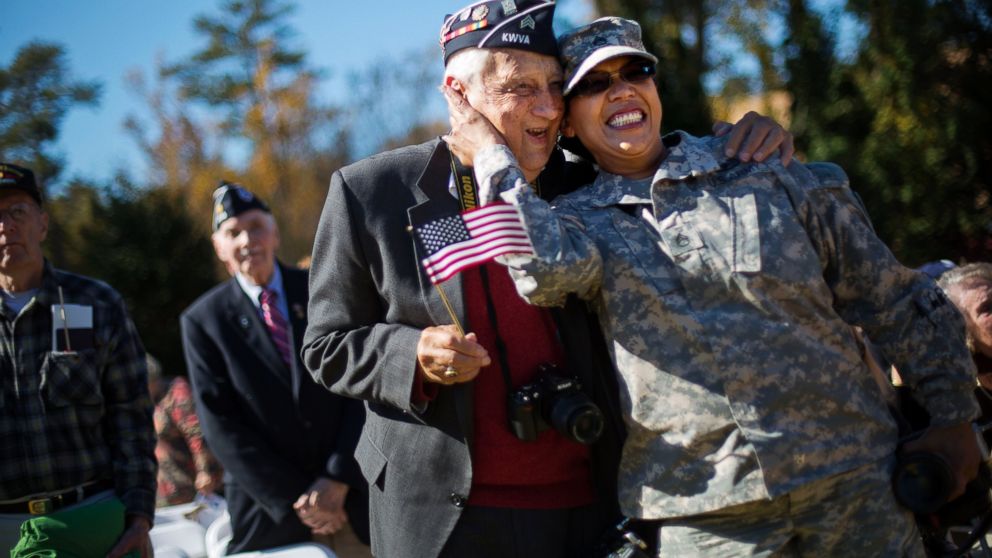 |
| As fewer World War II vets remain alive, they get lots of love. (Associated Press photo) |
All died years ago. There are no veterans of World War
I alive today in the U.S. The old Armistice Day customs,
however, continue to some extent. Church bells still ring at 11 a.m. on Nov. 11
in a small town near us. Veteran firing squads still launch volleys marking the
time. Although I've not seen a remembrance poppy worn for several years, there
may be places where they are available.
Wikipedia tells us that remembrance poppies remain common in
other nations, especially the UK ,
and there the day to honor those who gave their lives in battle is titled
Remembrance Day. That seems appropriate because the U.S. played a relatively small role
in World War I, where trench warfare produced wholesale slaughter.
The U.S.
didn't enter the five-year conflict until almost the final year. Casualties
totaled 320,000. That seems like a lot, but consider that British
Empire dead and wounded totaled more than 3 million and French
casualties topped 6 million. Some 37 million people from all participating
countries were killed or wounded in the horrific struggle. The U.S. military casualty
total was much higher in World War II--more than a million.
During World War II, Armistice Day began to morph into
Veterans Day. Informal observances using the new name started in 1947. In 1954,
Congress officially recognized Veterans Day, declaring it a national holiday
and a time to honor all veterans.
I was discharged from the Army in 1960, and don't recall any
wholesale changes in observances until fairly recently. The old Armistice Day
traditions simply continued under a new name. Veterans usually were respected,
but not always. Many Vietnam War vets complained about shabby treatment when they came home from the
killing fields in Indochina .
If anything, recognition and tangible rewards for veterans
declined. My brother-in-law and other Korean War vets pointed out that
monuments in city squares omitted them. Supposedly, that was because Korea
officially was a "police action," not a war. The nation's biggest
veterans' organization, the American Legion, refused membership to thousands of
veterans of my era, a practice continuing today. An ungrateful government
reduced or eliminated some veterans' benefits for us as well. On Veterans Day,
a vet might be thanked for service with a fee doughnut or cup of coffee in a few
places, but those were about the only tangible gifts from private people that I
remember.
Everything seemed to start changing after the 9/11 attacks.
Suddenly, those cups of coffee became free meals. A huge variety of businesses began to offer 10
percent or more price reductions to veterans. Because some hotels and motels gave
room discounts, the proverbial "three hots and a cot" provided to
active duty G.I.s could once again be enjoyed by veterans. Offering gifts to
vets seemed to take on a snowball effect, and it hasn't stopped yet.
 |
| I think this Denny's ad deserves an award for salute creativity. |
This year lists of free or cut-rate offerings on Nov. 11,
and sometimes throughout the week, were easy to find. It was a "take your
pick" situation.
I was right there picking. With our continuing home
remodeling project far from completion, it was a great time to get needed items
available at leading big box stores for 10 percent off. While on the track of some
special items, my son and I were near a Denny's restaurant, so I claimed one of
my favorite things--a free "build your own breakfast." In the evening
after more discount shopping, beautiful wife Sandy and I visited Applebee's
where I enjoyed a free steak dinner.
Just for fun, I added up the total value of my Nov. 11
discounts and freebies. The gifts were worth $111.30. And I didn't even have
time to get the free haircut or car wash offered by businesses near my home.
By coincidence, my biggest paycheck in the U.S. Army was
$111.00 a month. It usually lasted about two weeks. Maybe payback time finally
has arrived? Thanks to all the "thankers" who back up their words of
gratitude with material gifts. You, too, deserve a salute.
Monday, November 10, 2014
The Picture of Contentment
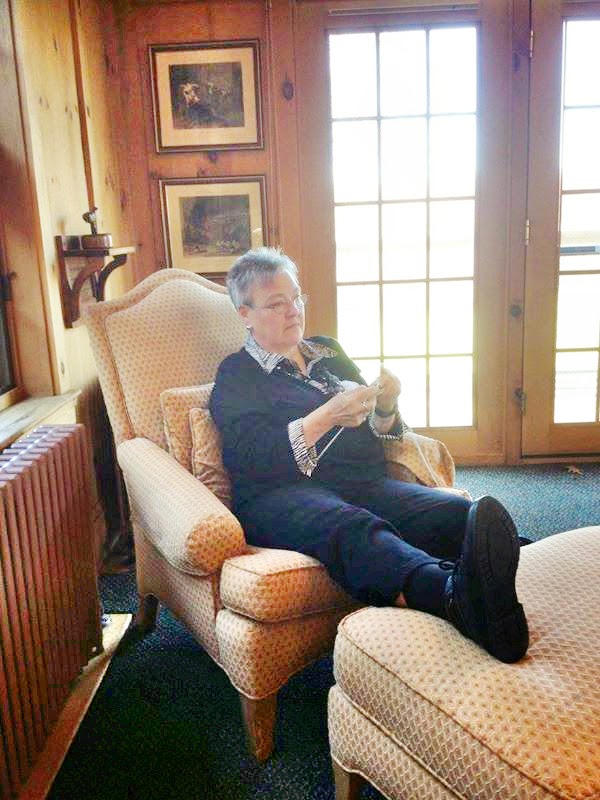
Who is she? A satisfied Republican following last week's
route of the electoral opposition? A smug Packers fan after last night's
gridiron trashing of their arch rivals, da Chicago Bears?
Neither of the above. It's beautiful wife Sandy taking a
break during a retreat titled "Your Life Unplugged" at Yarrow Golf
and Conference Center Michigan 's most scenic
and elegant spots, a great place to spend a few days gaining inspiration and
developing a feeling of satisfaction.
Son Lee's fiancée, Karen Vogelmann, made most of the arrangements
for the retreat. It was a major task, but it paid off . Some 25 ladies loved
it, judging from post-meeting comments. The event was so successful that plans
immediately went into effect for a repeat next year.
This photo by one of her new-found friends suggests Sandy
Wednesday, October 29, 2014
Democrat Voted with Democrats. Duh.
I intended to comment on the proliferation of lies and
misrepresentations in television ads leading up to Tuesday's election. However,
so many unsupportable statements were advanced that I simply
couldn't muster the energy to do the topic justice.
Although selecting the biggest lie, or biggest liars, would have been a daunting task, picking the dumbest statement is no problem at all.
Although selecting the biggest lie, or biggest liars, would have been a daunting task, picking the dumbest statement is no problem at all.
Early in Michigan 's
seemingly endless campaign for governor, an ad blared over and over,
"Schauer voted with Obama and Democrats 95 percent of the time."
Mark Schauer is a Democrat. Which party might we expect him
to vote with? The Libertarians?
Perhaps recognizing that at least a few Michigan
But to prove stupidity dies hard, the same message just arrived in my mailbox. Only the pamphlet says the Democrat voted with Democrats 96 percent of the time. Wonder who came up with that added 1 percent? I was thinking about voting for the Republican. Now I wonder.
But to prove stupidity dies hard, the same message just arrived in my mailbox. Only the pamphlet says the Democrat voted with Democrats 96 percent of the time. Wonder who came up with that added 1 percent? I was thinking about voting for the Republican. Now I wonder.
Thursday, October 16, 2014
Lions Without Mountains
The news was terrible for wildlife when a recent report on
the world situation showed numbers down about 40 percent in just the
past several decades. Expanding human populations and activities are causing
the declines, the study compilers said. But, as in all broad trends, there are
exceptions. Mountain lions, missing from the landscape for a century, are
returning to the American Midwest.
Mountain lions (cougars) are secretive animals seldom seen
by humans even in western areas where numbers can be high. Eastern cougars
once were native to Wisconsin and Michigan , but they were eliminated by uncontrolled hunting and trapping and forest devastation by the early 1900s.
 |
| A camera set up to photograph trail users filmed this cougar near Merrill, Wisconsin. Other cougar sightings have been confirmed in the state in recent years. (photo: Wisconsin DNR) |
Since 1910, numerous farmers, hikers, and hunters have
reported sighting cougars in both states. The Michigan Department of Natural Resources so far has been
unable to find physical evidence to confirm a sighting. Not so in Wisconsin . There, on
July 30, a trail camera photographed a cougar on private property about 20
miles from my hometown. It was the third confirmed sighting this year, and
there were several in previous years.
According to the Wisconsin DNR, the animals known to be
roaming the state's north woods probably are western cougars, somewhat different
from the type that originally inhabited the area. Wildlife biologists think the
newcomers journeyed from the large populations in the Black Hills of South
Dakota. They probably were lured by excess numbers of deer, a favorite cougar
prey, in northern Wisconsin .
Only the presence of males has been confirmed so far, so it is unknown if
permanent populations are being established.
If you live in Wisconsin or
Michigan ,
don't start panicking about the possibility of being confronted by a cougar. In
the unlikely event you encounter one,
DNR advice is to face it squarely, open your coat or jacket to make
yourself appear bigger, make noise, and throw sticks or stones at it. Chances
are high the cougar will run. It probably won't run all the way back to South Dakota , though.
Saturday, October 11, 2014
Please, Let Us Stand Prosperity
Yesterday, I filled up the family car for $2.95 per gallon,
the first time gasoline has dropped below $3.00 around here since November 2010.
Today, I noticed the futures price of petroleum in the New York Stock Exchange
had fallen to $85.00 per gallon; it has not been that low for a long, long time.
The futures price is of interest because it tends to confirm
the opinion of some experts that prices at the pump in the U.S. will stay relatively low or
continue to fall in the near future. Why have we arrived in this happy
position?
1. Federal rules requiring auto producers to build machines
that get more miles per gallon are paying off. The builders complied by
designing vehicles in all categories that are more fuel efficient. And the
American public is buying more small cars and more electric and hybrid vehicles
in all sizes.
2. Fracking and improvements in more conventional extraction
methods have combined to glut the American market with gas and crude oil. No
matter what economic theories you subscribe to, that tends to keep prices down.
But fracking needs firm controls to prevent environmental disasters, and we
would be wise not to change policies to encourage more use of the technique.
3. For a variety of reasons, Americans generally have been
driving fewer miles in recent years, which contributes to the favorable supply
situation.

Low oil and gas prices reverberate positively through our
economy. Consumers have more cash to buy goods of all kinds. That demand then
can be met through lower manufacturing and transportation costs. That kind of
demand also creates jobs in many sectors. It is the sort of prosperity we
should embrace.
But some people are just too greedy to allow us to stand
prosperity. Those are the guys who control the big oil companies.
We have been protected to some extent from their avarice for
40 years. In 1973, several Arab nations put an embargo on oil exports, sending
prices soaring world-wide and creating shortages in the U.S. Our
government responded in several ways, one of which was a ban (with some
exceptions) on exporting crude oil produced here.
The idea was to break our dependence on foreign crude oil
and stabilize the domestic market for refined products. It has been a long
haul, but success seems imminent. It should be pointed out that the ban does
not include export of gas, which can be liquefied and shipped overseas, or
products from oil refineries.
Surprise: the American Petroleum Institute is leading a
lobbying campaign asking the Administration to circumvent the ban by
introducing more exceptions and the Congress to revoke it entirely with
legislation. Some refineries that profit from the ban are mounting
a counter campaign.
Genius is not necessary to know that no matter how
technology advances oil and gas are nonrenewable resources. We eventually will
run out of them. We are working to replace oil and gas with solar and wind
power, but the conversion will take a long time. It makes no sense not to
conserve our nonrenewable resources as much as possible.
Please, Mr. President and Members of Congress, let us stand
prosperity. Resist the petroleum lobby, and act in the national interest. Keep
the ban on crude oil exports in place, and delete some exceptions from it as
well.
Thursday, October 02, 2014
Shhh! I'm with the Secret Service
The Secret Service, after 150 years of exemplary work, is
much in the news of late for several poor performances. Reading about the gaffes and the resulting
resignation of the service's director, reminded me of an encounter with one of
the agents.

The Director of the Intermountain Research Station, where I was
working for the U.S. Forest Service, decided to check out the latest management
fad being promoted throughout the federal establishment. He sent me, our
biometrician, and an administrative services specialist to Washington , DC
It turned out to be a pretty high-level gathering. Among our
group of about 40 trainees was the Postmaster General and a two-star Marine
Corps general. We met daily just down the street from the Russian Embassy.
Forest Service lodging reimbursements didn't cover
the cost of rooms in fancy places, so our
trio stayed in a modest hotel and we had to walk a fair distance every morning
to the meeting place. We made the trek early, because free coffee and donuts
were available for about a half-hour before the training sessions started.
 |
| Keach would have been believable as a Secret Service agent. |
One fellow trainee was present every day when we arrived.
Often he was the only one there, so we chatted with him and became acquainted.
The man bore a startling resemblance to actor Stacey Keach. We learned that he
had been a lieutenant commander in the U.S. Navy before his present employment.
There was no doubt about his current work. Where our workshop name tags said
U.S.Forest Service, his said Secret Service!
Obviously, our new friend was there guarding somebody, but
in numerous conversations he never told us who it was. The cold war hadn't
thawed at that time, and we mentioned our proximity to the Russians and
wondered if he wasn't concerned about identifying himself so openly.
The agent said, "Oh, they know who all of us are. And
we know who all the KGB guys are."
Apparently, some
things aren't so secret in secret service work.
Thursday, September 11, 2014
Outsmarted by a Phone
About eight years ago as a daylight savings time change
approached, a fellow Forest Service
retiree told me of his tactic to remove any doubts about which way to reset his
clocks. He bought two cheapo watches--one set on standard time, the other on
daylight savings time. He merely switched them on change days and used his
wristwatch as a guide to reset all other timing devices in his household.
I already owned a cheap wristwatch. I found a duplicate at
Walmart on sale for $5.00 (sometimes that place is worth visiting). Ever since,
I have kept one on standby in a dresser drawer until it was
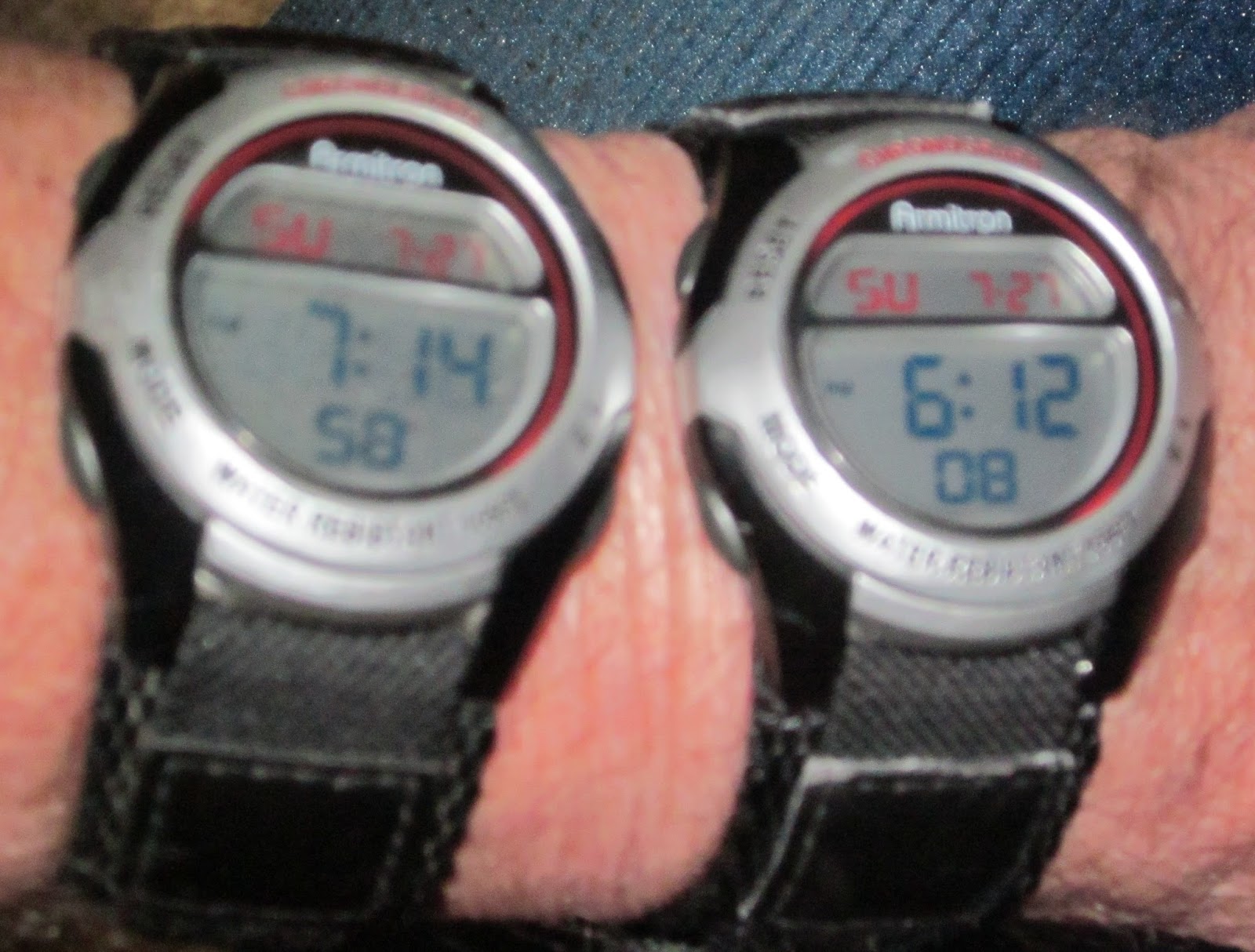 |
| So they're two minutes off. Who cares now that they're obsolete? |
The switcheroo worked equally well moving between eastern
time at our Michigan home and central time in often-visited
Wisconsin . My
son and I took that trip this summer. I decided to brag a little and made a
show of trading watches as we were about half way across Lake
Michigan on a ferry. Lee
said, "Oh, but time changes aren't any problem."
"How so?" I asked.
"My smart phone automatically makes the adjustment. I
just tap the time ap."
Time and technology once again have marched on. One of my
favorite schemes has been rendered obsolete. Anybody want to buy two watches used only
about half a year each throughout their lifetimes?
Thursday, September 04, 2014
It's That Time Again
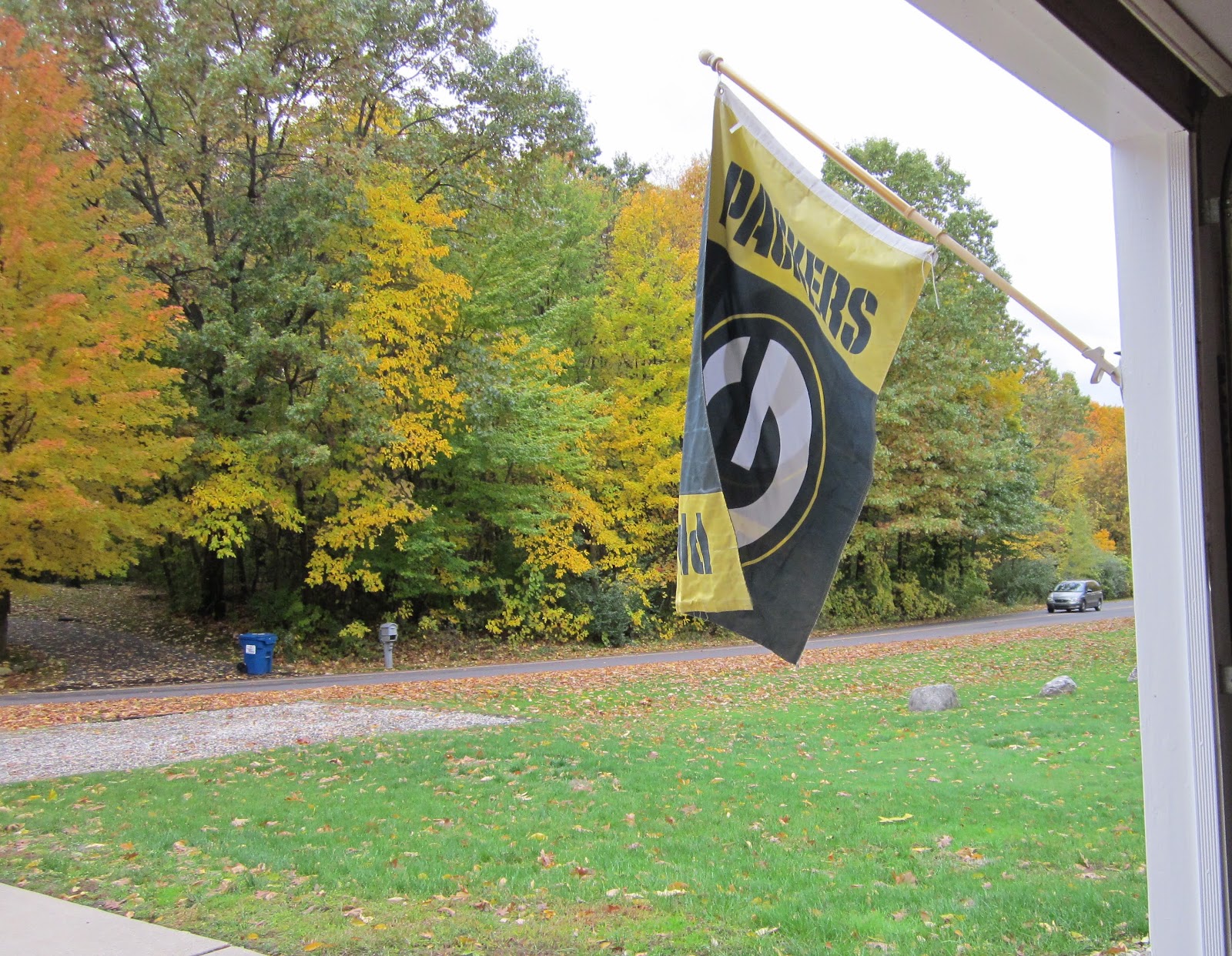
'Tis the season when footballs and banners of avid team
followers fill the air.
Some who pass our home wonder why my Packers flag flies only
intermittently. That's because ancient family tradition dictates the flag is
unfurled only after a victory. The first game of the season is tonight. At
dawn's early light tomorrow my flag may, or may not, be there.
At the moment, a very few leaves in our Lake Doster
Friday, August 29, 2014
Absence Makes the Heart . . .
The geezer never has been much of a fan of poetry, and a few
attempts to write in that format have ended in dismal failure. Over the past
year of so, however, I've been delighted almost daily by the creations of Marc
Leavitt, who posts his work at www.marcleavitt.blogspot.com
Marc occasionally puts together a lengthy work. I enjoy
those, but prefer his briefer offerings. He has a gift for conveying a big
message in a little poem.
My beautiful wife Sandy has been away for several weeks
visiting friends and relatives in Wisconsin .
These trips have been an annual event for a long time. Lake Michigan waters
permitting, she'll be back in our Michigan
home in two days, just in time to celebrate our 53rd wedding anniversary.
Inspired by Mr. Leavitt and the impending occasion and
despite my numerous previous failures, I've decided to go for it. I hereby
publish my first (and perhaps only) poem:
Your trip
was barely under way
When life
here ceased to be OK
How many times must I learn
When you
are gone
I soon
yearn for your return

Wednesday, August 27, 2014
"Don't Do Stupid" Ain't Stupid
The usual chorus of President Obama detractors got a boost
from an unusual source recently. Fellow Democratic Party leader and presidential
candidate in waiting, Hillary Rodham Clinton, attacked Mr. Obama's foreign
policy on the grounds it is a non-policy.
The president's policy earlier got a strange name. Staffers
leaked the news that inner circles have taken to defining it as, "Don't do
stupid shit." For the more sensitive masses, the policy is being redefined
as, "Don't do stupid stuff."
Ms. Clinton said "Don't do stupid" is not an
organizing principle, and great nations need organizing principles worthy of
their leadership role. I beg to differ. Ms. Clinton, in my opinion, did an
acceptable job as secretary of state, but she got this one wrong.
 |
| If you win, please don't do stupid stuff, Ms. Clinton (Wikipedia) |
It's about time a U.S. president decided to set aside
lofty rhetoric smacking of egotistical American "exceptionalism" and
adopted a realistic foreign policy standard. Remember how we fought to "Make the world safe for
democracy" and not may years later to establish the "Four
Freedoms" on the planet? How are those types of policy statements working
for us lately?
We could make "Don't do stupid" prettier, of
course. Something like, "Carefully analyze every foreign conflict and intervene
only when it is clearly in our national interest" says the same thing, and obviously states what President Obama tries to do, but
certainly there's nothing catchy about it. In this case, I like the negative
"don't do" better than the positive "do." For one thing,
it's more fun.
Mr. Obama, with Ms. Clinton as a top foreign policy advisor,
has made some boo boos, as all presidents have. A recent one was prematurely declaring,
"It's time for Assad to go." He forgot that Goldilocks could be
leading Syria
and it would have little effect on American interests. He also forgot that
displacing strong dictators in the Muslim world often creates chaos. Is that
part of the world more tranquil now than it was when Saddam ruled Iraq with an
iron fist? Hardly. How's the serenity index looking in Libya nowadays?
We did what was in our interest in Syria . With
Russian cooperation and good work by our more usual allies Assad's weapons of
mass destruction--lethal poison gases--a true threat to the world and thus us,
have been destroyed. We finally did what was in our interest in Iraq --we got
out. We're back now in a limited way, a far cry from the days when we invaded
the place with massive force over a pretext.
Soon we'll be out of Afghanistan ,
leaving the kids to fight it out in their sandbox as they always have. In a
strange turn of events, Assad may become part of a new coalition including the U.S. to help stabilize the Middle
East . Things might actually work out well for a change now that
the horrifically bad guys have come out of their closets and staked out some
territory where the good people can shoot and bomb the crap out of them.
"Don't do stupid stuff" has saved a lot of
American lives, and quite a bit of cash we can use to better advantage
elsewhere. The policy isn't a return to isolationism. It's simply a venture into
reality.
Thursday, August 21, 2014
Golf for the Footloose
Our Lake Doster Golf Course has come up with a new ploy to
increase play. Every Sunday afternoon, half the layout is available for a different
kind of game. Players need only bring a soccer ball and their feet. They kick
their ball around the course much as normal golfers move their small ball
around with clubs.

We've lived in homes adjacent to fairways for 35 years,
a long time to observe golfers in action. A few of them should be great Footgolf players. They've had lots of practice kicking their ball into an improved
position when they thought no one was watching.
Beautiful wife Sandy for several years got special chuckles observing
an older man who played the course by himself very early in the morning. He would
look around to ensure he was alone, and then drop a ball down the inside of his
pants leg into a good spot for his next shot. If it wasn't just right, he improved
the lie with a foot nudge or two.
Of course, Footgolf hadn't been invented when the old duffer entertained Sandy
Thursday, August 14, 2014
Old Beer Drinkers Just Fade . . .
Being able to "hold your beer" in Wisconsin , land of many
breweries, when I was a teenager was a badge of honor. That meant you could
down quite a few lagers, the only beer readily available in most places, and
act as though you were cold sober.
"Quite a few" was a bunch when an eight-ounce glass
from the tap cost a dime. A dollar financed a fairly long night out at a beer
bar. The legal drinking age was 18 back then, but it wasn't difficult to find
bar owners who weren't at all concerned about winking at a fake draft card
altered to prove a 15- or 16-year-old was really 18 or 19. Sometimes, they just
took your word for it. Pete Zemlis served me my first beer at his Half Moon Lodge near Tomahawk, Wisconsin, when I was 14.
Practice may well make perfect in the beer guzzling world.
By the time my real 18th birthday came around, I could walk a straight line
after downing seven or eight short (eight ounce) beers. Later, I held my own at several bars during Mexican
vacations at a level that would have made Jimmy Buffett proud.
I took to drinking dark ales, which had much more robust taste
than the pale lagers. Ales also had slightly higher alcohol contents. I could
no longer drain as many glasses without major consequences, but I still liked
to think I was pretty good at "holding my ale."
Along with other things that faded with advanced age, my
beer and ale capacity declined considerably. I retreated from dark ales back to
light lagers. Even then, two beers became my limit. Perhaps that was good,
because now I get full well before I get loaded.
 |
| Three Two Hearteds are two too many for me! |
Nevertheless, there is room for adventure at any age. I began to take notice of "Two Hearted Ale," an India Pale
Ale produced by Bell Brewery, a local brewer in our area. A newspaper article
pointed out that the Beer Advocate Society gave Two Hearted a 95 rating, which
translates to "world class." Another rating agency called it
"outstanding." Yet another group concerned with such things announced
Two Hearted Ale was the best beer in the world. After seeing that claim, I just
had to try the stuff.
About then, the brewer announced that Two Hearted was being
made available in cans for the first time. I found a four-pack, just enough for
a trial drink or two, at the local supermarket. My son was coming over for a
meal, and I thought two cans for him and two for me would be just right.
Each can held 16 ounces, four more than the usual amount. The
ale tasted great, but I barely made it
through one can. A check of the label showed Two Hearted had an alcohol content
of 7 percent. No wonder all those raters gave it such outrageously high marks;
they probably quaffed one small glass and experienced what happens late at
night to many tavern patrons when all the girls suddenly are beautiful.
Incidentally, the ale is named after the Two Hearted River in Michigan 's Upper Peninsula . That probably is of little or no
significance, but it's the kind of thing one might ponder after downing a
couple.
Thursday, August 07, 2014
Sign Writers Wanted?

If only one stone is loose, wouldn't it make more sense to pick it up rather than putting up a sign?
This sort of thing, however, does point out a possible opportunity.With a continuing tight job market for English majors and
journalists, the unemployed might do
well to check with organizations such as the Michigan Department of
Transportation. They might consider upgrading their writing staffs.
Friday, July 25, 2014
Leaping the Lake to Lambeau
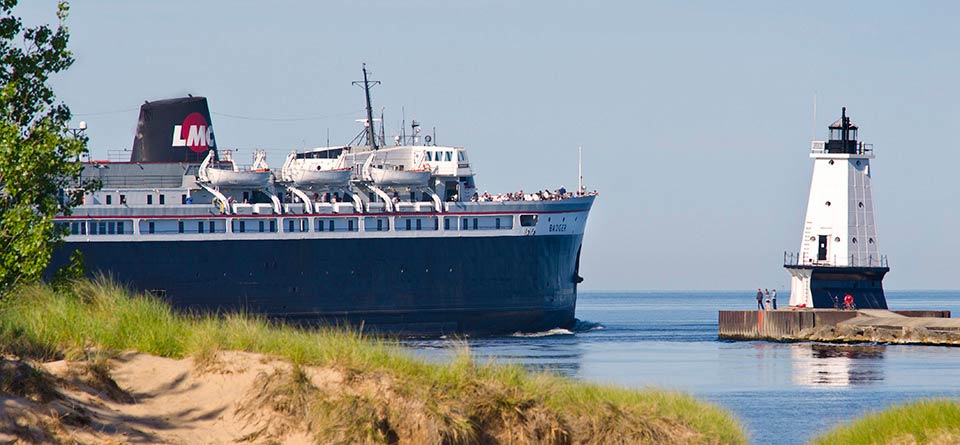 |
| The SS Badger leaving Ludington harbor. (photo from the ship's web page) |
Our son Lee and I needed a road trip from our Michigan homes to Wisconsin.
Lee had business to do near Madison with a gallery displaying some of his
stained glass art. I had a bucket list item to attend to--a visit to Green Bay to get a look
at Lambeau Field after several hundred million dollars in renovations and
expansions since I last was there to see a Packers game about 40 years ago. We
decided it would be fun to go the old fashioned way, with a 60-mile voyage
across Lake Michigan aboard the SS Badger.
A "road trip" on a boat? Among other SS Badger trivia is the fact that
it officially is part of U.S. Highway 10, linking the eastern and western
sections of the route. We were amused by the highway sign displayed prominently
on the ship, and thought it was a joke--a bit of research proved it wasn't.
Another thing sets the Badger apart from other ferries; it is the only vessel registered
as a historical site by two states.
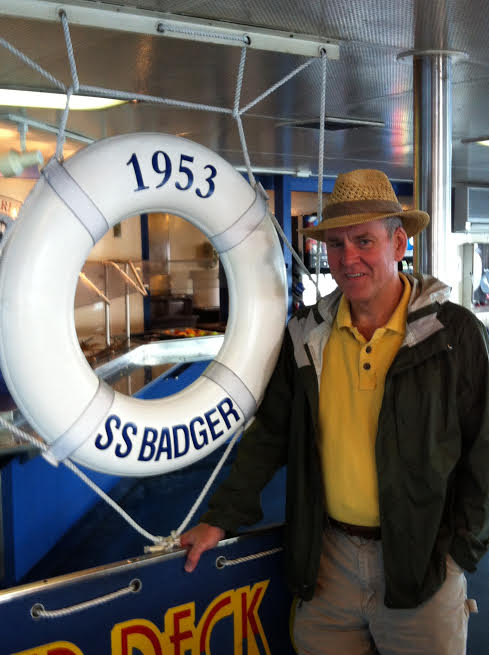 |
| We used a photo op to give Lee a souvenir. |
The Badger is the last large coal-burning steamship in the United States , where many once sailed the Great Lakes and other waterways. It and a sister ship,
the SS Spartan, were built in 1952 in a Wisconsin
shipyard and launched the next year.
Of course, University
of Wisconsin Michigan State University Ludington , Michigan Michigan comes out on top in daily
operations, however. The Badger runs on eastern time; Wisconsin is in the central time zone. Michigan also has the
upper hand financially, the state collects the sales tax on all tickets.
The Badger, built with a reinforced hull, originally served
as an ice breaker as well as a commercial vessel. It traveled between Wisconsin and Michigan
year round. It is a big ship. An important use for many years was transporting
railroad cars between the two states. We saw the railroad tracks imbedded in
the floor of the hold where now only motor vehicles are carried. The Chesapeake and Ohio
Railroad owned the ship for many years.
The need for railroad car transfers gradually declined, and
in 1983 railroad interests sold the Badger. It was rebuilt and remodeled for
service with an emphasis on carrying autos and passengers. However, it still
has commercial uses. A huge tanker truck was driven into the hold shortly after
our mid-sized sedan went aboard. A crew member said an important business for
the ship is transporting oversized trucks carrying blades for giant windmills that
generate electricity in new developments.
The Badger can carry 600 passengers and up to 180 vehicles.
Nowadays, it runs from May 16 to Oct. 26. It travels slowly. The 60-mile trip
from Ludington to Manitowoc ,
Wisconsin Mackinac Bridge Chicago
would keep you on the road about 7 hours, but that trip can be much longer
during rush hours.
 |
| The Badger can carry big rigs, such as the Budweiser Clydesdales' truck. |
Unless one has a fascination for gazing at unbroken
stretches of sky and water, a cross-lake journey can be dull. Badger management
tries to make up for this with activities similar to those offered on a grander
scale by ocean liners. Food and drink is available in a large cafeteria and a
smaller lounge that has a well-stocked bar. A museum room has exhibits tracing
the ship's history in detail. A few of the 50 to 60 crew members are hired as
entertainers. A bingo game was in progress in one large area throughout most of
our trip. Children were being entertained with a variety of games.
Ours was Lee's first voyage on the Badger, and my second. We
had a ball exploring the old ship and agreed running our road trip over the
waves was a good idea.
The conclusion of the trip was to be another lake crossing,
which would be a first for both of us. We planned our return to Michigan via the Lake
Express , a much newer ferry than the
Badger that sails from Milwaukee to Muskegon and beats the
older ship's travel time by about an hour and a half. Beautiful wife Sandy has
traveled on the Express many times, and highly recommended it.
The phone call came when we were about five miles from the Milwaukee harbor.
"We're sorry, but we have high winds and waves on the lake, and passengers
wouldn't be comfortable. Our remaining trip today is cancelled."
Oh yes, several of the various descriptions of the SS Badger
claim because of its size and design it seldom cancels a trip due to bad
weather. We thought about that several times as we sat motionless on Chicago expressways or in countless construction zones in Indiana .
I phoned the Badger office today to check. "Did you
folks cancel any of your trips on Wednesday?"
"Oh, no. We made all crossings on schedule."
Apparently, the grand old lady of The Great Lakes still has some good sailing in her and even can outdo a
younger upstart sometimes.
Thursday, July 17, 2014
Winging It Safely
Oh, they
sailed out from England
When the rich refused to associate
with the poor.
So they put them down below
where they'd be the first to go.
It was sad when the great ship
went down.
--from a version of "The Titanic"
Oh yes, the guys with the big bucks have long known how to
place themselves in the safest possible positions. And they sometimes did it by
making those less fortunate more susceptible to disaster. It therefore is
strange that the moneyed classes could have gotten it so wrong when modern
airliners became the travel vehicles of choice.
Many years ago, I heard mutterings about relative safety in
airliner seating, so the idea is nothing new. The smokers exiled to the rear of
the plane sometimes joked about it with observations such as, "The smoke
may be doing us in, but if we crash we're in the catbird seats."
 |
| Be smart, move back |
Safety and seating locations, however, never became much of
an issue. But now that could change. The question popped up in a latest issue
of AARP The Magazine. The AARP
publication has huge readership, so we may assume the word will get around, and
be relayed to those who can afford to travel in style. Here's the item:
"In 2007, Popular
Mechanics published an analysis of 36 years worth of airline seating charts
and 20 accidents, back to 1971. The numbers were decisive. Passengers sitting
behind the wings had a 69 percent survival rate in an accident. Folks sitting
over or in front of the wings had a 56 percent rate (first class was lowest, at
49 percent.)"
Wealthy folks fully understand 20 per cent differences. How
long do you think it will be before first class is relocated to the tail
sections of planes?
Friday, July 11, 2014
A Blogday Anniversary
Today is the eighth anniversary of this blog. No national,
or local, celebrations were held.
Some fairly accurate calculations indicate more than 400
little stories have been posted since July 11, 2006. Some of them have been
read. Some very nice people have been met in cyberspace. Those are good enough
reasons to continue.
Thursday, July 10, 2014
You Called Me, What?
I thought oldsters were overreacting when they moaned about the
way many of today's younger adults address their elders. That was before a
recent trip to my credit union.
 |
| I may be cute, but I'm not your honey |
It should not be difficult for juniors to use more
respectful tried and true salutations when speaking to older people. "Ma'am"
seems acceptable for older women. I feel good about a "Sir" applied
to my geezerly presence. A snappy salute also would be nice, but that would be
overkill and is not recommended.
While waiting for respect to return to polite discourse,
which may be a long wait, I'm planning a counterattack. However, so far it's a
tough decision whether to respond to unwanted terms of endearment with
"Darling" or with "Sweetheart."
Subscribe to:
Posts (Atom)