This week's annual medical exam, paid for by Medicare thanks to a provision of Obamacare, had a new twist. The nurse asked if I minded having a trainee participate with our regular family doc.
"Not at all," said I, and that was a good call. A pleasant, efficient, and obviously competent woman training to be a nurse practitioner arrived and did a fine job of poking, jabbing, inspecting and questioning before the doc arrived to analyze things. I could find only a tiny flaw in her performance. As we were discussing the possible need for a colonoscopy, she observed, "You've reached your life expectancy, you know."
I chuckled at that lapse in exam-side manner, and suggested it only meant I was likely to live a little longer. But later in the day the full import of the statement hit me, and I felt a bit depressed by once again being reminded that it is no longer wise to make a lot of long-range plans.
This morning another pleasant woman lifted me from any lingering sadness. I headed for the local favorite breakfast restaurant to take care of hunger pangs caused by fasting before some routine blood tests ordered by my medical examiners. Two attractive waitresses called me Honey, Sweetie, and Darling in the span of about 10 minutes.
Of course, many geezers no doubt are addressed that way. But I'm going to hang around a while longer to confirm that.
Wednesday, October 28, 2015


Tuesday, October 06, 2015
A Pope of Hope
Pope Francis has come to these shores and gone. The evening news can return to over-emphasizing other stories. What did the papal visit mean to Catholics and others in the U.S.? That was the topic of a lively discussion this weekend by a dozen friends.
Our group included one person who grew up as a Catholic, has left the church, and is unlikely to return. Another was once married to a Catholic and has many Catholic friends, although she is an Atheist. The rest of us had various religious backgrounds that did not include Catholicism; most now are Unitarian-Universalists.
 Very few negative words were spoken about Pope Francis or his visit. What's not to like about a charming man who champions causes dedicated to helping the poor, reversing economic inequality trends, and living in harmony with our natural environment? And this Pope practices much of what he preaches, living modestly unlike some of his predecessors who favored regal splendor for themselves while telling others to sacrifice.
Now the question is what, if any, lasting positive effects will the papal words have. Our discussion group members advanced several ideas.
One with considerable expertise on environmental matters thought the Pope's statements that global warming is a fact and human activities are a principal cause would help move reluctant members of the U.S. Congress to see the light. Another said any advances toward more humanitarian and less dogmatic characteristics in the Catholic Church were welcome, and Pope Francis is steering the church in that direction.
I thought the most insightful comment was that Francis' appearance at this time in America was a masterful stroke of public relations. The church as been hard-hit by membership and financial losses in the wake of revelations of priestly misconduct. Exposure to a new leader who exhibits personal warmth, tolerance, and a gentle spirit was a positive thing for an organization very much in need of some warm fuzzies.
I agree that Pope Francis, with only a few minor exceptions, rather expertly delivered the right messages at opportune times. There is hope that some of his words will promote lasting changes.
Our group included one person who grew up as a Catholic, has left the church, and is unlikely to return. Another was once married to a Catholic and has many Catholic friends, although she is an Atheist. The rest of us had various religious backgrounds that did not include Catholicism; most now are Unitarian-Universalists.

Now the question is what, if any, lasting positive effects will the papal words have. Our discussion group members advanced several ideas.
One with considerable expertise on environmental matters thought the Pope's statements that global warming is a fact and human activities are a principal cause would help move reluctant members of the U.S. Congress to see the light. Another said any advances toward more humanitarian and less dogmatic characteristics in the Catholic Church were welcome, and Pope Francis is steering the church in that direction.
I thought the most insightful comment was that Francis' appearance at this time in America was a masterful stroke of public relations. The church as been hard-hit by membership and financial losses in the wake of revelations of priestly misconduct. Exposure to a new leader who exhibits personal warmth, tolerance, and a gentle spirit was a positive thing for an organization very much in need of some warm fuzzies.
I agree that Pope Francis, with only a few minor exceptions, rather expertly delivered the right messages at opportune times. There is hope that some of his words will promote lasting changes.
Wednesday, September 09, 2015
A Government of Laws, Not Clerks
When Kim Davis, clerk of Rowan
County in Kentucky , was released from jail a few days
ago, hundreds showed up to greet her with cheers. Davis
had refused to grant marriage licenses to same-sex couples, despite a Supreme
Court decision that such unions are legal. Supreme Court
decisions are the law of the land in the U.S.

It is quite clear that the job of county clerks is to follow
the laws of their state government and the federal government. Those laws
require them to issue marriage licenses to qualified individuals, and the licenses must be provided immediately upon application or after only
a brief waiting period.
State laws vary somewhat, but most require the clerk to
consider only that applicants meet an age requirement (usually 18), are not
attempting to marry a close relative, have the mental capacity to understand
their actions, and are not already married. A few states require blood tests. In
no state are clerks authorized to interpret laws or follow only those they
happen to agree with.
Davis is free to select any authority she wants to guide her personal beliefs. However, only properly constituted authorities are empowered to define what she must do in her public service job. That's how government works in
this country, and if Davis
Friday, August 21, 2015
Gamrat Dishonors Our Community
Plainwell, a small city (pop. 3,900) in southwestern Michigan, has a new claim
to fame. News of a sex scandal involving the area's representative in the state
legislature has spread to the major television networks, been mocked on
late-night comedy shows, and circulated to all manner of media by the Associated Press. Reuters is
carrying the story, so it may even have reached foreign shores.
I was much more content when Plainwell's claims to fame were servings of great treats at the Plainwell Ice Cream Company and a history
of papermaking at a giant mill now mostly decomposing in the center of town after
shutting down about 15 years ago.
My inclination has been to let the scandal play out without
comment here. Several investigations are under way to determine if laws as well as moral principles have been violated. However, a few folks have
poked fun in my direction because of the situation. A couple of things need clarification.
It is true that Cindy Gamrat, the female partner in the
sordid affair, is a neighbor. News stories correctly identify her as "R-Plainwell,"
and we both have Plainwell mailing addresses. We actually live about 5 miles east
of town in a community of some 450 families. Although Gamrat resides on the edge
of my neighborhood, we have never met.
My silence regarding the now infamous representative should
not be construed as support. Usually, I consider voting a very private matter, but I'll make a small exception in this case. I have never
 |
| Courser and Gamrat need to resign. |
Gamrat moved to our neighborhood from Indiana about four years ago. She became the
founder and leader of the Plainwell Patriots Tea Party. She and another
first-term legislator, Todd Courser, upon arriving in Lansing took the unusual step of sharing office space and staffs. They now
admit to sharing a lot more.
So what? Sexual
transgressions involving politicians, some of them prominent (Bill Clinton
comes to mind), seem so routine that news of another one usually gets ho-hum
reactions.
One respected local newspaper columnist addressed the
question by producing statistics indicating affairs involving female
legislators are much less common than those of males. The counter argument that
there are many more men than women holding office doesn't hold up. Correcting
for that, it appears to be a fact that far fewer women politicos than men go
astray, or at least fewer get caught.. That truth helps make the Gamrat-Courser affair unusual, and that makes
it newsy.
More unusual is Courser's bizarre attempt to create a cover
story. One of his staff recorded Courser discussing the whole thing. The tape
was given to the Detroit Free Press, which broke the story. Courser arranged to have an e-mail sent to Republican leaders in Lansing
stating that he was an habitual drug user who had been caught having sex with a male
prostitute. That was supposed to create such a sensation that revelations about
the Gamrat-Courser affair would be dismissed or discounted.
Another major factor in turning a minor Michigan affair into national news is that
the participants are outspoken social conservatives who do not hesitate to
bring up their dedication to "family values" and hurl God bombs
around at will. Both are married. Gamrat has three children (she home schooled them), Courser has four children.
Courser has said he won't resign because God hasn't told him to do so.
There are many other strange quirks to this story, including
Gamrat being thrown out of the Republican caucus for breaking its rules. If you
like to delve into political-sexual intrigue, do a computer search and you'll
find all sorts of interesting stuff.
If you study the matter, you probably won't wind up
feeling sorry for Gamrat or Courser, only their families. They clearly have not
been star-crossed lovers caring intensely only for each other. In one of his
cover-up statements, Courser called Gamrat "a tramp." Gamrat stood
beside her husband while making a tearful public confession about the affair, and never
mentioned Courser by name.
Six of seven top Republican leaders in our county have
called for Gamrat's resignation. Michigan Tea Party leaders have demanded that
both Gamrat and Courser resign. The Mayor of Plainwell said Gamrat has made a
mockery of her role in government, and "needs to go away." I agree.
(On Sept. 10, Courser resigned from the Michigan House of representatives while votes were being taken on expelling him. A short time later, the House voted to expel Gamrat. Both decided to run in Nov. 3 special elections to fill their seats, stating "let the voters decide." The voters did. Gamrat finished third with less that 10 percent of the vote; Courser did even worse finishing behind a bevy of opponents with about 3 percent of the vote )
(On Sept. 10, Courser resigned from the Michigan House of representatives while votes were being taken on expelling him. A short time later, the House voted to expel Gamrat. Both decided to run in Nov. 3 special elections to fill their seats, stating "let the voters decide." The voters did. Gamrat finished third with less that 10 percent of the vote; Courser did even worse finishing behind a bevy of opponents with about 3 percent of the vote )
Tuesday, August 11, 2015
A Dubious Distinction
Our town featured a different kind of summer diversion this
year. The Smithsonian Institution's traveling exhibit "The Way We
Worked" had a place of honor for several weeks in a renovated area of the
historic Plainwell Paper Mill.
Our local arts council and district library were principal
sponsors of the exhibit, and they created

Several days after the exhibit left town, a cheerful
librarian called with the news my essay was a winner and prizes would be
forthcoming. It was great news, but got
a little less great when she laughed and said there were six prize packages for
the five authors who entered the competition, so everybody got a prize. I felt a bit as some youngsters might when
everybody who races around the track gets a blue ribbon because "we all
are winners."
My ego got a small boost when the librarian said she thought
my essay was the best. But when I
stopped in to get my prizes and read the other four entries on display,
I realized there were some pretty darn good stories in the "contest."
Did that pleasant lady tell everyone their essay was the best?
The prize packet included a nice "Essay Contest
Winner" certificate and a Barnes and Noble gift card. The third item was a
$25 share of stock in the Michigan Paper Company of Plainwell. Wow, those were
issued many years ago. Could be very valuable. Not really--the Plainwell Paper
Mill ceased operations 15 years ago. The buildings are being demolished or, in a few cases, remodeled
for other uses.
Incidentally, the Smithsonian exhibit is an outstanding
audio-visual presentation. If it comes your way, take the opportunity to see
it. And, if the locals sponsor an essay contest, give that a go. Chances of
winning are very good. If nothing else, you might ask about that sixth prize
package the Plainwell folks couldn't find a winner for.
Friday, July 24, 2015
Unladylike Luck
Members of my family shared a belief that unexpectedly
finding money made the discovery date "your lucky day." Thus, I was
pleased to spot a penny in the parking lot of my dentist's office when I opened
the car door.
Why not, I thought. I was there merely to have a final cap
placed over what had been a troublesome
 |
| Not all pennies are lucky. |
The new dental assistant told me what to expect.
"I'll pop off the temporary crown, clean up the old adhesive, fit the
final, and take an x-ray so the doctor can be sure all is well. Then he will
cement the final crown in and you'll be good to go."
That worked for a couple of minutes. The assistant failed
twice with the x-ray. She called in another assistant. Two more attempts
failed. An assistant who had worked there for several years was summoned. Zip.
Done. "Would you look at this, please?" the original assistant asked.
"Hum," said the veteran. "Where is that image
from?"
"It's one we took from the wrong angle before you got
here."
I heard a muffled conversation in the hallway, and the
dentist appeared. He clicked the computer monitor back and forth several times,
studying the screen intently. "Well," he said, "there's good
news and not so good news. Your crown work is perfect, but the tooth next to it
is in serious trouble. You need a root canal. We'll set it up."
"How much?" I asked.
"Only about $700."
I later figured my net good luck for the day could be valued
at around minus $699.99. Old family beliefs aren't always reliable.
Friday, July 17, 2015
How Terrible: Oil May Get Cheaper
The headline in USA
Today shouted: "Iran
deal boosts fears of global oil glut."
Of course, I had to read the story to see who was afraid and
how serious this whole glut business could be. Surprise! The fearful are those who
devote their lives to gambling on Wall Street, and apparently their concern
relates only to the possibility the mega-oil companies of the world may see
their profits, and thus their stock values, fall a bit.
 |
| Let it flow, let it flow, let it flow |
Hey guys. Do any of you care about the effects on the folks
who use oil products? I can't think of anything those of us who are forced to
fill the gas tanks of our vehicles to survive in this modern world have to fear
from stable or lower prices. I can
think of several reasons for us to celebrate.
1. Lower oil prices may hurt economies of producers such as Russia , Venezuela ,
Nigeria , and Saudi Arabia ,
but they help net oil importers, including the U.S.
Lower oil prices make our companies more competitive. More
important, they put extra dollars in the hands of consumers, and consumer spending drives most of our economy.
2. U.S.
oil producers have been on a drilling and pumping spree since fracking
technology made increased production possible. If world prices drop, some of
that activity will stop or decline as it becomes too expensive. Problem? Heck
no. Fracking can have very serious environmental effects. If we need less of it, that is all to the
good.
3. Unless our politicians are willing to accept continued
deterioration of our roads and bridges, they must raise taxes, and the most
convenient way is to increase existing per gallon taxes at the pump. Here in Michigan , even with a
decidedly anti-tax legislature, our pols are flirting with a deal that would
increase our tax by 34 cents per gallon by 1217.
The federal government so far has shown little interest in a
tax increase, but it cannot support that position forever. The highway trust
fund is unsustainable.
Of course, tax increases will reduce or eliminate the
positive effect of lower oil prices on consumers, but at least they will not
cut into our present spending power much, if at all. And we'll have a better
and safer transportation infrastructure.
If benefits such as these promote fear, I would like to be terrified.
If benefits such as these promote fear, I would like to be terrified.
Saturday, July 11, 2015
Another Blogaversary
Today is the ninth anniversary of the birth of this blog.
This small-time journalist created the first post in 2006 after checking out a
blog by big-time journalist Mort Reichek titled "Octogenarian."
Mr. Reichek was 81 at the time his work encouraged me to
start blogging. He continued posting well-crafted stories until he suffered
serious injuries from a fall. He died at 87 about a year after the accident.
So far, I've posted some 500 items. As my own octogenarian
years rapidly approach, I find story ideas
flowing as freely as ever, but the energy needed to do the hard work of
expressing them clearly

My biggest pleasure has been new insights gained from fellow
bloggers whose posts I read regularly and who visit here to view my offerings
and make comments. Also important to me have been those who choose not to make
comments on the blog itself, but express their opinions about my writings
personally. As every writer knows, appreciation, and even disagreement, by
readers is what keeps us going. It tells us somebody out there cares.
I've come to value many of the people who go to the trouble
of commenting on my work as new friends, even though I've not met some of
them face-to-face. If you are thinking about starting a blog, think about that.
Go ahead--it's worthwhile.
Thursday, July 09, 2015
How About a Civility Bomb?
I've been watching a few newer movies lately and, against my
better judgment, reading some comments on web page items. It's disgusting how
many F. . . bombs are being tossed at us. None of the F's added a thing to the
movie plots. And certainly none enhanced the reputations of commentators who
insist on leading off their opinions with them.
One that really disgusts me is the title of a very good
site: "I F . . . . . . Love Science." Does that F-bomb serve any useful
purpose? For me, it spoils a visit to a
place that has some great information.
Just now, I saw a comment by a more civil individual. She started
with: "WTH." For those turned off by even the mild "hell,"
a totally acceptable "heck" might be imagined here. I like it. Even
better, couldn't we stand to touch one more key and respond to ridiculous stuff with,
"Huh?"
Saturday, June 27, 2015
The Confederacy's Place in History
(I've been trying to craft a post that would cut through, with a rational statement, the controversy related to display of the Confederate battle flag at the South Carolina state capitol and elsewhere. So many conflicting opinions, interpretations of Civil War history, and downright nonsensical statements have appeared that sorting things out proved to be a daunting task. Yesterday, a fellow blogger did the job for me. "Morning Fog," a site whose proprietor had a career with the U.S. State Department, displayed just what I was feeling, but struggling to put into words. His post follows.)
In recent days, and for many years before, governments, politicians, and others in the U.S. South have sought to justify the continued widespread public display, sale, and reverence for the flag of the Confederacy as a matter of history. "It's our history," they may say, or perhaps they say they are honoring the valor of those who fought for what they believed in. I'm very much against any efforts to deny, or to whitewash, U.S. history. The Civil War (or if you prefer, the War Between the States), is part of what we are as Americans, imbued in our psyches, even for our most recent immigrants, because its effects and its many remaining manifestations are still a part of our everyday lives. So historians will continue to attempt to analyze and explain it, and museums will continue to offer glimpses of it. But symbols aren't history, when raised to the top of flagpoles around the country, or splashed across automobile bumpers. Despite claims to the contrary, they are rallying points that serve only to keep sick
Allegiance to what, though? Is it history, even if Americans generally have very little regard for history? Is it pride in relatives who served loyally for a cause, although there are lots of people in this country today who are descended from the Tories of the Revolutionary War period, who weren't evil and believed in their cause, yet I'm not aware of any state in the union today that flies the Union Jack Causes are embraced only when someone wishes they weren't lost. And what is that cause? Some would have us believe that it has to do with legal issues (the right to secede), or even economic ones (concerns about destroying the economic base of the South). And it did, in part, at that time. That's history. But it also had to do with a principle, or as Vice President of the Confederate States of America Alexander Stephens put it shortly after several states officially seceded, the new CSA government's cornerstone: ...rests upon the great truth that the negro is not equal to the white man; that slavery, subordination to the superior race, is his natural and normal condition. A devil's advocate might suggest that allowing the symbols of Confederate principles to be widely on display would give relatively harmless vent to regressive thinking that might otherwise go underground and turn to violence. That has not proved to be the case. It's time to recognize claims on "history" for what they are: a sham. |

Monday, June 22, 2015
It's Time to Toss the Symbols of Hatred
While we mourn our brothers and sisters who were murdered in Charleston, we also need to stand up and declare it
is time for bigots who continue to inspire racial violence with outdated symbols to discard their battle flags.


Saturday, June 06, 2015
A Ford in Your Past?
To the delight of many Michiganders, Ford Motor Company sold
a quarter-million vehicles in May. It was another in what has become a long
string of positive performances since the U.S. economy started to emerge from
the depths of the "Great Recession."
Ford's revival has been a do-it-yourself affair. The company
declined to accept government financial assistance to weather the economic
storm, while rivals General Motors and Chrysler dipped deeply into the federal
till to stay in business. Ford management anticipated the crisis and, unlike
the others, got its house in order before banking disasters struck.
Perhaps it's fitting that Ford led the way. It often did so
in the history of American automotive companies. Henry Ford, a farm boy with
little formal education, had a remarkable ability to introduce or develop novel
ideas in building a manufacturing empire. His first product was the Model T,
and his factories ultimately produced more than 15 million of them. The video
celebrating the Model T has, I think, some fascinating scenes of the vehicles
being produced and driven.
Ford did not invent mass production, but he was the first to
develop the idea in a big way. He made large capital investments to build giant
factories that housed assembly lines. Some believe he created the first
workable private auto, but Karl Benz of Mercedes-Benz renown did that two decades before the first
Model T Ford rolled off the line in 1909. Likewise, Ford did not invent mass
media advertising, but he was one of the first to use it effectively.
Ford Motor Company produced print ads in color when color
printing was a rarity. "There's a Ford in your Future" became perhaps
the best-known advertising slogan in the 1940's, and various versions of the
phrase popped up on the American scene for many years after the company adopted
new tag lines.
Henry Ford gained some of his fame by paying assembly line
workers $5 per day, an unheard of sum in the early 1900's. His motivation
probably was not entirely altruistic.
Skilled workers flocked to Detroit
for good paychecks, and Ford managers could take their pick from many
candidates for every job that became available.
Whether or not there's a Ford in your future, there probably
was one in your past. American families (and many in other countries) either owned a Ford at one time or
another, or owned other mass-produced vehicles whose development mirrored the
Ford example. The video claim that the Model T was the "great-great-grandparent
of most every car on the road" has some truth to it. Sometimes the connection is close in unlikely places. On a trip to Europe , a German family member loaned us their car for a
lengthy road trip--it was a Ford SUV!
My family didn't own a car during most of my years at home.
Dad bought a 1927 Model T in 1945. It was one of the stranger of the many
"T" models--a convertible pickup truck. Dad used it to carry
materials to a lake lot about five miles from our home where he was helping
build a cottage for an uncle. The tough old truck did the job well for about a
year.
 |
| Dad (age 53), me (age 9), and our Model T (age 18). |
One statement in the video probably is over-exuberant hype.
There is no way our Model T ever was started with a "half-turn" of
the crank. Dad was a strong guy, and he did a whole lot of cranking to get that
four-banger engine going on many occasions when I was responsible for adjusting
"the spark" at just the right time.
The last Model T's were produced in 1928; I bought one of
the first successors, a 1929 Model A, in 1952 for $50. I drove it for about a
year and sold it for $55. Wouldn't it be grand if today's cars held their value
like that?
Monday, May 18, 2015
Will Polite Enforcement Work?
An ancient axiom holds there is some good in every
situation. Indeed, there are indications that police forces in many parts of
the U.S.
are examining their practices and policies and making positive changes as a result
of a rash of documented brutality in
dealings with the public they should be safeguarding, especially the reprehensible
shootings of black men without sound justification. Justice may yet be served properly.

However, one might ask if the pendulum could swing too far
the other way, a characteristic of American political life and social change
seen often in the past.
The new sign pictured here popped up recently on a route we
travel often between a home improvement store and our favorite supermarket. I
am certain that the old sign it replaced said, "VIOLATORS WILL BE
PROSECUTED."
Saying less forcefully they "may be" prosecuted, it seems to me,
opens a loophole for miscreants who might be willing to play the odds and take
a chance they will be among those who escape punishment. There also could be an
administrative problem. Who decides which dumpers will be prosecuted? Based on
what? The volume of junk they drop off? The esthetics of the stuff? The nastiness
of any odors?
Could it be this type of more sensitive warning could
go so far that tellers with their hands raised might say, "Please don't
rob our bank. You may be prosecuted." I'm sure the bandits would pay a lot
of attention to that sort of notice--right after they entertained the hostages with a round of LOL.
Monday, April 20, 2015
Modern Media Work Magic
Critics lamenting the vast changes in American news media
continue to mutter throughout the land, and my voice has been among them for
some time. The main concern is the disappearance of investigative reporters as
newspapers continue to decline and die.
We oldsters reason that without ethical media watchdogs to create
awareness of government, corporate, or ideological excesses democracy cannot
flourish, or perhaps even exist. But recent events bring hope. Perhaps the old
dogs simply are being replaced by a whole new breed that may prove capable of
doing a better job of guarding the public interest.
Recent events in Indiana
show that internet media can expose unsavory political actions and force change.
And they can do it with remarkable speed and effectiveness.
On March 26, Governor Mike Pence expressed pleasure as he
signed into law a "religious freedom" bill that supposedly had the
benign purpose of defining rights
generally protected by the U.S. Constitution. The measure had overwhelming
support in the legislature. Laws in one-party states, such as Indiana , enacted by wide margins and
enthusiastically supported by the governor usually are impossible to overturn
or modify without major electoral upheaval or campaigns that can take years to
develop.
 |
| Justice was served remarkably quickly. |
Yet the Indiana
law bit the dust in a matter of weeks. The opposition said the law clearly would
allow discrimination against a minority, in this case LGBT people, and that was
intolerable. A huge storm of protest erupted within days. Statements by
individuals on blogs and in social media led the way. Facebook and Yelp
participants played major roles in the outcry. Businesses and organizations
took action to penalize Indiana
economically by canceling meetings, postponing investments, or threatening to
pull operations out of the state.
Gov. Pence quickly went on television to explain that the
law really did not promote discrimination. He failed miserably to make the
case. As criticism and punitive actions mounted, he surrendered and backed a
change in the law to make it clear it will not permit discrimination because of
sexual orientation.
The fallout from the protests was dramatic. Pence's approval
rating within Indiana
plummeted. He went almost instantly from consideration as a presidential
candidate to a man fighting for his political life.
I doubt any such change would have happened in the past when
newspapers, radio stations, two press associations, and three television
networks constituted our media.The Indiana
law signing might have rated a couple of paragraphs in the Indianapolis Star. The Associated Press might have condensed that
to a few sentences if its editors decided to circulate the news at all. Chances
of the item drawing any national media attention would have been extremely low.
The American Civil Liberties Union, which keeps an eagle eye
out for injustices, perhaps would have launched a protest. And probably few people
would have paid any attention to it. It is doubtful the law would have become any
sort of factor in Indiana
or national politics.
Our traditional media developed over many years. Internet
media still are the new kids on the block. The newcomers just proved they can
work magic in righting a wrong that the institutions being replaced could not
match.
Many questions of responsibility and ethics surround the
internet as a news purveyor. But there always were similar issues with
traditional media. Perhaps we critics of media change should relax a bit and
just watch the new kids grow up and see if they mature into solid citizens.
Monday, March 02, 2015
Let It Snow, Let It . . . Argh!
Among the presents under the tree on my ninth Christmas morn
was a shiny new snow shovel with my name on it. The shovel was a little smaller
than the giant scoop Dad used, but it obviously was intended for serious work,
not as a plaything.
I became intimately familiar with the duties of an only son
in northern Wisconsin .
Calls for "snow relocation" seemed endless during the long, cold winter
seasons. I was expected to answer. Our house was on a corner lot bordered by
concrete sidewalks. There was no need to go to the gym for exercise.
Much later, we lived for 16 years in a townhouse within a
homeowners association in Utah .
Monthly association fees covered snow removal. I never tired of cheering on the
workers as they removed the white stuff from our driveway and sidewalk. Having
long ago mastered the art of battling snow drifts, I was pleased to leave the
job to others.
Nearly seven years ago we moved to southwest Michigan . We had visited
the neighborhood of choice several times--never in winter. I noted with a
degree of satisfaction the absence of sidewalks in the rural community.
Responses to questions about winter weather generally took the tone of
"not too bad." I thought clearing a driveway once in a while would be
good exercise.
Snowfalls indeed were "not too bad" our first
several years in Michigan .
They gradually worsened. Last winter they were awful; this season has been
worse, reminding us that weather runs in cycles. We may be in for a long and
unpleasant series of winters featuring large and frequent "lake
effect" snows.
 |
| Reaching the end of our driveway on a snow removal day is cause for celebration (or soaking in a tub and a nap). |
It turns out I perhaps should have worried more about
driveways than sidewalks when searching for a new home. Our driveway is long
and about three times as wide as the sidewalks that surrounded my boyhood home. Rough measurements indicate a big net gain in concrete area from the days of
my youth when shoveling was tiresome. Now it just plain wears me out.
I compensate by hiring trusty neighbor Chad to remove the heaviest stuff (as much as eight or ten inches several times
this winter) with his snow blower. When accumulations are only an inch or two,
son Lee, beautiful wife Sandy, or I take care of things by hand.
So far this year, Chad has cleared the driveway ten
times. The "Klade shovelers" have done the job eight times. It has not
been a lot of fun. The last time I pushed a light, one-inch accumulation out of
the way the temperature was 9 degrees F. What's forecast for tomorrow? Most of the weather gurus think we'll get up to
three inches of new snow followed by ice showers and then freezing rain. Should be
wonderful.
In Idaho
they're planting gardens. In Utah
they're playing golf. In Michigan .
. . Argh!
Monday, February 23, 2015
The Wizardly Oz
Who is the leading celebrity quack in the U.S.? It's none other than the charismatic Dr. Mehmet Oz. Watch and listen to him at your peril. (But watching and listening to John Oliver take on bad guys and groups on HBO television can be both enlightening and entertaining.)
Tuesday, January 13, 2015
A Failed Hope
Sometimes it's interesting to look back at statements of our
hopes to see if dreams came true. A small commentary and remembrance about
journalism appeared nearly seven years ago in a book I authored, "Days
With The Dads." Obviously, my wish that the "yellow journalism"
experiencing a resurgence in the electronic media would turn out to be only a
temporary phase did not come to pass.
News reporting in the U.S. has become steadily worse, and
there are no indications it will get better. With only minor changes, my 2008 item
follows.
* * * * * * * * * *
By the time I became public relations coordinator at the McCoy Job Corps Center
in 1967, "yellow journalism" was almost a thing of the past in the U.S. The
practice flourished in the 1890s and early 1900s, when powerful publishers
emphasized sensationalism, bias, and phony images in their newspapers to boost
circulation.
Although yellow journalism gradually yielded to objectivity in
news reporting, some of the bias in images and presentation stayed around a
long time. At the extremes in my
lifetime were the Capital Times in Madison , Wisconsin , and the Manchester Union-Leader in New Hampshire . The Cap Times stood ready to flail any
available Republican; the Union-Leader displayed similar antagonism toward
Democrats.
The McCoy Job Corps Center was about an equal distance between the
communities of Sparta and Tomah in Wisconsin . News media in Sparta treated us with respect, and often
gave welcome support. Not so in
Tomah. The radio station, especially,
seemed to delight in whacking us below the belt at every opportunity.
I spent several hours preparing my remarks. Three sentences that brought considerable
applause were: "I came here after working for the biggest corporation in
this State. Our center managers
sometimes grappled with more problems in the first few hours of a day than the
corporate executives had to deal with in a typical week. But our people faced the challenges, solved
every one of the problems, and made the McCoy center a success."
A reporter from the Tomah radio station was taping the
proceedings. Starting that afternoon and
lasting throughout the next day, the station played my comments as part of its
news reports. However, the last of the
three sentences was omitted.
Unfortunately, the yellow journalism practiced by the Tomah
radio station made a comeback in 21st
century electronic news media. Fox News
obviously slanted its television presentations and images to support
archconservative political views. MSNBC
was accused of doing the same thing on the liberal side. Various talk show
hosts were even worse. Let us hope this
is a passing fad and not a trend back to what would be an undesirable norm once again.
* * * * * * * * * *
Tuesday, December 02, 2014
Hooray! The Smokeout is Winning Out
With violence at home and abroad dominating the news lately,
the 38th Great American Smokeout on Nov. 20 passed with little notice. That was
too bad, because news on the anti-smoking front is good.
The Smokeout for a time was a date when users were urged to
quit for a single day, hoping that would lead them to stay tobacco-free
thereafter. Lately, more emphasis is given to helping smokers develop a plan for
quitting, drawing on many resources.
It's working. According to the most recent reports from the U.S. Centers for Disease Control and
Prevention, cigarette smoking is continuing to decrease. For middle grade and
high school students, the rate has declined from 28 percent in 2001 to 12.7
percent last year. The rate for adults 18 and older dropped from 23 percent to
about 18 percent. Back in 1965, smoking was very popular and acceptable; about
42 percent of adults smoked. I was one of them.
I smoked for 50 years. My daily consumption of cigarettes
ran between one and two packs. I also

How do I know I'm an addict? In 1963, I made a strong
attempt to end my cigarette habit. I went completely to pipe smoking, and
didn't inhale the fumes. That lasted three years. One evening, after a
stressful day at work, I stopped at a drug store on the way home, bought a pack
of cigarettes and resumed puffing as though I'd never stopped. I wasn't able to kick
the cigarette habit again for 38 years.
Quitting all tobacco use for good was one of the most difficult things
I've ever done. Beautiful wife Sandy and I, after consulting our family doctor,
formed a detailed plan that included an exercise program. We set a firm stop date.
Sandy curtailed
her usual activities and provided strong support for the two weeks it took to
get beyond my most urgent needs to puff. Progress was complicated by the
complete failure of medication intended to help me with stress. It produced a
violent reaction, raising a red rash over most of my body.
One of the surprising things about tobacco addiction is how
differently it affects different people. One of our closest friends was able to
smoke a pack a day for weeks and suddenly stop for days, weeks, or months
without apparent effort. One of my golfing buddies said he didn't believe how
hard it was for me to quit. He had smoked for 20 years. "When I quit, I
just tossed my last pack in the trash and stopped," he said. "What's
the big deal?"
Another pal had been clean for 10 years after 25 years of
puffing. He said in his dreams he still saw himself smoking a cigarette in every
scene he could remember upon waking. Strangely, some of the public service ads
on TV encouraging quitting give me a strong urge to resume smoking. While other
quitters came to dislike the smell of second-hand smoke, I enjoyed it, and I do
to this day.
And I know if a pleasant whiff of smoke led me to light up
just one cigarette, I would be right back into a two-pack a day habit. I hope
the Smokeout sponsors and others promoting quitting succeed in helping us
reach the day when no tobacco products (or e-cigarettes) are around to tempt me
or anyone else to do one of the worst things possible to themselves.
Tuesday, November 18, 2014
Santa Takes Back Seat to Vets
Santa Claus arrived in Kalamazoo
on Saturday (much too early to suit me and many others) as thousands attended
the annual Holiday Parade. The jolly one got lots of appreciative oohs and aahs
as he was escorted by 11 marching bands and a variety of floats, but he was not
the star of the show in southwestern Michigan
last week.
Santa clearly lost the appreciation contest to the U.S. military.
Active G.I.s and veterans were showered with gifts starting the weekend before
Veterans Day (Tuesday). Free meals and
discounts on all sorts of goods and services continued in some cases right up
until Santa grabbed the next weekend spotlight.
November 11 observances have undergone a transformation
during my lifetime. Originally,
"Armistice Day'" marked the end of World War I. It was a day of
reflection and a time to honor those who gave their lives or were crippled in
the conflict.
When I was a youngster, people observed a moment of silence
at 11 a.m., when the treaty ending the war was signed. Everyone was encouraged
to make a donation to the American Legion Auxiliary in return for a red
"remembrance poppy," a paper creation we wore all day in honor of the
dead soldiers buried in France .
The Legion ladies used poppy donations to benefit disabled veterans or other
vets or their families known to be in need. I remember my Dad encouraging me to
drop a nickel or dime in the collection can as he explained the significance of
the poppies.
Armistice day was important in my family. Dad, his two brothers,
and my Mom's brother all served in WWI. One of my uncles came home from France
permanently disabled from effects of a gas attack. Another returned with a
Croix de Guerre medal awarded by the French government for bravery.
 |
| As fewer World War II vets remain alive, they get lots of love. (Associated Press photo) |
All died years ago. There are no veterans of World War
I alive today in the U.S. The old Armistice Day customs,
however, continue to some extent. Church bells still ring at 11 a.m. on Nov. 11
in a small town near us. Veteran firing squads still launch volleys marking the
time. Although I've not seen a remembrance poppy worn for several years, there
may be places where they are available.
Wikipedia tells us that remembrance poppies remain common in
other nations, especially the UK ,
and there the day to honor those who gave their lives in battle is titled
Remembrance Day. That seems appropriate because the U.S. played a relatively small role
in World War I, where trench warfare produced wholesale slaughter.
The U.S.
didn't enter the five-year conflict until almost the final year. Casualties
totaled 320,000. That seems like a lot, but consider that British
Empire dead and wounded totaled more than 3 million and French
casualties topped 6 million. Some 37 million people from all participating
countries were killed or wounded in the horrific struggle. The U.S. military casualty
total was much higher in World War II--more than a million.
During World War II, Armistice Day began to morph into
Veterans Day. Informal observances using the new name started in 1947. In 1954,
Congress officially recognized Veterans Day, declaring it a national holiday
and a time to honor all veterans.
I was discharged from the Army in 1960, and don't recall any
wholesale changes in observances until fairly recently. The old Armistice Day
traditions simply continued under a new name. Veterans usually were respected,
but not always. Many Vietnam War vets complained about shabby treatment when they came home from the
killing fields in Indochina .
If anything, recognition and tangible rewards for veterans
declined. My brother-in-law and other Korean War vets pointed out that
monuments in city squares omitted them. Supposedly, that was because Korea
officially was a "police action," not a war. The nation's biggest
veterans' organization, the American Legion, refused membership to thousands of
veterans of my era, a practice continuing today. An ungrateful government
reduced or eliminated some veterans' benefits for us as well. On Veterans Day,
a vet might be thanked for service with a fee doughnut or cup of coffee in a few
places, but those were about the only tangible gifts from private people that I
remember.
Everything seemed to start changing after the 9/11 attacks.
Suddenly, those cups of coffee became free meals. A huge variety of businesses began to offer 10
percent or more price reductions to veterans. Because some hotels and motels gave
room discounts, the proverbial "three hots and a cot" provided to
active duty G.I.s could once again be enjoyed by veterans. Offering gifts to
vets seemed to take on a snowball effect, and it hasn't stopped yet.
 |
| I think this Denny's ad deserves an award for salute creativity. |
This year lists of free or cut-rate offerings on Nov. 11,
and sometimes throughout the week, were easy to find. It was a "take your
pick" situation.
I was right there picking. With our continuing home
remodeling project far from completion, it was a great time to get needed items
available at leading big box stores for 10 percent off. While on the track of some
special items, my son and I were near a Denny's restaurant, so I claimed one of
my favorite things--a free "build your own breakfast." In the evening
after more discount shopping, beautiful wife Sandy and I visited Applebee's
where I enjoyed a free steak dinner.
Just for fun, I added up the total value of my Nov. 11
discounts and freebies. The gifts were worth $111.30. And I didn't even have
time to get the free haircut or car wash offered by businesses near my home.
By coincidence, my biggest paycheck in the U.S. Army was
$111.00 a month. It usually lasted about two weeks. Maybe payback time finally
has arrived? Thanks to all the "thankers" who back up their words of
gratitude with material gifts. You, too, deserve a salute.
Monday, November 10, 2014
The Picture of Contentment
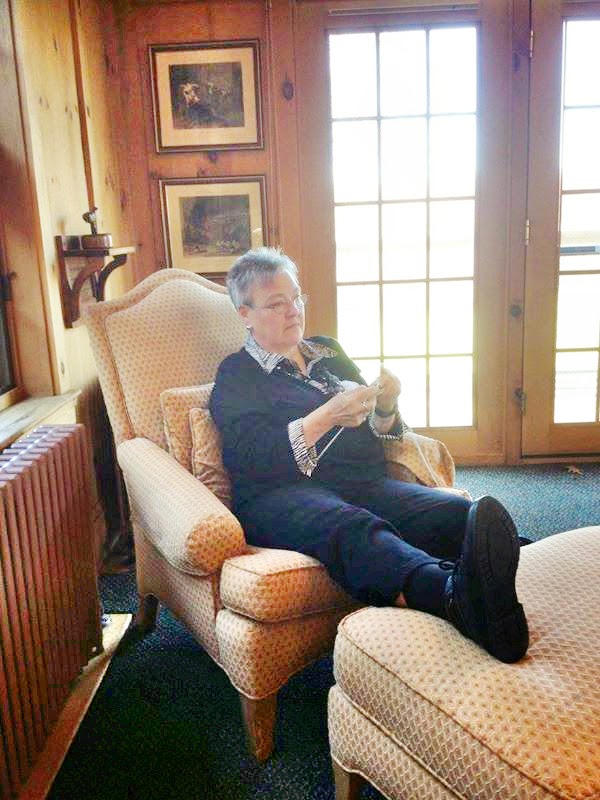
Who is she? A satisfied Republican following last week's
route of the electoral opposition? A smug Packers fan after last night's
gridiron trashing of their arch rivals, da Chicago Bears?
Neither of the above. It's beautiful wife Sandy taking a
break during a retreat titled "Your Life Unplugged" at Yarrow Golf
and Conference Center Michigan 's most scenic
and elegant spots, a great place to spend a few days gaining inspiration and
developing a feeling of satisfaction.
Son Lee's fiancée, Karen Vogelmann, made most of the arrangements
for the retreat. It was a major task, but it paid off . Some 25 ladies loved
it, judging from post-meeting comments. The event was so successful that plans
immediately went into effect for a repeat next year.
This photo by one of her new-found friends suggests Sandy
Subscribe to:
Posts (Atom)