Showing posts with label Armistice Day. Show all posts

Tuesday, November 18, 2014

Santa Takes Back Seat to Vets

Santa Claus arrived in Kalamazoo on Saturday (much too early to suit me and many others) as thousands attended the annual Holiday Parade. The jolly one got lots of appreciative oohs and aahs as he was escorted by 11 marching bands and a variety of floats, but he was not the star of the show in southwestern Michigan last week.

Santa clearly lost the appreciation contest to the U.S. military. Active G.I.s and veterans were showered with gifts starting the weekend before Veterans Day (Tuesday).  Free meals and discounts on all sorts of goods and services continued in some cases right up until Santa grabbed the next weekend spotlight.

November 11 observances have undergone a transformation during my lifetime. Originally,  "Armistice Day'" marked the end of World War I. It was a day of reflection and a time to honor those who gave their lives or were crippled in the conflict.

When I was a youngster, people observed a moment of silence at 11 a.m., when the treaty ending the war was signed. Everyone was encouraged to make a donation to the American Legion Auxiliary in return for a red "remembrance poppy," a paper creation we wore all day in honor of the dead soldiers buried in France. The Legion ladies used poppy donations to benefit disabled veterans or other vets or their families known to be in need. I remember my Dad encouraging me to drop a nickel or dime in the collection can as he explained the significance of the poppies.

Armistice day was important in my family. Dad, his two brothers, and my Mom's brother all served in WWI. One of my uncles came home from France permanently disabled from effects of a gas attack. Another returned with a Croix de Guerre medal awarded by the French government for bravery.
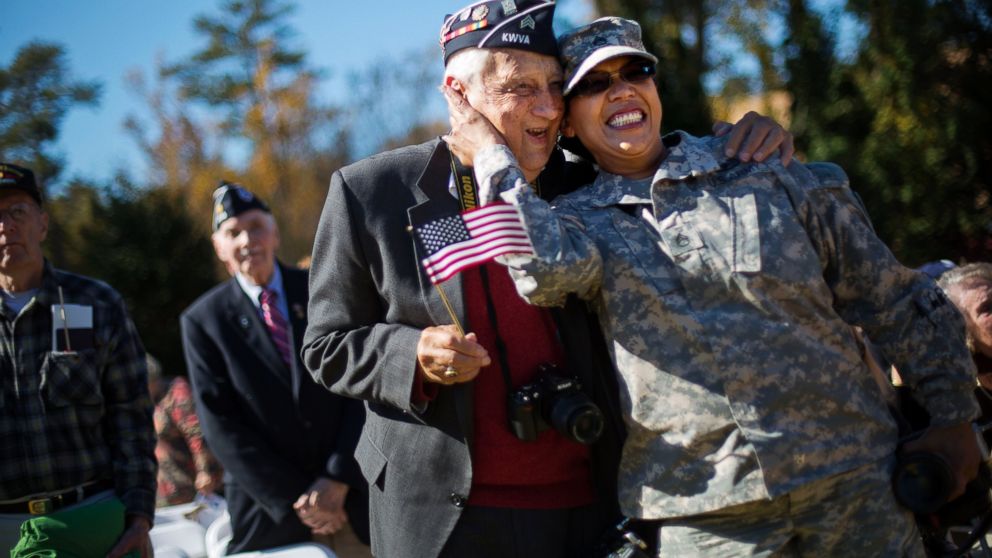
As fewer World War II vets remain alive, they get lots of love. (Associated Press photo)
All died years ago. There are no veterans of World War I  alive today in the U.S. The old Armistice Day customs, however, continue to some extent. Church bells still ring at 11 a.m. on Nov. 11 in a small town near us. Veteran firing squads still launch volleys marking the time. Although I've not seen a remembrance poppy worn for several years, there may be places where they are available.

Wikipedia tells us that remembrance poppies remain common in other nations, especially the UK, and there the day to honor those who gave their lives in battle is titled Remembrance Day. That seems appropriate because the U.S. played a relatively small role in World War I, where trench warfare produced wholesale slaughter.

The U.S. didn't enter the five-year conflict until almost the final year. Casualties totaled 320,000. That seems like a lot, but consider that British Empire dead and wounded totaled more than 3 million and French casualties topped 6 million. Some 37 million people from all participating countries were killed or wounded in the horrific struggle. The U.S. military casualty total was much higher in World War II--more than a million.

During World War II, Armistice Day began to morph into Veterans Day. Informal observances using the new name started in 1947. In 1954, Congress officially recognized Veterans Day, declaring it a national holiday and a time to honor all veterans.

I was discharged from the Army in 1960, and don't recall any wholesale changes in observances until fairly recently. The old Armistice Day traditions simply continued under a new name. Veterans usually were respected, but not always. Many Vietnam War vets complained about shabby treatment when they came home from the killing fields in Indochina.

If anything, recognition and tangible rewards for veterans declined. My brother-in-law and other Korean War vets pointed out that monuments in city squares omitted them. Supposedly, that was because Korea officially was a "police action," not a war. The nation's biggest veterans' organization, the American Legion, refused membership to thousands of veterans of my era, a practice continuing today. An ungrateful government reduced or eliminated some veterans' benefits for us as well. On Veterans Day, a vet might be thanked for service with a fee doughnut or cup of coffee in a few places, but those were about the only tangible gifts from private people that I remember.

Everything seemed to start changing after the 9/11 attacks. Suddenly, those cups of coffee became free meals.  A huge variety of businesses began to offer 10 percent or more price reductions to veterans. Because some hotels and motels gave room discounts, the proverbial "three hots and a cot" provided to active duty G.I.s could once again be enjoyed by veterans. Offering gifts to vets seemed to take on a snowball effect, and it hasn't stopped yet.

I think this Denny's ad deserves an award for salute creativity.

This year lists of free or cut-rate offerings on Nov. 11, and sometimes throughout the week, were easy to find. It was a "take your pick" situation.

I was right there picking. With our continuing home remodeling project far from completion, it was a great time to get needed items available at leading big box stores for 10 percent off. While on the track of some special items, my son and I were near a Denny's restaurant, so I claimed one of my favorite things--a free "build your own breakfast." In the evening after more discount shopping, beautiful wife Sandy and I visited Applebee's where I enjoyed a free steak dinner.

Just for fun, I added up the total value of my Nov. 11 discounts and freebies. The gifts were worth $111.30. And I didn't even have time to get the free haircut or car wash offered by businesses near my home.

By coincidence, my biggest paycheck in the U.S. Army was $111.00 a month. It usually lasted about two weeks. Maybe payback time finally has arrived? Thanks to all the "thankers" who back up their words of gratitude with material gifts. You, too, deserve a salute.

Thursday, November 07, 2013

They, Too, Were Heroes

With Veterans Day approaching, many stories in the media tell us about the actions of heroic military personnel who were crippled or killed facing enemy fire. Some interesting tales are repeated year after year and circulated widely. But others emerge only long after the event when an enterprising historian publishes a previously untold tale.

Lieutenant Charles J. Searl, a World War II pilot, bore a family name familiar to most residents of my hometown of Tomahawk, Wisconsin.  Bronsted-Searl Post 93, American Legion, has been active in veteran’s affairs and community service work since shortly after Armistice Day (now Veterans Day in the U.S.) ended World War I. My father was an active member of the post for more than 40 years. I played baseball for two seasons on a team sponsored by the post. One of my most treasured possessions is a trophy awarded by the Legionnaires for achievements in high school.

Yet all I knew about the post name was that “Bronsted” was killed in World War I , and “Searl” died in World War II.  I knew that because my father told me. I believe some Tomahawk natives with fewer ties to the local American Legion group had no inkling about the origins of the name.

Just a few weeks ago, Lt. Searl’s story appeared on the internet, posted by a Tomahawk resident on Facebook. The Tomahawk Leader carried a similar story this week. The story didn’t originate in Tomahawk, or Wisconsin, or anywhere else in the U.S. An Englishman, Ronald M. Setter, compiled “B-17 ‘Tomahawk Warrior’ A Tribute to Charles J. Searl and Crew.”  Mr. Setter made the story very personal, including ages and home states of all the crew members and some speculation about how they might have spent their off-duty time in the village of Royston, near the airfield where they were based.
Lt. Searl (top row, third from left) and the other crew members with "The Tomahawk Warrior"

Exercising a pilot’s privilege, Lt. Searl named the B-17 heavy bomber he flew after his hometown. “The Tomahawk Warrior,” with its original crew of 10, flew 24 missions to France and Germany, including one on D-Day, after it arrived at the Nuthampstead airbase in March 1944. On August 12, the plane took off for the 25th mission, one it did not complete.

A 25th mission might convey the idea to some that the crew of “The Tomahawk Warrior” would be safe permanently when they returned, but that probably was not the case, and Mr. Setter does not make that claim. American bomber crews suffered horrendous losses early in their participation in mainland European bombing raids. During the first three months (1941) the typical crew completed only 8 to 12 missions before their plane was shot down or disabled.

Apparently to boost flyer morale, the Eighth U.S. Army Air Force decreed that finishing 25 missions in a heavy bomber constituted a “completed tour of duty” and the crew could stand down. I know that happened sometimes, because a Tomahawk resident who lived on our street was sent back to state-side duty after his bomber safely completed 25 missions. However, histories tell us the “25 mission rule” was extended to 30, 35, or more depending on circumstances. By the time “The Tomahawk Warrior” arrived fairly late in the aerial campaign, fighter plane cover was much improved and German resistance was diminished. So, claiming that the “Warrior” crew might have been on its last mission on August 12 would add drama to the story, but probably would not be true.

On Saturday, August 12, 1944, without one crew member who was left behind for unknown reasons, “The Tomahawk Warrior” took off for a bombing run to Versailles, France. Less than an hour later one engine caught fire, and Searl turned over the town of High Wycombe to return to base. Another engine was observed to be on fire.

Mr. Setter wrote, “It has always been accepted that the pilot was trying to find open ground to attempt a landing when he had no chance of reaching his base or even Bovingdon airfield, which was only ten miles away to the north. He would have seen the populated area he was flying over and realized the devastation the plane would cause if it crashed there. It skimmed over the farmhouse of Lude Farm and crashed into open fields opposite. ‘Tomahawk Warrior’ and its crew of nine young men ended life in a massive explosion and fire. No one had bailed out of the stricken plane and no distress signal was ever traced. They stayed together, comrades now for all eternity. . . A short entry in official records at their base read: Takeoff 0618 hours, 0720 no return.”

To my knowledge, no special ceremonies have been held in the U.S. to mark the end of “The Tomahawk Warrior” and its crew. However, the remarkable part of their story is that the Brits in the area (Penn) have never forgotten.

Each Armistice Day, a special service at Penn Church honors the American flyers. Their names are read along with men from the village who gave their lives. Usually, “The Battle Hymn of the Republic” is sung during the service. Small American flags, each with the name of a crew member, are placed with British flags along the path to the church door. The Book of Remembrance in Penn Church has the American as well as the British military names inscribed in memory of their sacrifice.
At Penn Church, the crew of "The Tomahawk Warrior" are not forgotten

Mr. Setter concludes his story: “To all who read this tribute, remember . . . they gave their lives just as bravely and in sacrifice for peace, just as those who were lost on and over the battlefields of Europe.”

Charles J. Searl, age 23, left behind a wife and two small daughters. None of the other crew members was married. Their ages ranged from 20 to 27.