Showing posts with label Boise National Forest. Show all posts

Wednesday, April 23, 2014

Good People Make Good Places

While I was trying to decide what I wanted to be when I grew up, a process still under way, our son had little choice but to come along on the trip. It was quite a journey. We lived in eight different cities while Lee was growing up.

Lee proved there may be truth to the currently overused pronouncement: "What doesn't kill you makes you stronger."

No doubt it was difficult for Lee to periodically leave good friends and adjust to a new community and school. I've often regretted causing those problems for him. But I think he became a man of integrity and honor who has been able to adapt to difficult situations partly because of his diverse experiences. The nature of two communities we lived in may have contributed positively to his development.

Forbes latest list of the top 10 best places to raise a family in the U.S. includes two cities where we have lived. Forbes ranked metro areas based on household incomes, costs of living, housing affordability, home ownership, commuting times, crime rates, and local school quality. Lee attended school and participated in organized sports in two of the top 10--Boise, Idaho, and Ogden, Utah.
 
Ogden, Utah, is a great place to live in any season.
Ogden was No. 3 in the rankings. It has one of the lowest crime rates in the country, an excellent spread between incomes and living costs, and great access to outdoor activities. Lee learned to ski nearby; a trip to the mountain slopes was just a few miles from our first home there adjacent to a Wasatch-Cache National Forest boundary. Lee made school friends in Ogden with whom he still stays in touch.

Boise ranked as the seventh best place for families on the Forbes list. Boiseans also enjoy a good income to cost of living ratio and great opportunities for outdoor lifestyles. School quality rated high and the crime rate is low. Several of Lee's early school years were spent in Boise.
 
Boise, Idaho, has a State Capitol and much more to recommend it.
Lee, Sandy, and I conferred today about characteristics of the places we've lived. We agreed the Forbes people got it right with Ogden and Boise. But, because it would be almost impossible to quantify, the raters didn't consider the factor we believe was most important. We all thought the people in those two cities generally were pleasant, thoughtful, and helpful. For us, good people made Ogden and Boise good places to live.

This might lead you to think I was pretty smart about picking places to apply for jobs. Not so.

We had never set foot in Idaho before moving to Boise. The only individual consulted was my sister, who knew a little about the city because her husband worked for Boise-Cascade and they had visited company headquarters a few times. The endorsement was lukewarm at best. Jane's final statement was, "I suppose its OK if you like sagebrush." We made the change simply because it was time for me to move on.

We moved to Ogden strictly to get a Forest Service promotion and the improved income that came with it. Most of the comments I heard before the move were negative, but that was because my boss (who had lived in Ogden earlier) mounted a campaign to convince me not to leave Idaho. Some of it was absurd.

The most imaginative, and least convincing, statement by Boise National Forest Supervisor Ed Maw was, "Those Mormons will steal your horse; then they'll steal your wife."

Well, I didn't own a horse, and Sandy has stayed on as my beautiful wife to this day. We didn't find a lot of bad guys in Utah. What we did find in Ogden, just as we did in Boise, were good neighbors and friends.

Monday, May 27, 2013

Mysteries Great and Small

This Sunday the Rev. Jill McAllister, minister at People’s Church in Kalamazoo, did what I thought was an outstanding job of addressing “The Great Mystery”—who are we, where did we come from, and what is the meaning of life?  Several times, she quoted statements by Forrest Church, a leading Unitarian-Universalist minister, author, and theologian.

Those references set me thinking about one of the minor mysteries in my life—did I or did I not, meet Forrest Church back in 1974?  I pondered the question briefly six years ago while writing a passage in 
Forrest's father, Sen. Frank Church (Wikipedia)
my memoir, “Days with the Dads: Recollections of a Small-Time Journalist.” Included was a story about encounters with the Church family. One was a fairly lengthy conversation with Forrest’s parents. Years later, beautiful wife Sandy and I stayed several nights in the Church family home in BoiseID after it had been converted to a bed and breakfast.

Because my memory of the first encounter with the Churches was more concerned with a personal lesson in humility than precisely who all the characters in the story were, I spent no time researching the identity of the young man who was present. Here is an excerpt from the story in my book:

“Merely spotting or exchanging only a few words with a famous person is, of course, nothing like spending a little time talking with one. I've had only a handful of those opportunities. One momentarily inflated my ego, but then quickly took the excess wind out of my young sails.

“In 1974 (while serving as Public Information Officer for the Boise National Forest), I was directed to drive over to the Sawtooth National Forest from my duty station in Boise, hook up with my boss at Redfish Lake, and then attend a meeting with some other people at the lodge on the lakeshore. My boss was Forest Supervisor Ed Maw, a man with many years of service in Idaho and other places in the Intermountain West.

“I got there early, and was the only person around as I stood outside the lodge having a smoke and waiting for Maw. Out of the lodge came a handsome man dressed in western-style clothes. A lovely woman and a young man accompanied him. They came directly to me (I was in uniform), and started a conversation about what my job was, why I was there, and what my thoughts were about some of the National Forest management issues of the time . . . .

“The whole situation put me on cloud nine. Here was little old me exchanging chit chat with members of one of the most prominent families in the state, and Senator Frank Church was among the best-known politicians in the country. He served in the U.S. Senate for 24 years, leading many national initiatives. He was a prominent contender for the Democratic Party’s presidential nomination in 1976, losing out to Jimmy Carter. His wife Bethine, the lady in our little discussion group that day, was the daughter of a former Idaho governor and was engaged in many high-profile activities of her own.

“By the time Maw approached us, I was pretty pumped up about the prospect of introducing my boss to my famous newfound friends. It didn’t happen. Senator Church stuck out his hand and said, ‘Hi, ya, Eddie.’ He and my boss were well acquainted. I was treated to a good dose of instant humility.”

About 30 years later, I read “The Jefferson Bible,” a document the famous president spent years assembling. Forrest Church wrote a lengthy introduction to the work. That caused me to wonder if the young man I met at Redfish Lake was Forrest. I started doing some research to determine that, but other matters intervened and I never got back to it.

Rev. McAllister’s sermon on Sunday caused me to wonder once again. This time, I checked some dates. The research proved conclusively that I could not have met Forrest Church that day in 1974 at Redfish Lake. He would have been quite a few years older than the lad I talked with. It must have been his younger brother, Chase, who Wikipedia tells us still lives in Boise. Forrest Church died at age 61 in 2009.

Although I’m slightly disappointed at learning I cannot claim a personal encounter with the famous cleric, it is always a pleasure to ponder some of the inspirational words he left behind.
   

Thursday, March 07, 2013

A Nominee for Best Film Line


The geezer rarely watches a movie simply because so few have been produced lately that are worth devoting a couple of hours to. Yet it seems while the number of good shows is declining the number of awards film folk bestow on each other is increasing.

It had good lines
So many Oscar winners were named at this year’s Academy Awards that there wasn’t time to allow many recipients to get to the podium to thank their mothers and anyone else they could think of for guiding them to the top of whatever their work is. It’s getting embarrassing. Nevertheless, the Academy is missing an important category.

Every now and then, a memorable line is spoken by one of the pretty people on the silver screen. Remember Rhett Butler telling Scarlett how much he cared? Or, Rick advising Sam to play it?  Such statements should rate a special award for the writer who produced a concise bit of unforgettable prose.

The best statement I’ve heard in the past several years came from a not-so-pretty, but pretty funny, little guy who was operating “The Best Exotic Marigold Hotel.” Sonny Kapoor said:

“Everything will be all right in the end. So if it is not all right, it is not yet the end.”

Hard to top that one. It’s the ultimate optimism. Think of all the times Sonny’s advice could provide welcome reassurance to someone who needs it during your day-to-day activities.

Although the thoughts have nothing in common, for some strange reason, Sonny’s statement reminded me of a saying common in the Forest Service during my working days at the Boise National Forest some 40 years ago:

“If you don’t know where you’re going, any road will take you there.”


Thursday, June 07, 2012

Where're You From, Mac?

Nobody likes being an outsider.  But if you’ve relocated a time or two, you’ve had no choice but to be “the new kid on the block.”  In some places, acceptance of newcomers is a lengthy process. You could be a new kid for a very long time, especially in a small town.

During a dinner conversation at our home in northern Wisconsin when I was a teenager, my mother several times referred to “that man from Illinois” in a discussion of a happening across the street from our house.  We weren’t sure who she was talking about. A clarification revealed that the “man from Illinois” had owned his home in our neighborhood for 26 years!

I’ve only been an outsider in one place where a native enjoyed identifying and embarrassing newcomers. My first job outside Wisconsin (except for Army duty) was an assignment as the Public Information Officer for the Boise National Forest.  One of the duties was participating in team teaching at environmental education workshops. The Idaho Fish and Game Department always had one or two representatives on the team.

It was obvious that one of the F&G men, a native Idahoan, was not overly fond of U.S. Forest Service personnel, nor was he delighted to be working with National Park Service people who sometimes were team members.  At that time, pay for the federal natural resource people was considerably better than that of state personnel. The federal agencies didn’t employ many wildlife biologists, so state wildlife specialists had a difficult time moving to the Forest Service, Park Service, Bureau of Land Management, or Fish and Wildlife Service as a way of gaining a heftier paycheck. 

In addition to resentment about pay disparities, there sometimes was an undercurrent of native-newcomer tension.  The majority of Idaho Fish and Game employees at all levels were born and raised in the state, or at least were long-time residents.  Most professional federal agency people had transferred to Idaho from other locations. 

The state man liked to make it clear he was a native son.  He did that at least once during every environmental education workshop by suggesting we all stand and sing the state song: “Here We Have Idaho.”  He, of course, rendered every word loudly and correctly.  Most of the rest of us muttered along as many have while trying to mouth an unfamiliar hymn in church.  The F&G man made a point of staring at me a time or two as I stood there pretending to sing the state song.

I actually tried to learn “Here We Have Idaho” just to thwart him.  The tune consists of two short verses and a chorus. It should have been easy, but I never got the hang of it.  That wasn’t surprising.  How many Americans know the words to any state song?

“On Wisconsin!” should be a snap for me.  The tune doubles as the university’s football fight song and the state anthem.  After years of hearing both, I can negotiate the football version pretty well, but can’t get past the first line of the lyrics honoring the state.

Apparently destined to forever flunk the Idaho anthem test, I strongly suggested to the song leader that he drop the whole hidden-agenda affair.  “You know damn well there aren’t two of every ten people you con into this who know the words, whether they spent their whole lives here or not,” I said. “You’re just embarrassing everybody.”

He finally agreed to suspend the musical salutes to the Gem State. “I know how to show you flatlanders up, anyway,” he said.  “I just get you talking about the Idaho Panhandle.  As soon as you say you like that big lake near Sandpoint, ‘Lake Pend Orioles,’ I gotcha.”

Hard to bluff your way through that test.  Any worthy Idahoan knows Pend Oreille, the state’s largest lake, is pronounced “pond-o-ray.” Seldom does a newcomer get that one right, perhaps with the exception of a French immigrant.

Other states we’ve spent some time in have place names designed to baffle a neophyte. On the way from our long-time home in Ogden, Utah, for a little recreation in the nearest Nevada gambling houses, we drove through Tooele County.  Telling locals you had traversed “Toolee County” brought big guffaws every time.  After several years as Utah residents, we became experts at announcing we had just returned from a trip through “Twilla County.”  We had become old settlers.

Indian names can be especially tricky.  Many acres in far northern Wisconsin are included in the Chequamegan National Forest.  “Shewameegun” rolls right off the tongues of people from my hometown and environs.  How would you say it?
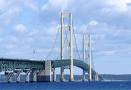
The "Big Mac" truly is AWEsome.
Here in our adopted State of Michigan, a designation based on Indian words probably holds the record among U.S. geographic names mispronounced most frequently. Much of the fun started in 1957 with completion of the Mackinac Bridge linking the state’s upper and lower peninsulas.  At the time, the bridge was the longest two-tower suspension span in the world, so it got lots of attention.

Many tourists said they’d crossed the “Straits of Mackinack” on the “Mackinack Bridge,” and they still do. Actually, the newcomers traversed a bridge over waters whose name ends in “awe,” not “ack.”

The endings of most names in the area that look like "ack" are pronounced "awe." That holds for the bridge, the straits, and Mackinac Island, plus Fort Michilimackinac.  But just to confuse things, Mackinaw City sounds just like it looks.  And, to add more fun, some Michiganders refer to the famous “awe” bridge as “Big Mac.”

A little off the point is the fact that many long-suffering winter residents of both northern Wisconsin and Michigan wear sturdy overcoats known as “mackinaws.”  But that can be a help.  Think of big coats and you have a key to remembering the proper name of the big bridge and associated heart-warming stuff.

Much more could be written on this topic, but beautiful wife Sandy is telling me it’s time to start on our day trip to Dowagiac.  Folks, I haven’t a clue about how to say that.  Some local surely will be delighted to tell me after a guffaw following my feeble attempt to say I’m enjoying my first visit to D…..something or other.

Don’t look it up.  I did it for you.  Dowagiac (Doe-WAH-jack) is an Indian name meaning foraging ground.  Don’t damn those Indians; a legacy of unpronounceable names is just a reasonable bit of revenge for past war crimes against the tribes.

Thursday, December 08, 2011

Get the Real Deal

Some folks continue to assume that real Christmas trees are removed from forested areas, thus doing damage to the natural environment.  That simply is not true today. It probably seldom was true in recent history.

Back when I worked on the staff of the Boise National Forest, our District Rangers  issued a few permits for local residents to cut one tree about this time of year.  The charge usually was a dollar.  With the permit came instructions about where to harvest the tree so the forest would be improved in the long run.  Our Idaho City Ranger District was the only one to have a big program.

Near Idaho City several large burned areas had been reforested with ponderosa pines native to the sites.  Tree plantings can have a high percentage of failure in that part of the country if seedlings are mishandled or low rainfall prevails during the first few growing seasons when the little trees struggle to get established.  To counteract climate problems, foresters directed seedlings be planted quite close together, assuming there was a pretty good chance nature would thin the stands. 

Growing conditions at the Idaho City sites apparently were well above average.  As the trees got to be three to eight feet tall, they severely crowded each other and growth was slowed. So for a number of years the Idaho City foresters tagged trees for removal and invited the public out to select and cut a family Christmas tree.  Remaining trees grew more vigorously, the families had a ball, and taxpayer dollars were conserved because there was no need to hire crews to thin the stands.

The Idaho City program ended the year after I left for another job. Idaho City had a population of only 80, and thus most people had to travel some distance, usually from Boise, to get to the cutting sites. Despite that, the public response to the annual invitation for a family Christmas tree outing had been so good there simply was no further need to thin the plantations.  That was several decades ago, and I’ve not heard of any large-scale Christmas tree cutting in a National Forest or other forested area since then.

Lee and Karen with their selection at Peterson's nursery
Today, trees come from some 15,000 farms spread through all 50 states.  Michigan, where we cut our tree every year, ranks third among tree-growing states behind Oregon and North Carolina.  We are told the growers plant three trees for every one removed. Our experience supports that.  When we cut our tree at Peterson’s Riverview Nursery each year, we must be careful not to step on the new little seedlings as we move our prize to a loading area. 

Peterson’s is no rinky-dink operation.  Trailers pulled by tractors deliver customers to large cutting areas and return them and their trees to a processing site near the office.  Crews there put your tree in a shaking machine to remove foreign matter. They drill holes in the base to help you with mounting and also facilitate moisture movement into the tree after you have it in a stand at home. Workers will trim branches to your specifications. Then another machine ties the branches to form a neat bundle, and the men carry your tree to your vehicle.

It sounds like a big operation, and in some respects it is (this year Peterson’s shipped more than 6,000 wreaths in what is just one part of the business).  However, like most tree nurseries, this is no huge corporation run by overpaid executives who never dirty their hands with production work. Jerry and Anne Peterson started the business 18 years ago.  They and son Josh, now a co-owner, work in the fields and production and sales areas year round. The firm has six to 25 employees, depending on the season.

Every time we’ve gone to buy a tree we had an opportunity to chit-chat a bit with Jerry, Anne, and Josh.  They are local people.  Their nursery is only a few miles from our home in the same county.  It is nice to know payroll dollars and profits are returned to our area.

American tree farmers like the Petersons collectively sell 30 million Christmas trees annually.  The total has declined by about 3 million in the past 10 years.  The chief reason is the growing popularity of artificial Christmas trees.  No doubt some people have good reasons to buy the plastic trees, but enhancing the environment is not one of them.  Following are several reasons why buying a natural tree is a good deal.  Thanks to the Nature Conservancy for some of them:

1. Tree farming protects precious open space, keeping fairly large areas of land free from urban development.

2. More than 80 percent of artificial trees sold in the U.S. are manufactured in China.  They are made from vinyl plastics based on petroleum that require large amounts of carbon-producing energy in their manufacture. Vinyl plastics are among the most difficult to recycle.  When they can be, the reprocessing again requires large amounts of energy. Ships transporting the plastic trees across the Pacific burn big quantities of diesel fuel, emitting more air pollutants.

3. Natural trees, especially young, vigorous ones, purify the air we breathe by taking in carbon dioxide and giving off oxygen.  

4. After use, natural trees are easily recycled as mulch using simple chipping equipment, and the mulch improves soils as it breaks down.  About 4,000 communities in the U.S. have Christmas tree recycling programs.

5. Natural trees add a pleasant aroma to your home during the holidays.  Plastic trees, of course, cannot do this.

6. Selecting your tree at a lot, or cutting one at a nursery if you prefer, is a lot more fun than picking up a boxed plastic model at Walmart.  Son Lee and his fiancée Karen radiate pleasure with their find at Peterson’s nursery in the photo with this post.  So can you when you find and bring home the real thing.

Thursday, February 03, 2011

May the Ranchers Be With You


One of the things we like about our new home is the way Michigan state and local governments have provided connections with recycling systems.


Most of our household trash is picked up monthly at the curb by a private contractor hired by our township who separates plastics, glass, and paper for processing. State law makes it possible for cans and bottles of many types to be returned to major supermarkets at any time for a refund of the 5 cents each that we pay when we buy the originals.


Where we previously lived in Utah, aluminum drink cans were the only items readily recyclable. We saved them in big bags in the garage for a couple of months, and then had to make a 12-mile roundtrip to a junkyard in a shabby part of Ogden to collect five or six dollars. We did that, not because we were hard up for five bucks, but because we were strong believers in the benefits to society of recycling. Lots of people didn’t bother.


Enthusiasm for new large-scale recycling programs surged throughout the country in the early 1970s as the environmental movement began to flower. The new activists no longer were satisfied with supporting an occasional paper drive by the Boy Scouts or our traditional reliance on random trips to junk dealers who bought scrap metal.


I was the Public Information Officer for the Boise National Forest in Idaho in 1972. The Forest Supervisor was designated as the liaison between the U. S. Forest Service and the state legislature. One of my duties was to help with the legislative tasks.


Up popped a bill in the legislature to require food markets to pay five cents for every metal can turned in to them. At the time, most cans sold in Idaho were steel, not aluminum, and the economics of reusing can metal were not good. An association of can manufacturers and several large grocery chains announced their firm opposition to the “five cent bill.”


One legislator and two prominent environmentalists asked us to testify in favor of the bill. We had to get approval from the Regional Forester to give testimony on a state matter. We asked for approval. A denial came quickly. Regional Office staffers said although we had littering problems on National Forest land, it was a minor concern compared to other issues. They did not want us to appear to be interfering in a state matter by pushing a recycling bill in what was a very conservative state.


Dick Stauber, our Recreation and Lands staff officer, wanted to support the bill. So did I. Stauber was a stickler about keeping our facilities and adjacent lands in good condition, and he thought anything that would reduce litter was worthy of endorsement. I thought supporting the bill would give us some needed support from local environmentalists.


As good civil servants often do, we found a way to game the system. Stauber volunteered to testify, and we had a little strategy meeting with Supervisor Ed Maw. Maw grew up in Idaho and had many contacts in our area. He was well aware that environmental groups were relatively weak, and commodity groups were powerful. He also knew ignoring Regional Office people generally was not a good idea. He reluctantly agreed to let Stauber go ahead. Maw told me to accompany him to the hearing. I got the feeling he wanted me there to take the blame if something went badly wrong.


The hearing room was crowded. Opponents of the bill spoke first. Maw was fidgeting around nervously in the chair next to me. Then, a few supporters spoke before Stauber was called. His opening words were:


“I’m Richard Stauber, Recreation and Lands Staff Officer for the Boise National Forest, U.S. Forest Service. I’m testifying in favor of this bill as President of the Boise Chapter of the Society of American Foresters.”

Who could argue with that? He didn’t really claim to represent the Forest Service. I wondered later if he actually asked any SAF members what they thought about the bill. He indeed was the local chapter president that year, so maybe he felt he didn’t have to.


A few minutes later the hearing ended. Maw had stopped fidgeting and had a little smile on his face.


I said, “Stauber did a nice job, don’t you think.”


Maw said, “Yeah, but that didn’t matter much. As soon as I heard that guy from the Cattlemen’s Association support the bill, I knew we were in good shape.”

Unfortunately, our trickery didn’t carry the day. The bill died in committee. But we did come away with a few new friends, and no new enemies.

Thursday, February 04, 2010

More to the Story

Just when you think you’ve said it all on a topic, up pops a new angle on an old story.

I thought a tale in Days with the Dads, my memoir, included every detail of the connection between Jerry Kramer, a five-time All-Pro with the Green Bay Packers in the 60s, and our son and me. It did. At least, it included everything I knew about that when the book was published late last year.

I was mystified, and frankly a bit miffed, about Kramer’s lack of interest in talking with me while we were seated next to each other for an hour or more in the Chicago airport. After all, I had told him I was a long-time Packers fan and admired his play. Only recently did I stumble onto a fact that would have guaranteed some Klade-Kramer conversation.

Sandy and I were visiting one of our local library’s periodic discount book sales. Sandy usually fills a couple of bags with titles to support her two to three book a week reading habit. I usually fill one hand with two or three titles. This time, I found more. One was a well-worn copy of Jerry Kramer’s Farewell to Football, published in 1969. I’d never heard of the book, and assumed he authored only two—Instant Replay and Distant Replay.

When we got home, I casually flipped Kramer’s book open, and read a few lines. One jumped right out at me. “I’d just pledged Sigma Nu,” Kramer said on page 106. That was at the University of Idaho. That was the same year I pledged Sigma Nu at the University of Wisconsin. Lo and behold, our family football hero and I were fraternity brothers! I just didn’t know it when we met at O’Hare.

Kramer’s Farewell book has a lot of personal information. He includes several descriptions of Sigma Nu happenings on the Moscow campus. He gives “clowning around” with buddies, including fraternity brothers, as one reason for his lackluster academic work. Kramer finished nearly four years at Idaho as a football and track all-star, but without a degree.

The Sigma Nu chapter at Idaho was known to be strong during the time I worked in the state and nearby in Utah. Its members included plenty of academic achievers, and a number of men who went on to become leaders after graduation. I met several who were successful businessmen in Boise. Throughout the 1980s, both U.S. Senators from Idaho—Republicans Steve Symms and Jim McClure--were Sigma Nus. I met one of them.

I did not meet McClure, but as far as I know, he served with distinction during his 18 years in the Senate. He was said to be strongly influenced by the mining industry, which did not always gladden the hearts of those of us interested in sound forest management. But mining was important in Idaho, and McClure was up front about his political positions. I saw no reason not to respect him.

Symms was another story. When we met in Boise in 1973, I was performing one of those low-level duties that sometimes fell to information officers. Wearing my uniform, I was working at a booth at the Idaho State Fair, answering questions about the National Forests and handing out maps and brochures. Symms had a booth almost directly across the aisle where he was promoting his candidacy for Congress.

The Symms family ran a large orchard and fruit processing business west of Boise. His campaign slogan was, “Let’s Upset the Applecart.” He was running hard against the status quo in Washington and what he saw as excessive governmental control on every level (sound familiar?). He and his supporters said some pretty nasty things about federal and state employees during that first campaign.

When the lunch hour provided a lull in booth visitors, Symms strode over to me. He offered a friendly smile and a firm handshake. “You’ve probably heard some of my comments about feds,” he said. “You know, of course, I don’t mean you Forest Service guys. You do a great job.”

I said, “Sure, we know you’re not talking about us.” By that time in my career, I had met enough politicians to not be surprised by enthusiastic insincerity. And I knew he probably was not surprised by my insincere response.

Symms won the election and went on to serve four terms in the House and two in the Senate. If he was distinguished by anything, it was as an accomplished philanderer. Rumors flew about his romantic adventures in Washington. Idaho journalists were said to know about several, but, as they did in those days, they kept his personal life out of their reports. However, when Symms’ long-suffering wife sued for divorce she put his alleged extra-marital activities on the public record. The media carried the stories, and Symms declined to run for another term, perhaps thinking his behavior would not be appreciated by voters in a conservative state.

I saw Symms once more after our Boise encounter. He passed within several feet of me as he rushed down a busy hallway in the Capitol Building in Washington. I was there as part of a legislative training course. I called out, “Hello, Steve.”

He responded with a big wave, and a hearty, “Well hi, great to see you,” as he continued on his way. He made it sound as though he remembered me well. I didn’t believe it for a minute.

So what does all that prove? Fraternity brothers, especially those from other chapters, certainly are not equivalent to birth brothers. However, they have one thing in common. Whether you respect them, admire them, choose to ignore them, or dislike them and their activities, they are yours forever.