Showing posts with label Kalamazoo. Show all posts

Thursday, August 01, 2013

The Art of Friendship--Numazu and Kalamazoo

You can fly from Detroit Metro to almost any major airport in the world in a single day, although sitting for 14 or 15 hours on a direct flight can make it feel like a very long day. Nowadays, it usually takes much more time to plan a trip overseas than to actually make the journey.

Our son Lee’s recent Japanese adventure took a lot longer to develop than most. Its genesis was a casual conversation four years ago between his mother, Sandy, and a fellow shopper in a Kalamazoo store. As proud parents often do, Sandy found an opportunity to mention that her son was a stained glass artist who produces beautiful creations.

Unknown to Sandy, the lady she chatted with was connected to the Kalamazoo-Numazu Sister City Committee. Committee members make a cultural exchange trip to Japan in odd-numbered years to stay with Numazu citizens and serve as hosts to sister city friends in even-numbered years.

Lee putting finishing touches on the gift from Kalamazoo to Numazu
Committee planners soon contacted Lee about the possibility of getting an original stained glass piece from him. Two years later, several representatives visited Lee’s studio near Plainwell. They needed something special to mark the 50th anniversary of the sister city association. They requested and approved a preliminary drawing. A few months ago, Lee was commissioned to create the work of art that would be carried to Numazu as the official gift from the City of Kalamazoo to recognize the long-time friendship.

Lee’s creation features two symbolic birds—a Japanese Crane and a Cardinal representing the U.S.—holding a banner proclaiming “Understanding, Friendship, Kalamazoo-Numazu 1963-2013.” The biggest part of his compensation was an all-expense-paid trip to Japan as part of the 41-person American delegation visiting their sister city. Lee gave a brief speech at an evening banquet where his work was presented to the Mayor of Numazu.  By all accounts, the mayor and the other Japanese friends loved the gift.
A banner at the Numazu City Hall entrance greeted the Kalamazoo delegation

Lee stayed with a Japanese couple in their home for eight days. Much of his time was spent on organized tours with the visiting group of area sites that represented ancient and modern Japanese activities. However, during times reserved for host family-visitor interactions, Lee’s “house father” and “house mother” liked to just stay in their home and talk. Lee said those discussions were highlights of his visit. The fact that his house mother is an English teacher was a big plus.

Lee found he liked traditional Japanese food, which in some cases surprised his hosts. They also were amazed to discover he was proficient with chopsticks. He acquired that skill years ago when his mother and I often took him to Asian restaurants in the U.S. As a little boy, Lee developed an exceptional ability to eat with chopsticks, much more advanced than ours.
Lee went traditional at a cultural fair sponsored by the Japanese committee


Lee had to cut his visit short because of a commitment to display his art at a show in Michigan. His house father provided a final kindness. The trip to the Tokyo area’s Narita Airport by train involved two transfers, a very difficult situation for a tourist who spoke no Japanese. The house father escorted Lee all the way. Although they got lost for a time in one of the world’s busiest airports, the host found the correct departure point. In parting, he offered a final bit of house fatherly advice: “Go home and continue to produce beautiful art.”

Thanks to the house father’s train route navigation talents and his quick thinking in the airport, Lee got on the plane just in time. His art will stay in Numazu, however, on permanent display in the city’s Cultural Center.

Lee’s creations now are owned by discerning people in Japan, Australia, Italy, and Germany as well as many states in the U.S.  If you want to take a look at representative pieces of his work, the easiest way is a quick visit to www.kladewerks.com. Enjoy.

Friday, July 13, 2012

Tri-Motor Adventures

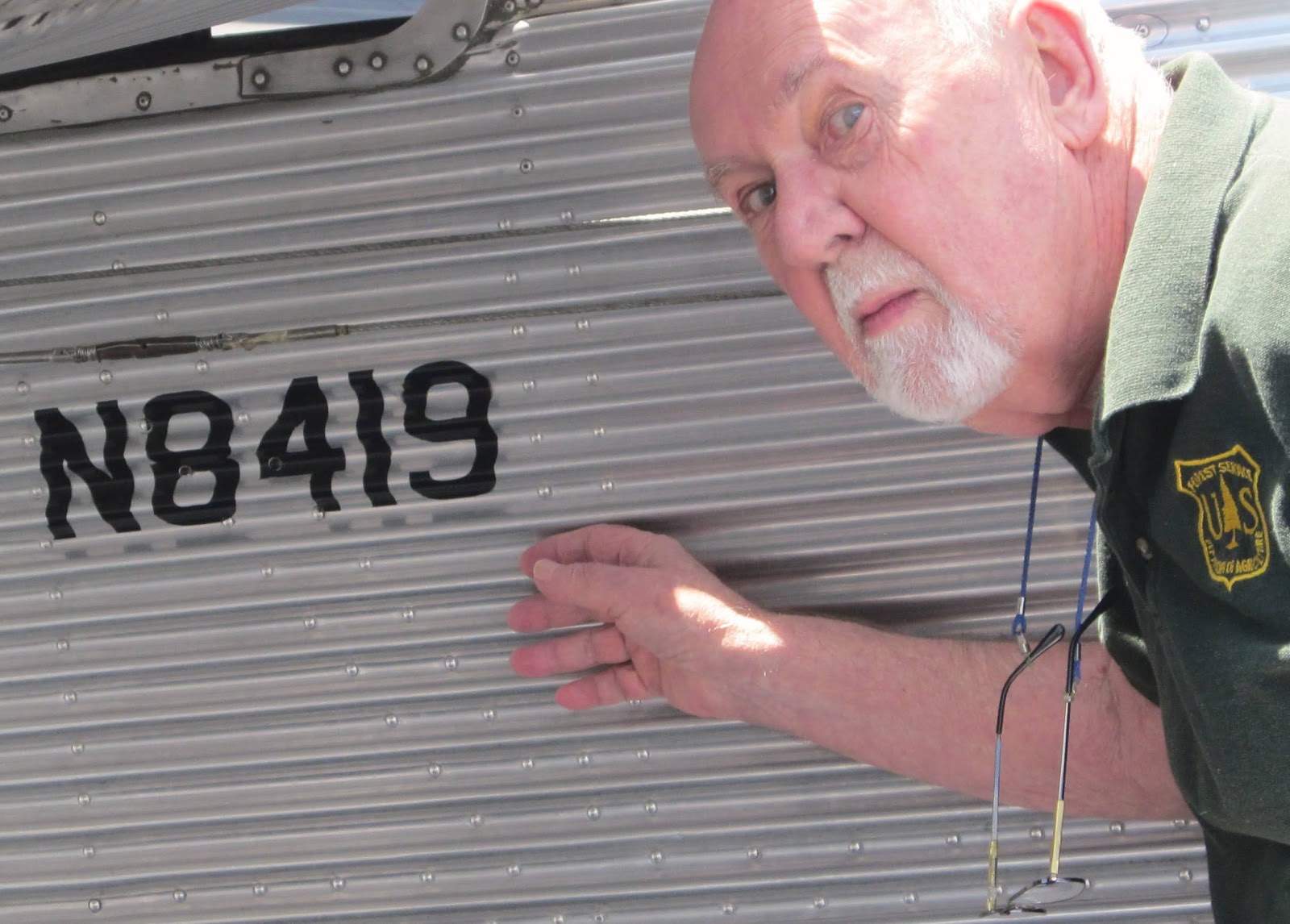
The tail tag confirmed our plane was N8419
When pilot Cody Welch activated the starter for the nose engine of the 1929 Ford Tri-motor at the start of our flight this week at Air Zoo, it reminded me of the rasping sound of the starter used to get my first automobile going.  Coincidentally, that first car was a 1929 Model A Ford.

The two Ford products manufactured in the same year had some other similarities.  Both featured relatively simple systems that were quite easy to repair, both were somewhat boxy, solidly built, rugged machines, and both had received numerous updates by the time I got involved with them.  The differences were perhaps equally important.   

My old Model A chugged along, coughed often, and stalled occasionally due to neglected maintenance and the poor driving skills of the inexperienced owner.  After Welch started the left Tri-motor engine and then the right, and allowed plenty of warm up time, the three Pratt and Whitney engines operated smoothly. Throughout our half-hour flight from Kalamazoo-Battle Creek Airport the N 8419 engines performed like machinery guided by an expert and cared for by dedicated mechanics.

Welch easily fits in the expert category.  When he welcomed the 10 passengers after all were aboard, I asked, “How many times have you done this?” The answer was “5,000.”
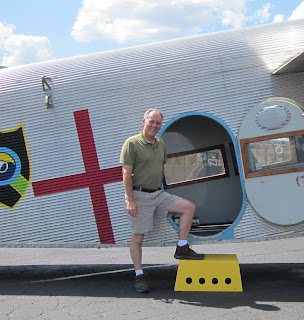
Lee Klade learned walks in boarding bridges aren't needed to enter a tri-motor--just duck your head and step right in
After we landed, Welch and our co-pilot graciously stayed beside the plane talking with son Lee and me until just minutes before their next flight.  Welch knew a lot about tri-motors generally, and N8419 specifically.

Mechanics gave N8419 lots of TLC during recent years.  After 10 years of carrying passengers at Air Zoo, corrosion problems caused the plane to be grounded.  During a long-running reconstruction project the aircraft was literally taken apart and reassembled with many new or improved parts.  Work was performed in an Air Zoo hangar and at a facility in Alma, Michigan.

You can get an insider’s look at the tri-motor by visiting www.n8419.blogspot.com
There a mechanic who worked on the reconstruction project has posted photos of various stages in the process and added his comments. As a bonus, you can watch a video of the first flight of the “new” N8419 in 2009 and see how the cockpit and passenger area look today. A mechanic who calls the machine he is working on “the old sweetheart” obviously is dedicated to quality work.

In addition to a lot of updated components, N8419 has a new role. It is owned by Air Zoo, but is not a permanent resident. It is leased to the Experimental Aircraft Association, a large organization of aviation enthusiasts based in Oshkosh, Wisconsin.  Like other historic aircraft maintained by EAA, the tri-motor appears at air shows and also travels to selected sites to offer rides.  So far this year, N8419 has flown in Wisconsin, Ohio, and Michigan. It will be available for rides again at Air Zoo for several days in August.

At a pre-boarding briefing an Air Zoo volunteer told us we could expect our ride to be fairly noisy and just a little bit bumpy. With a broad grin, he said, “We don’t provide air conditioning, but you won’t need it, anyway.”

Our host then said, “Every seat has its own window and every one is an aisle seat, so you won’t have anything to argue about. Just take a seat.” This and his earlier statements proved to be correct. His last statement was a bit of an exaggeration: “You’ll fly low and get great views of the area. If the plane goes over your house and your neighbor is cooking out, you’ll be able to tell if he’s grilling hotdogs or hamburgers.”

The noise level increased as we accelerated down the runway. We gained altitude quickly after lift off, something tri-motors are good at. The ability to ascend and descend rapidly and sturdy landing gear were major assets when the planes began flying in the 1920s.  Long, paved runways were rare and they did not become common for many years.

Our flight did stay “low and slow.”  We traveled at altitudes of about 1,000 feet at speeds around 90 mph.  Pretty tame stuff compared to long-distance cruising at 30,000 feet in today’s speedy jetliners.  But I liked traveling at the slow pace and low altitude.  There was a definite feeling we were experiencing airline flying as it was in its infancy.

I didn’t see amateur cooks flipping hamburgers, but we were treated to great views. As we flew over downtown Kalamazoo every building could be easily identified.  That also was true when we peered down at the Western Michigan University campus. Streets, vehicles, boat docks, and other features of the community were seen clearly.

As advertised, parts of the ride were a little bumpy when the plane encountered changing air patterns.  I thought the small jolts were merely annoying.  I’ve flown in many big commercial liners where the going was much rougher.  In fact, as we progressed I got used to the occasional bumps and forgot all about them. I was only one seat from the cockpit and could see small adjustments being made to keep the plane flying smoothly.

Lee and I agreed that the noise level also was not much of a negative.  The three engines were loud enough to interfere with normal conversation.  Yet it was possible to exchange comments with fellow passengers simply by speaking up.  We thought the noise, as well as the little bumps, contributed to the experience.

One update might have helped hold the noise levels below those reported by old-time tri-motor passengers.  All the original corrugated aluminum that covered N 8419’s fuselage has been replaced by new panels of an improved type of aluminum alloy.  We didn’t hear any noises generated by the exterior covering.

Every passenger did have a window, and every window had a small plastic circle that could be opened easily to let air in.  The pilot and co-pilot opened cockpit windows, and air from them flowed back into the passenger area.  Backwash from the two wing-mounted engines increased the airflow through our window vents.  The combined effect was a pleasant temperature in the plane throughout the flight, and it was a late afternoon trip on a warm sunny day.  The tri-motor had a “green” air conditioning system!

I’ve flown in enough smaller aircraft to know that smooth takeoffs are routine, but landing is a whole different thing.  N8419 hit one of those little air bump glitches just as we were about to touch down.  The right wheel made contact a tad early.  I observed Cody Welch fix that with a deft flick of his wrist. He straightened us out perfectly.  I gave the landing a 9 on that proverbial 10 scale, and I’m pretty picky.

Lee and I summed up our flight aboard Tri-Motor N8419 on July 10, 2012 in one word: Enjoyable.

Tri-motors made thousands of successful flights for a long time.  They were the first all-metal airliners.  Ford Motor Company produced 199 tri-motors between 1925 and 1933. We were told only three are flying today, but another five are certified as airworthy and about a dozen more are in various stages of restoration.

Henry would be proud. A "flying Ford" logo goes along on every N8419 flight to show who built her in 1929.
Henry Ford foresaw a great future in air travel and the company’s tri-motors initially were produced for the commercial market. Later, many were built to military specifications and flown by air corps pilots in the U.S. and several other countries.

Ford ended production when more-advanced aircraft were being rapidly developed and produced by others.  New planes, such as the Douglas DC-2, pushed the tri-motors out of the major airline market, but the Ford aircraft found new employment at small airlines and other enterprises.  Ford Tri-motors ultimately were flown by more than 100 airlines world-wide. Many served commercial purposes into the 1960s.

Northwest Airlines bought N8419 from Ford Motors in 1929.  Northwest later sold it to Air Alaska.  After its duty as an Alaskan airliner, it was sold to Johnson Flying Service, a fast-growing aviation company located in Missoula, Montana.  Johnson acquired several tri-motors, plus other aircraft capable of operating in rugged northern Rocky Mountain terrain.  The U.S. Forest Service became a major customer through contracts.

The Forest Service used planes owned by Johnson and flown by Johnson pilots for many purposes. The first full-time fire researcher left an account of an early experiment conducted with a plane piloted by Bob Johnson, founder of the service company.  Tri-motors were used to spray pesticides over millions of acres in programs intended to reduce populations of destructive forest insects. Tri-motors carried supplies to remote National Forest administrative sites. At least one tri-motor was equipped with two large tanks mounted under the wing so it could drop fire retardant chemicals to help control blazes. 

Following several years of experimentation with air drops, two Forest Service employees in 1940 were the first to parachute into a remote area to fight a wildfire. Smokejumping was born, and Ford Tri-motors became the drop vehicles of choice. It was a happy marriage. During World War II, the number of smokejumpers increased to some 250, and many tri-motors well-suited to the task were busy delivering the firefighters wherever they were needed throughout the West.

Considering the volume of business and the circumstances in which they operated, both smokejumpers and tri-motors compiled good safety records.  But wildland firefighting is dangerous business, and there have been some tragedies.  My last post briefly described one—on August 4, 1959 when Tri-motor N8419 crashed and burned at a remote airstrip in northern Idaho.  I said Ron Stoleson, a golfing pal for some 10 years, was fortunate that day, and I would explain why later.  Now I’ll try to do that.

Stoleson does not like to talk about the accident. I don’t recall him discussing it during or after golf games or elsewhere unless someone asked a direct question.  In fact, I think I first heard about the Moose Creek crash from Ross Parry, another long-time member of our golf group.  Parry was a smokejumper for six years.  Like Stoleson, he became a jumper foreman.  Also like Stoleson, he made his first jump and many others from a tri-motor.

The Moose Creek site, now in the Selway-Bitterroot Wilderness within the Nez Perce National Forest, in 1959 included a Ranger Station and a primitive airstrip. The airstrip is still in use. The site is at the confluence of Moose Creek and the Selway River, 25 miles from the nearest road.  Flanked by steep canyon walls, it is one of the few fairly flat pieces of land in the area.  Canyon winds are unpredictable and can be strong.

On the day of the crash, the tri-motor’s mission was to deliver supplies for the ranger district and then to drop two smokejumpers on a nearby fire. Stoleson was the smokejumper foreman at Grangeville, where the flight originated.

The quirk of fate that kept Stoleson among us involved tri-motor seating and Forest Service protocol.  N8419 was configured to carry cargo and smokejumpers, not 10 passengers in individual seats as its descendant did this week at Air Zoo.  As a jumper foreman, during a mission such as the one N8419 went on to Moose Creek, Stoleson normally would have occupied the only real passenger seat with good visibility—in the cockpit next to the pilot where co-pilots sat when tri-motors served as airliners.

Forest Supervisors can pretty much choose any day they please to review activities at units within their jurisdiction. It just happened that Alva W. Blackerby, the Nez Perce Forest Supervisor, decided the day of the crash was a good time to ride along on a flight to check out operations at Moose Creek.  Blackerby became the top-ranking passenger, and thus occupied the cockpit seat. Stoleson rode in the back compartment with cargo and the two smokejumpers he intended to help later with their jumps.

In an interview, Stoleson described the events that day for an article published by the Lewiston Tribune in 2009. I found the piece recently during a web search and asked him if it was an accurate report.  He said it was, except for two small errors. Those errors are corrected in this account.

Stoleson told the reporter the tri-motor made its usual flyover at Moose Creek to check the wind sock, and then went back down the Selway River to turn around and return for its landing on the slightly uphill runway.

“So we came back in and just as we were setting down there was a strong gust of wind that pushed us ahead into the trees.  The pilot (Robert Culver) knew what was going to happen because he yelled back at us, ‘We’re going to hit.’

“We knew we were in trouble. Then we hit.”

At first Stoleson said he thought everything was OK.  But then a fire exploded back through the plane. A tree that had caught on fire fell on the aircraft. By chance, Stoleson was in position to tumble out of the plane’s open doorway, but not until he was burned on his face and arms. (Smokejumper planes usually flew without a door on the entrance.)

A fire dispatcher at the Fenn Ranger Station got an urgent message from Moose Creek when the crash occurred.  Because communications from Moose Creek to other areas were limited, the Fenn dispatcher radioed a request for help to the Supervisor’s Office.

Smokejumper Gary G. Williams of West Valley, N.Y., who had been sitting under the plane’s gas tank, was burned extensively. He was carried outside and laid on the ground. Some smokejumpers who had come to the rescue talked to Williams and the other jumper, John A. Rolf of Buchanan, N.Y. Both Williams and Rolf were 23 years old.

Williams asked one of the smokejumpers, who was a good singer, to sing him a song. Then Williams died.

Rolf and Blackerby were transported to a hospital where they died a short time later. Pilot Culver also was badly burned, but survived for several years.

Only Stoleson and parts of Tri-motor N8419 lived long to fly on other days.

I fully understand why a survivor would be reluctant to talk about the incident.  It’s hard to write about it.

Thursday, July 05, 2012

Up, Up and Away

Tri-motor N8419 today carries the markings of a military plane, but its last regular service was as a U.S. Forest Service smokejumper aircraft.
Next week son Lee and I are going to take a brief flight over the Kalamazoo area aboard an airliner designated N8419. 

So what?  In the recent past, N8419 has carried many passengers on short hops originating at Air Zoo, the aircraft museum that owns the reconstructed 1929 Ford Tri-Motor. 

Our adventure will be special for me because of a personal connection.  One of my golfing buddies for many years, Ron Stoleson, is the sole survivor of a tragic day in 1959 when the original N8419 crashed and burned at a wilderness airstrip in the Nez Perce National Forest in northern Idaho.  The crash killed two smokejumpers and the Forest Supervisor. They died soon after rescuers pulled them from the aircraft. The pilot was badly burned, but lived for several years before he died.

My friend Stoleson escaped through the open door of the rear compartment.  Lady luck was with him that day.  A future post will explain just how lucky he was.

The original N8419 over 30 years flew a number of different missions before becoming one of several aircraft owned by the Johnson Flying Service of Missoula, Montana.  During fire seasons, Johnson contracted with the U.S. Forest Service to fly the plane for smokejumpers.  In that role, it carried cargo to remote forest locations as well as dropping parachutists on fires.

N8419 was thought to be reduced to scrap after the 1959 crash.  A Kalamazoo company bought the remains and those of two other Tri-Motors to be used for parts in restoring another Tri-Motor, which flew from Port Clinton, Ohio. However, when that restoration was completed the firm decided enough remained of N8419 to justify bringing it back to life.

The restored Tri-Motor made its first flight at Air Zoo on July 24, 1991. Over the next 10 years it carried tens of thousands of passengers on short trips over the Kalamazoo area.  However, in 2001 the plane was grounded when corrosion problems were identified in its wing spars. 

My son and I saw N8419 in the Air Zoo shop about 5 years ago.  We got a briefing on extensive work being completed, in addition to wing spar replacement, to make the aircraft ultra-safe again as an airliner. An old Johnson Flying Service sign and the original plane's number were displayed on the shop wall.

After the two restoration projects, the plane has a modernized fuel system, three upgraded Pratt & Whitney engines, a new electrical system, and updated brakes, among other improvements.

The most recent restorers decided to jazz up the plane’s appearance with identification from a slightly different model Tri-Motor flown by the U.S. Army’s 60th Service Squadron as a medical transport. Those Tri-Motors started flying in 1930.

Despite the changes, we will be taking a ride in the direct descendant of N8419, a designation the Air Zoo Tri-Motor can carry with pride reflecting its many years of service as one of the first all-metal airliners in the world. We’re looking forward to a happy landing.

Thursday, March 15, 2012

Kalamazoo, Of Course

A couple of TV stars showed up in Kalamazoo last week, and of course there had to be some questions about the uniquely named city.

Jonathan and Drew Scott, the “Property Brothers” on HGTV’s home remodeling show, came to town for weekend appearances at the Home Expo, an annual event featuring local builders and various products offered to homemakers.  In a newspaper interview, Jonathan said one of the most frequent questions posed by their fans lately was, “Is Kalamazoo a real place?”

A view of downtown Kazoo. It's real.
How could anyone question the existence of Kalamazoo?  Didn’t Glenn Miller immortalize the place by writing and playing that big-band musical hit, “I’ve Got a Gal in Kalamazoo?” Weren’t those famous Checker taxi cabs manufactured in Kalamazoo?  What expert angler never cast for the big fish with a Kalamazoo-made Shakespeare reel? And, thousands of  music lovers strummed or listened to notes from Gibson "Banner" guitars, fine instruments made for years in Kalamazoo.

Oh, yeah.  Only fully mature adults are likely to remember those things.  So we can forgive a few youngsters in the 13 countries where “Property Brothers” is broadcast if they aren’t convinced of the reality of Kalamazoo.

The question caused the Geezer to reflect on advice in the old Associated Press Style Manual on how to present names of cities in news stories.  The manual said use both the city and state names in the first mention of the community in a story. After that, drop the state name.  But for a major metropolis, omit the state identifier altogether.  Write or say only “Los Angeles” or “Chicago,” not “Los Angeles, CA” or “Chicago, IL.”

Kalamazoo is no major metropolis, but its one-of-a-kind status ought to qualify it for the metropolis rule. Anybody who knows about it knows it’s in Michigan. When you've said Kalamazoo, you've said it all.

A precise location is a bit more difficult.  But, if you lay a ruler on a map on a line between Chicago and Detroit, measure the distance, and divide by two, you will hit pretty close to Kalamazoo.

Kalamazoo also is about 15 miles south of our home, but we’re not a landmark.  We welcome visitors, however.  Just turn on your GPS, set it on Plainwell, Michigan (yes, Plainwell needs a little extra identification) and let one of the marvels of the electronic age guide you to within five miles of us. We then can direct you here for a rest stop and a little visit and then precisely tell you the way to Kalamazoo. It is a real place, and a rather nice one at that.

Wednesday, June 23, 2010

Hospital Chow, Then and Now


Anyone who said in 1950 the food at Sacred Heart Hospital in Tomahawk, Wisconsin, was just fine would have been viewed with suspicion.


Anyone in 2010 who said the food at Borgess Medical Center in Kalamazoo, Michigan, was not very good probably was there for a mental health adjustment.


Patient meal service at both hospitals was neat, orderly, and sanitary. There the similarities pretty much end. Except for those with a special diet need, all Sacred Heart patients got a standard meal three times a day. Breakfast arrived at an ungodly early hour, and everybody was abruptly awakened from slumber when it arrived. Many complained about that. Almost everyone said the food at all meals was “bland” or “tasteless” and few or no condiments were provided to make it tastier.


Lots of patients I visited toyed with chunks of plain Jell-O or small mounds of unappealing steamed veggies. I don’t remember seeing anyone eat everything on a tray. Trays were sectioned, as they were in those days in school cafeterias and the U. S. Army. Patients who weighed 97 pounds got the same portions as those who weighed 307 pounds. The bigger people complained, loudly sometimes, that they were hungry much of the time. Sometimes those complaints brought portion adjustments, sometimes not.


Complaints about hospital food were widespread. Sacred Heart was a well-run hospital and patient care was good. Meals appeared to be balanced nutritionally. In the 50s, just about everybody who had been hospitalized anywhere complained about the food. Across America, the hospital food service systems were much different than what I encountered at Borgess recently.


Meals at Borgess are customized for every patient, as they probably are nowadays at many other hospitals. The menu resembles a condensed Applebee’s list of offerings. With 11 entrees for lunch or dinner and an array of pastas, salads, desserts, and other individual items to choose from, it is possible to construct a five-course meal akin to those served on cruise ships. The Borgess food is not as elegant as that served on the better cruise liners we’ve sailed on, but it’s as good as some we’ve enjoyed on the lower cost ships.


As at Applebee’s, symbols indicate the healthier items on the Borgess menu. But you can get a cheeseburger, pizza, hotdog, or other fast-food favorites that are contributing to obesity in America. That is, you can, if the medical staff has not put a restriction on your diet that your order would violate.


I had a salt restriction during my Borgess stay. So, when I picked up the phone to order any meal, the order taker tapped into a computer program that automatically matched anything I ordered to the amount of salt I was allowed to have. Once, I ordered a Caesar salad, but I couldn’t have Caesar dressing because that put me over the total allowable salt level for my meal. The order taker suggested alternative dressings with less salt, or other salads. We worked it out to my and the computer’s satisfaction. The computer program might also have been calculating calories, but I never ran into that kind of limit.

One might think the order takers would try to exert a lot of pressure on patients to select the healthier menu choices, but they didn’t. As part of a lifelong battle against excess blubber, I seldom eat desserts. As I was about to order my last Borgess meal, a personal care associate recommended a dessert that sounded healthy to me, so I went for it. The order taker asked, “Aren’t you going to have some ice cream with that?” I succumbed to the temptation. There was nothing low-fat or low-cal about the generous portion of vanilla that arrived with lunch. But it sure was good.

Breakfast at Borgess is served at a reasonable time. Patients have about an hour-long window to order it and other meals, and delivery is within 45 minutes. Caregivers can, and do, order full meals or special snacks for patients outside the standard ordering times.


Meals are delivered by cafeteria personnel in snappy black-and-white uniforms. They announce “Room Service,” not “Dinner” or “Lunch,” a nice touch. It’s the kind of delivery you would expect in a good hotel, and the food is as good as or better than typical hotel fare brought to rooms.


Several caregivers told me people with no connection to the hospital often visit the Borgess cafeteria for lunch. Some are regulars. And quality and variety are the attractions, not the prices. I was told prices are reasonable, but higher than at some other Kalamazoo eateries.


I joked about it with the nurse who was checking me out, but secretly wished for a couple of hours delay in my discharge from Borgess . . . so I could have one more dinner there.


Thursday, June 17, 2010

The Penguins are Gone


Dr. P. Tatineni expressed surprise when he learned I’d lived three-quarters of a century without spending a single day as a patient in a hospital. So were several nurses and other caregivers at Borgess Medical Center in Kalamazoo after my health winning streak ended on June 9.


One nurse suggested I might be forgetting something, perhaps intentionally. “Oh, you must have been born in a hospital,” she said. Not so, I was born at home with Dr. William McCormick presiding. He and other doctors routinely made house calls 75 years ago. Dr. McCormick was said to have delivered a good share of the population in northern Lincoln County, Wisconsin, during a long career. He went where he was needed, to a farm, a home, or to the delivery room at Sacred Heart Hospital.


Dr. Tatineni mused about changes in hospital care during our brief conversation. He said he was a student of the history of medicine in the United States. He pointed out that hospital use has come full cycle. Early in hospital history, almost no one was born or died in them. Those two important events most often occurred at home. Now, a great many Americans are born and die in hospitals, although the cycle may be heading in the other direction lately as ancient birthing practices and hospice care become more popular.


I would not have had the pleasure of talking with Dr. Tatineni, or the displeasure of an unscheduled visit to his workplace, had June 9 been routine for me. It started normally. A little computer work and play was followed by some light yard work helping wife Sandy with a landscaping project. The day was hot and humid, but I took frequent breaks. Nonetheless, I felt more tired than usual in the evening, and went to bed early.


A few hours later, I awoke with a little problem. I was struggling to breathe. Breathing is fairly fundamental to the human condition. I thought my visit to earth was about to end. I felt the way we felt as kids at the end of a sprint when we needed a rest period to “catch” our breath. My trouble the evening of June 9 was I couldn’t catch it, and it felt like I never would.


Sandy and son Lee and his fiancée Karen were my first caregivers. They rushed me to the nearest emergency room five miles from our place very quickly. We arrived at 11:30 p.m., and a nurse had me connected to an oxygen supply within minutes.


After two hours of tests and treatments, the presiding doc decided I needed a hospital stay. He gave me a choice of two in Kalamazoo, about 15 miles away. I picked Borgess Medical Center because Sandy had good experiences there earlier. The nurse made some calls and I soon was strapped to a gurney and on the way, monitored closely by two paramedics.


The paramedics said it was their fourth consecutive trip to Borgess in what had been a long day. A nurse at the hospital said such trips cost $1,500 each (when the bill came weeks later, it was slightly more than $1,000). In a big country like ours, the sheer distance between facilities contributes to high health care costs, a factor seldom mentioned when we discuss the quality of care versus the expense.


I roomed at Borgess for three days. The experience included many revelations for a first-time hospital resident. I intend to describe some of them, here and later. Now, before you click to another site after observing that this neophyte is going to babble about a lot of stuff we already know, or any boob can discover by watching medical shows on the boob tube (I watch “House,” one of the few entertainment shows we bother tuning in on), let me elaborate. I’ll try to compare important, but not dramatic, situations you usually don’t observe on the TV shows with my recollections of hospital activities 60 years ago.


Whoa. How can this instant hospital expert know anything about conditions 60 years ago? He never was a patient. Well, I have a few qualifications in that regard.


As a younger man, I became very familiar with how things were done at Sacred Heart Hospital in Tomahawk, Wisconsin, my hometown. I visited many times to see friends and family members. My grandmother, father, and mother were among the patients I spent time with. Also, my family was very much in tune with medical practices in those days. One aunt spent her entire working life as a sort of business manager and general helper in the offices of Doctors Baker and McCormick, serving three of the four doctors who practiced in the city during most of her lifetime. An addition, members of the Baker and McCormick families were good friends of ours.


Sacred Heart and Borgess have a common heritage. Both were founded by nuns. Hospitals thus created have been one of the great voluntary contributions to American society. Andrew Carnegie built libraries to nurture our minds; Roman Catholic (and Episcolal) nuns established hospitals to minister to our bodies. Both types of institutions were open to everyone; most were from the start, all became so as racial segregation diminished in America.


As irreverent youths, we referred to nuns as “penguins,” but only at a discrete distance. The Tomahawk variety wore uniform, cumbersome, black habits. The more portly sisters tended to waddle a bit, and the net effect indeed was a certain resemblance to the Antarctic birds. The flight of these wonderful “birds of mercy” at Sacred Heart and Borgess over the years roughly parallels the changes in what is most important to every patient—the nature of the caregivers and how they deliver their services.


At Sacred Heart in the 1950s, nuns handled almost all the nursing and administrative duties. They wore their habits at all times on the job, and everywhere else in public. A few “civilians” staffed kitchen and maintenance positions and performed some aspects of patient care. The latter, as I recall, all wore white uniforms. The nuns were in full command of hospital activities. That was very clear. Three doctors performed surgeries, prescribed treatments, and made rounds at the hospital. I remember seeing them attired in business suits, often with vests, during routine visits to patients.

It seems reasonable to assume staff composition, appearance, and duties were similar at Borgess years ago, although the scale of things was much different. Sacred Heart had 25 beds. Borgess, serving a much larger population, has hundreds today and probably always was larger. It is likely, however, at both places most nuns were extremely dedicated to their vocation. At Sacred Heart, they lived together in a building right next door to the hospital. Running that hospital was their major mission in life, and they had only to walk a few yards from their home to their workplace to get on with their daily business.


The hospital nuns mirrored what my Catholic friends said nuns as a group were like in the 50s. A few were cheerful and jolly. More tended to be reserved and severe, especially in dealing with youths. Discipline had high priority. Visiting hours at Sacred Heart were strictly enforced. Visitors and patients were expected to quietly follow all rules. Borgess in 2010 has the same “general visiting hours” and lots of suggestions about behavior in a guidebook, but nurses were willing to arrange all sorts of exceptions and nobody seemed a bit concerned about minor rules violations, unless they interfered with patient care.


Sacred Heart had no guidebook. The nuns told you what the rules were, or assumed you knew. In the 50s hospital, it was somewhat difficult to get answers to questions, including reliable reports on patient condition. The whole area of communications has changed greatly in hospitals. I paid attention to that at Borgess; communications has been my vocation.


Like television, hospital uniforms progressed from black and white to full color in 60 years. The black habits and all-white outfits have disappeared, with very few exceptions. Medical programs on TV show that, usually by treating us to views of heroic surgeons wearing colorful caps. But you have to spend a little time in a modern hospital to appreciate the full spectrum of costume color.


Personnel even are color-coded. The Borgess guidebook devotes a full-page chart to the codes. As examples, volunteers wear purple, occupational therapists dress in burgundy, and housekeepers wear light green. Only doctors have become more uniform, they all wear white lab coats nowadays, rather than business suits. I didn’t worry much about who was wearing what during my stay, but the color diversity added some welcome pizzazz to the place.


A more important kind of diversity contributes much to the ambience at Borgess. In the old days at my hometown hospital, every staff member was Caucasian. A few of the nuns spoke with pronounced accents, I think German in all cases, indicating they were immigrants. Other than that, there was no ethnic or racial diversity. All the doctors were men.

There were virtually no opportunities for Sacred Heart to have any staff diversity. The small city’s population included only one African-American family, and its members had good jobs with the railroad company. None of the Native Americans in the area lived within the city limits; as far as I know, none worked at the hospital. The commute from where they lived would have presented problems in those days, when not everybody had a car.


Sixty years ago the population in the Kalamazoo area no doubt was not nearly as diverse as it is today; it has diversified gradually. It’s safe to say the Borgess staff followed suit. Dr. Tatineni emigrated to the U.S. from India. A no-nonsense respiratory disease expert, a female African-American doctor, popped in to check on me in the middle of my first night at Borgess. One of my caregivers was an Asian-America, a young lady who was super-efficient and sported a perpetual smile. Many registered nurses (RNs) and other staff members appeared to be African-Americans, but they came in so many shades of color that heritage was not always apparent.


The difference in hospital staff competency between the 50s and now is vast. The early nuns probably got almost all of their training in convents or on-the-job. Older sisters taught and showed the younger ones how things were done. The “civilian” nurses’ aids I knew about also had little or no formal training. My aunt, with no medical training whatsoever, did things like taking x-rays and giving injections when she worked in a doctor’s office. The doctors taught her. We can assume that sort of thing occurred in hospitals as well.


However, I doubt the doctors who practiced at Sacred Heart had much time to devote to teaching nuns or anyone else about medical techniques. They had demanding schedules. A separate post will focus on that in the weeks ahead.


The Sacred Heart doctors in the 50s all had medical degrees. All were general practitioners; specialization just occurred over time. The townspeople had some opinions on that score. If you wanted excellent attention during pregnancies and at baby deliveries, or diagnosis by a doc with a kindly bedside manner, you went to Dr. McCormick. Dr. George Baker was your man for serious surgery. His son, Dr. Rowe Baker, was more of a jack of all trades. He was very efficient, and when urgency was important, he was the go-to guy. After Dr. George retired, before I got to know him other than by reputation, Dr. Rowe took over the complete Baker practice.


Some sophisticated procedures simply could not be done at Sacred Heart. At Borgess, staff doctors have special advanced training in caring for hospital patients, and many advanced procedures feature highly trained specialists. Borgess has a brain and spine institute and a heart treatment center, among other things, on its campus. A whole lot more medical brain power is available than in the old days.


I was around long enough for numerous shift changes to often bring new caregivers to my bedside. Shifts changed daily and once again with different people on the one weekend day I was there. Every RN I talked with had a four-year college degree. Every Personal Care Associate (PCA) who appeared in my room had a two-year degree. Every specialist (a respiratory therapist was available to me at all times) had at least a two-year degree. Several types of specialists were part of the staff. The day before I was released, an occupational therapist spent a solid hour running me through some tests and giving lots of good advice on how to cope with breathing problems in the future.


You might think with all that education the Borgess caregivers would be somewhat of a hoity-toity bunch. Not true at all. With one exception, to some degree all exhibited friendliness and good cheer almost all the time. The most mundane questions were answered, a few jokes were told, and a little time was taken for general chitchat, although all obviously had busy schedules. I think the level of dedication to their work was at least equal to that of the nuns in the 1950s.


The sole disappointment for me was a PCA who seemed somewhat too detached from her work and showed minimal interest in caring for me or my roommate (he was a soft-spoken gentleman who had been in the hospital for three weeks recovering from major surgery). Perhaps the PCA merely was having an off day. Or, perhaps she might find a different line of work more pleasant and rewarding. No organization is perfect. Generally, the Borgess people were terrific.


Despite the high levels of education the Borgess staffers had attained, they wanted more. I think this is another major difference between them and the Sacred Heart personnel in the 50s.

The Sacred Heart nuns were not known for personal ambition. After all, except for those who might aspire to becoming administrators, they had reached their career goal the day they dedicated themselves to their vocation. Other staff had high school educations, or less, and seemed content with their status in life. Going on to college was not considered as important in those days as it is today. The doctors were firmly established in the community as family physicians; they were highly respected and fairly wealthy citizens. They had no particular motivation to complicate their busy lives with advanced training.


It’s altogether different at Borgess. One RN was completing a master’s degree and intended to pursue a PhD so she could operate a high-level business in the future. Most of the PCAs I talked with were working on four-year degrees, or expressed a strong desire to do so. A nice young man doing housekeeping work was earning cash to help him along the way as he studied at a local college.


A whole lot of Borgess staff members I met were interested in higher education as a key to their personal advancement, and not just the youngsters. Several taking courses had ten or more years experience as caregivers. Incidentally, that attitude of valuing education permeates the Kalamazoo community to a remarkable degree. Some think much of it is motivated by “The Kalamazoo Promise” to public school students. I promise to write some about The Promise at a future date; it’s an unusual, unique actually, financial assistance program that has national implications for community improvement. If this aside arouses your curiosity and you don’t want to wait, check out The Promise with a web search.


Put a flock of intelligent, highly educated, ambitious and culturally diverse people together in often-stressful situations and interpersonal conflict is likely. Yet, I never heard any sniping at colleagues or back-biting during my stay at Borgess. Things got a little tense once in a while, but the RNs stepped out of their role as friendly consultants into an order-giving capacity, and when the crisis was over the whole crew returned to normal. Normal seemed to be friendly coexistence.


The closest thing to competitiveness was a comment by one of the PCAs who talked with me several times because she was finishing up a college writing course, learned I dabble in discourse, and wanted to compare notes. With a mischievous grin, Amy said she would be pleased to answer some of my questions about her work at the hospital, but only if I agreed to write, “Amy was the coolest PCA.”


Amy was finishing the last writing assignment in her English course; she was happy about that. We agreed that writing is not a particularly easy chore. But if she could concentrate on it in her limited spare time, I can make a little extra effort, too. I intend to tackle at least six topics related to my hospital stay and earlier experiences in my hometown. One, dear to every patient’s heart, will be the food. Others will be staff communication networks, effects of computerization, patient-staff communication, caregiver pay, and suggestion systems.


One future topic has some political importance in these parts. The question is about the merits of expensive duplicate services when two major hospitals coexist in the same area. My stay at Borgess completely changed my mind about that. Other things interest me, so the duplication discussion and the other hospital stories will be interspersed with other items on this Blog.


But if you want a chance to agree or disagree with the views of one mature adult about hospital care, past and present, check in here once in a while and see what’s posted. I hope a nun or two will read this, and do that. I want to conclude this piece of the picture with a little message for all of them.


The last time I visited Sacred Heart Hospital, when my mother was a patient there during her final days, I saw only one nun. She was in modern, attractive attire, not wearing a habit in the traditional sense. She was not working as a nurse or personal care provider.

There may be more than one nun on staff at Borgess Medical Center now, but all those I talked with could name only one off-hand. She is not serving as a nurse. Her coworkers admired her good work as a spiritual counselor and patient confidant.


Sacred Heart Hospital is no more. Labor costs as the number of nuns available to staff it declined surely were a factor in its closing. What now is Borgess Medical Center overcame that and other obstacles to grow and prosper as part of Borgess Health, a huge health-care organization in southwestern Michigan. Although very few nuns work in day-to-day Borgess operations, the Sisters of St. Joseph continue their involvement as sponsors.


The penguins have flown away. Hospital care is in the hands of the Amys of the world and their associates. And they are pretty cool. But those nuns gave a great gift to many hometowns across America, whether the hospitals they founded ultimately died or flourished in other forms.


The nuns I’ve encountered over the years were rather secure people. They didn’t really need morale boosts to keep them going—especially from a fairly impious Lutheran who was raised as a Christian Scientist and has been told his name is on the rolls in a Mormon mountain vault whether he wants it there or not. But they deserve great amounts of appreciation, whatever the source.


Bless you all, hospital sisters, wherever you may be.

Sunday, June 13, 2010

A Wowser of a Ritual


Normally, I wouldn’t walk across the street to attend a high school graduation ceremony. Tuesday I gladly would have, but I couldn’t.


President Barack Obama came to nearby Kalamazoo as promised to speak at the ceremony honoring 282 graduating seniors from Kalamazoo Central High School. Central won the presidential visit in a contest to recognize the best school improvement program in the nation. No tickets were available to the general public.


The lead story in the Kalamazoo Gazette’s eight-page special section the next day said it this way: “Best. Commencement. Ever.” The section backed that claim with numerous photos of students, faculty, friends, and dignitaries, all laughing, clapping, or cheering wildly. One reporter said the students were “joyful and jubilant.” Actually, just about everyone involved was.


I did the next best thing to being here. I watched  on one of two regional TV stations that aired the two-hour proceedings.

As expected, Obama gave a masterful speech, urging the grads to take personal responsibility for their future success. He wowed the audience with humor, no-nonsense advice, and many local shoutouts, talking to students by name and mentioning area institutions.


Somewhat unexpectedly, the students stole the show. The Gazette quoted a graduate who summed that up: “I thought it was going to be about Obama, but it turned out to be about us.” The kids wowed me. They made it one of the most interesting programs I’ve seen on the tube in a long time.


One young lady, after receiving her diploma and an Obama handshake, asked for and got a presidential hug. That touched off a series of hugs, pats on the back, and personal comments from the President as the graduates filed by. He shook all 282 hands, some twice because he dropped in on a gathering of the seniors unannounced before the ceremony started and smoozed with them for 15 minutes.


The band had been practicing “Hail to the Chief” for nearly a week before the conductor was advised that only the U.S. Marine Corps Band was permitted to play that music when a President enters a room. The Central bandmaster said his group would switch to a customized version of “Pomp and Circumstance.” What I heard sounded suspiciously like a customized “Hail to the Chief” when Obama arrived. He looked just a tad startled.


The class valedictorian, a South Korean immigrant, struggled a little with a few parts of her talk. But she earned a standing ovation with a punch line punctuated by a huge grin and raised arms: “Less than four years ago I came to Kalamazoo and to America for the first time. Just look where I am now!”


The salutatorian, at 18 a speaker nearly as polished as Obama, said his goal was to be elected President of the United States. After Obama took the podium he told the young man, “I’m glad that, according to the Constitution, you can’t run until you’re 35. So I’ll be long gone by then.”


The observation in my May 13 post (Hey, Look Them Over) that many Americans are eager to see and hear a sitting President in person was verified. Despite a move to a 5,000-seat venue, there was no way for me to get a ticket. Administrators allocated all the tickets to seniors at the three district high schools, some other students, and a limited number of family and friends of the graduates.


The level of interest in the community was amazing. Every seat in three school auditoriums and a church viewing area was filled by individuals viewing the event on big-screen video. One lady drove from Decatur, Illinois, just to experience the togetherness of watching with a group, although she had no chance at a ticket to the actual ceremony.


No nastiness marred the occasion. Two small groups, one lobbying for an end to war and one for immigration reform, held rallies away from the Western Michigan University campus where the President spoke. Both were peaceful. Area Tea Party adherents, a group that might be expected to provide hecklers for an Obama appearance, declined to show up. A Gazette reporter quoted a spokesman as saying, “This shouldn’t be a political event on his part or ours. It’s the kids’ day and the families’ day, and they should be able to enjoy it without interference.”


Amen. After seeing those thrilled young people, I don’t regret for a moment missing what probably was my last chance to see and hear a sitting President in person. Those students earned their thrill of a lifetime, and they have many more years than I to enjoy the memory.


Sandy and I got one little thrill, though. About 9:15 p.m. huge sound waves drew our full attention as big helicopters roared directly over your house, something that never happened before. We figured the squadron escorting Mr. Obama would have left Kalamazoo about that time, so one of them might be Marine One. Marine One would be carrying the President of the United States to Grand Rapids where he was to board Air Force One for his return flight to Washington.

I got off my best recollection of what a snappy salute ought to be as the choppers passed over us. Heck, I thought, even if it wasn’t the commander-in-chief overhead, saluting some standout Marines was something I was proud to do.


News reports confirmed that Marine One was sighted leaving Kalamazoo minutes before 9:15 and heading north right toward our home. At least I now can claim to have saluted a President in person, even if I still haven’t seen one.

Wednesday, November 26, 2008

Geezer A-Go-Go

With my long-running garage improvement project (see Nov. 13 post, “Timely Inaction”) completed, the way is clear for us to sell our Utah home and zip off to Michigan. Of course, real estate conditions being what they are this could take a while.

We’re claiming the reason for the move is to be near our son Lee and his fianceé Karen, who live near Kalamazoo. The real reason is a yearning to be where people don’t say, “We gotta remember we need the moisture,” when digging out from under two feet of winter snow or bailing gallons of threatening water after springtime mini-floods.

There’s something in this for everybody. Some will be delighted to know we are leaving. Some may be a bit sad, but pleased to know we're doing what's best for us. For both groups, we hope the news contributes to a Happy Thanksgiving. And best holiday wishes as well to the many who couldn’t care less.