Sgt. Justin M.Hansen (U.S. Marine Corps), 26, Kingsley, Michigan. Killed by a gunshot while checking a house for enemies in Badghis Province, Afghanistan, July 24, 2012.
Sunday, July 29, 2012
Thursday, July 26, 2012
Crimes without Punishment
Of course, we have no guarantee life will be fair, but sometimes distinctions between illegal and merely bad public behavior are ludicrous.
It is illegal to let your pig run free in Detroit unless it has a ring in its nose. That outdated ordinance most likely was enacted because pigs unhampered by ring jobs harmed people other than their owners. In their ringless state, pigs greedily root around for food in gardens and lawns, causing considerable property damage—enough damage so early Detroiters decided the activity needed to be declared criminal.
In contrast, it is not illegal in Michigan to conspire to fix an election. One might think such activities do great damage to society, and thus would be unlawful. But Michigan politicians greedily pursuing electoral victories by fraudulent means are breaking no laws.
This sad situation came to light recently when news media publicized activities by Michigan House Speaker Jase Bolger and Representative Roy Schmidt. Both now are Republicans, but when their well-documented misdeeds began Schmidt was a Democrat and Bolger carried the GOP banner. This is what they did:
Bolger helped persuade Schmidt, a long-time Grand Rapids Democrat and a four-year member of the House, to change parties. No problem with that. It is perfectly legal and ethical.
However, the two conspired to withhold the announcement of Schmidt’s conversion until near the deadline for candidates to file for the November election. Then a fake candidate was recruited to file as Schmidt’s Democratic Party opponent.
Schmidt’s son offered to pay an acquaintance, Matt Mojzak, $450 to enter the race. They agreed that Mojzak would make no effort to campaign. His job was to merely fill a spot on the ballot, which would limit any competition from serious Democrats to write-in efforts. Mojzak withdrew, even though the fee offer had been increased to $1,000, when he learned state police were investigating the situation.
The investigation resulted in an eight-page report by Kent County Prosecutor Bill Forsyth. Forsyth said, “Incredibly, while it would be illegal to pay a boxer to take a ‘dive” or a basketball player to ‘point shave,’ it is not currently a crime in Michigan to recruit someone to run for public office, place them on the ballot at the ‘eleventh hour’ and essentially pay them to make no effort to win. This scheme by Rep. Schmidt and Speaker Bolger was clearly designed to undermine the election and to perpetrate a fraud.”
“As a Republican elected official, I am embarrassed and offended by what transpired,” Forsyth said.
Schmidt admits he did wrong and regrets his actions. Bolger doesn’t even do that. He admits only to “political gamesmanship” and losing sight of the need to focus on serving the people rather than manipulating elections.
What penalty will the two miscreants suffer? Probably, none. Although political opponents called for their immediate resignations, both men and their supporters said they will stay in office and urged voters to judge them on their total records.
In a display of journalistic cowardice, our local newspaper concluded editorially that the conspirators should be “judged by the voters.” That hardly is likely to result in any punishment at all.
As things stand, Schmidt is running unopposed in the November election. A quickly organized, heavily funded write-in campaign would be needed to defeat him, which probably will not be possible. Bolger represents a district so safe he would have to commit a really heinous crime to be defeated in future elections.
Couldn’t we at least require them to wear rings in their noses while we hold ours?
Thursday, July 19, 2012
An Incorrect Weather Assessment
When we contemplated moving from our long-time Utah home to southwestern Michigan we of course considered weather among other factors.
In Michigan’s favor, we listed:
1. Much higher and more frequent rainfall means we won’t have to worry about watering lawns or most plants.
2. Lower summer temperatures will give us more hours to enjoy the outdoors.
Oh, yeah?
From June 1 to the 22nd, a time when frequent rains usually help plants grow vigorously, our total rainfall has been 2.83 inches. That’s equivalent to one serious day of rain.
From June 22 until last night we’ve had nothing at all that could be classified as rain—just a few drops from occasional little thunderstorms.
Throughout the whole period, temps have consistently reached the high nineties. Tuesday the high was 101. Humidity around 75 percent made it a truly unpleasant day.
Yesterday, things cooled off to a mere 90 in the shade. After last night’s light little rain, we’re going to enjoy 80 degree temps for about two days. Then we enter the fearsome Dog Days of Summer, which last until mid-August, traditionally the hottest and driest time of the year.
One consolation: We don’t have to mow the lawn. The grass stopped growing three weeks ago.
Labels:
drought,
lawn care,
rainfall,
weather forecasting
Friday, July 13, 2012
Tri-Motor Adventures
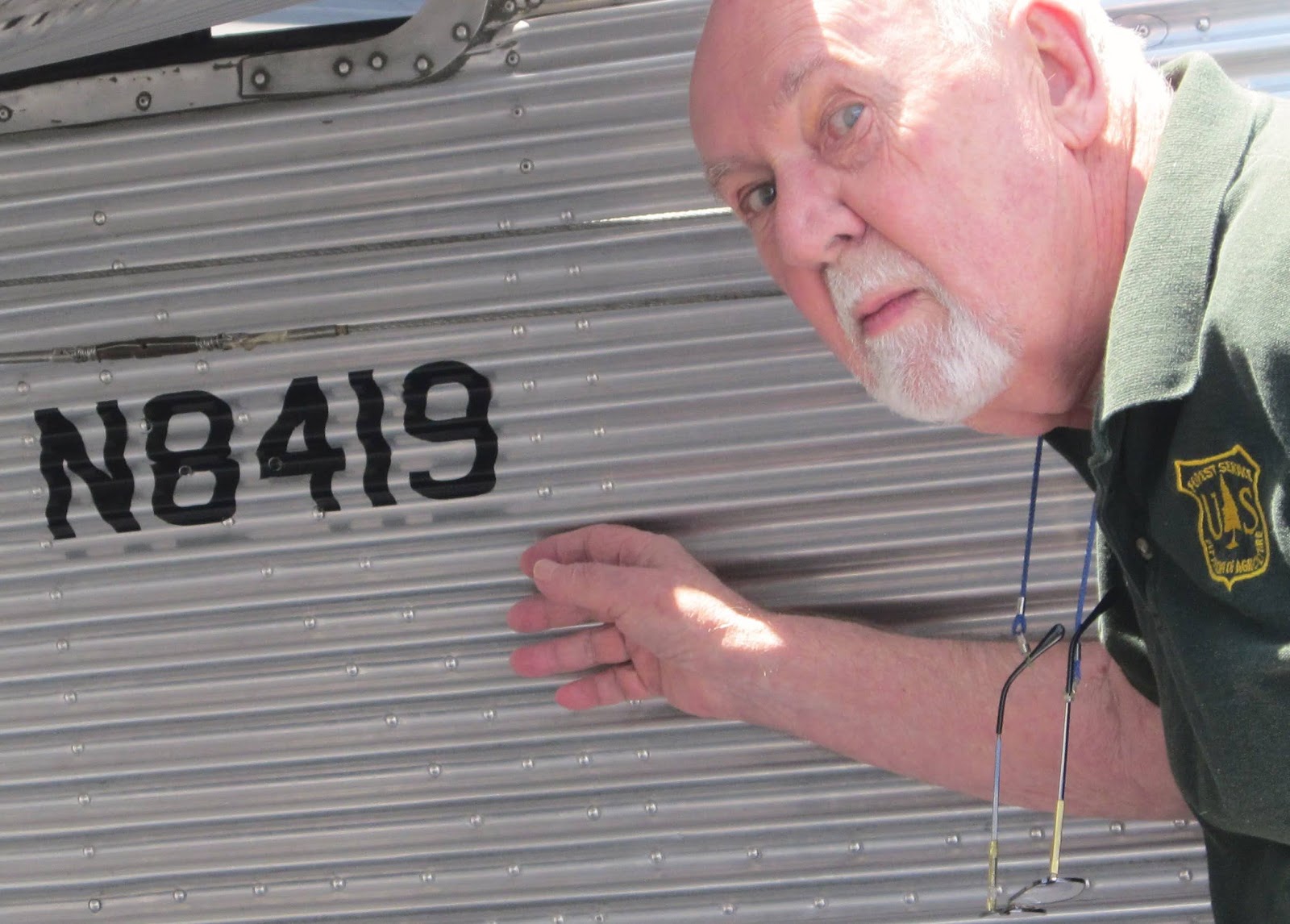
| The tail tag confirmed our plane was N8419 |
When pilot Cody Welch activated the starter for the nose engine of the 1929 Ford Tri-motor at the start of our flight this week at Air Zoo, it reminded me of the rasping sound of the starter used to get my first automobile going. Coincidentally, that first car was a 1929 Model A Ford.
The two Ford products manufactured in the same year had some other similarities. Both featured relatively simple systems that were quite easy to repair, both were somewhat boxy, solidly built, rugged machines, and both had received numerous updates by the time I got involved with them. The differences were perhaps equally important.
My old Model A chugged along, coughed often, and stalled occasionally due to neglected maintenance and the poor driving skills of the inexperienced owner. After Welch started the left Tri-motor engine and then the right, and allowed plenty of warm up time, the three Pratt and Whitney engines operated smoothly. Throughout our half-hour flight from Kalamazoo-Battle Creek Airport the N 8419 engines performed like machinery guided by an expert and cared for by dedicated mechanics.
Welch easily fits in the expert category. When he welcomed the 10 passengers after all were aboard, I asked, “How many times have you done this?” The answer was “5,000.”
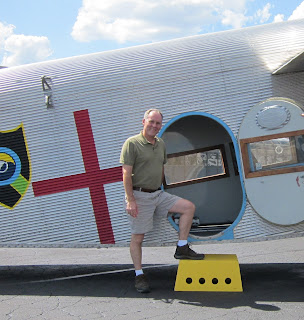
| Lee Klade learned walks in boarding bridges aren't needed to enter a tri-motor--just duck your head and step right in |
After we landed, Welch and our co-pilot graciously stayed beside the plane talking with son Lee and me until just minutes before their next flight. Welch knew a lot about tri-motors generally, and N8419 specifically.
Mechanics gave N8419 lots of TLC during recent years. After 10 years of carrying passengers at Air Zoo, corrosion problems caused the plane to be grounded. During a long-running reconstruction project the aircraft was literally taken apart and reassembled with many new or improved parts. Work was performed in an Air Zoo hangar and at a facility in Alma, Michigan.
You can get an insider’s look at the tri-motor by visiting www.n8419.blogspot.com
There a mechanic who worked on the reconstruction project has posted photos of various stages in the process and added his comments. As a bonus, you can watch a video of the first flight of the “new” N8419 in 2009 and see how the cockpit and passenger area look today. A mechanic who calls the machine he is working on “the old sweetheart” obviously is dedicated to quality work.
In addition to a lot of updated components, N8419 has a new role. It is owned by Air Zoo, but is not a permanent resident. It is leased to the Experimental Aircraft Association, a large organization of aviation enthusiasts based in Oshkosh, Wisconsin. Like other historic aircraft maintained by EAA, the tri-motor appears at air shows and also travels to selected sites to offer rides. So far this year, N8419 has flown in Wisconsin, Ohio, and Michigan. It will be available for rides again at Air Zoo for several days in August.
At a pre-boarding briefing an Air Zoo volunteer told us we could expect our ride to be fairly noisy and just a little bit bumpy. With a broad grin, he said, “We don’t provide air conditioning, but you won’t need it, anyway.”
Our host then said, “Every seat has its own window and every one is an aisle seat, so you won’t have anything to argue about. Just take a seat.” This and his earlier statements proved to be correct. His last statement was a bit of an exaggeration: “You’ll fly low and get great views of the area. If the plane goes over your house and your neighbor is cooking out, you’ll be able to tell if he’s grilling hotdogs or hamburgers.”
The noise level increased as we accelerated down the runway. We gained altitude quickly after lift off, something tri-motors are good at. The ability to ascend and descend rapidly and sturdy landing gear were major assets when the planes began flying in the 1920s. Long, paved runways were rare and they did not become common for many years.
Our flight did stay “low and slow.” We traveled at altitudes of about 1,000 feet at speeds around 90 mph. Pretty tame stuff compared to long-distance cruising at 30,000 feet in today’s speedy jetliners. But I liked traveling at the slow pace and low altitude. There was a definite feeling we were experiencing airline flying as it was in its infancy.
I didn’t see amateur cooks flipping hamburgers, but we were treated to great views. As we flew over downtown Kalamazoo every building could be easily identified. That also was true when we peered down at the Western Michigan University campus. Streets, vehicles, boat docks, and other features of the community were seen clearly.
As advertised, parts of the ride were a little bumpy when the plane encountered changing air patterns. I thought the small jolts were merely annoying. I’ve flown in many big commercial liners where the going was much rougher. In fact, as we progressed I got used to the occasional bumps and forgot all about them. I was only one seat from the cockpit and could see small adjustments being made to keep the plane flying smoothly.
Lee and I agreed that the noise level also was not much of a negative. The three engines were loud enough to interfere with normal conversation. Yet it was possible to exchange comments with fellow passengers simply by speaking up. We thought the noise, as well as the little bumps, contributed to the experience.
One update might have helped hold the noise levels below those reported by old-time tri-motor passengers. All the original corrugated aluminum that covered N 8419’s fuselage has been replaced by new panels of an improved type of aluminum alloy. We didn’t hear any noises generated by the exterior covering.
Every passenger did have a window, and every window had a small plastic circle that could be opened easily to let air in. The pilot and co-pilot opened cockpit windows, and air from them flowed back into the passenger area. Backwash from the two wing-mounted engines increased the airflow through our window vents. The combined effect was a pleasant temperature in the plane throughout the flight, and it was a late afternoon trip on a warm sunny day. The tri-motor had a “green” air conditioning system!
I’ve flown in enough smaller aircraft to know that smooth takeoffs are routine, but landing is a whole different thing. N8419 hit one of those little air bump glitches just as we were about to touch down. The right wheel made contact a tad early. I observed Cody Welch fix that with a deft flick of his wrist. He straightened us out perfectly. I gave the landing a 9 on that proverbial 10 scale, and I’m pretty picky.
Lee and I summed up our flight aboard Tri-Motor N8419 on July 10, 2012 in one word: Enjoyable.
Tri-motors made thousands of successful flights for a long time. They were the first all-metal airliners. Ford Motor Company produced 199 tri-motors between 1925 and 1933. We were told only three are flying today, but another five are certified as airworthy and about a dozen more are in various stages of restoration.
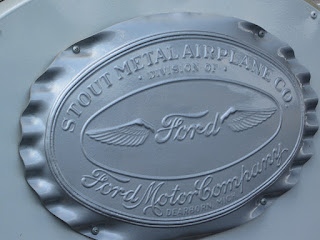
| Henry would be proud. A "flying Ford" logo goes along on every N8419 flight to show who built her in 1929. |
Henry Ford foresaw a great future in air travel and the company’s tri-motors initially were produced for the commercial market. Later, many were built to military specifications and flown by air corps pilots in the U.S. and several other countries.
Ford ended production when more-advanced aircraft were being rapidly developed and produced by others. New planes, such as the Douglas DC-2, pushed the tri-motors out of the major airline market, but the Ford aircraft found new employment at small airlines and other enterprises. Ford Tri-motors ultimately were flown by more than 100 airlines world-wide. Many served commercial purposes into the 1960s.
Northwest Airlines bought N8419 from Ford Motors in 1929. Northwest later sold it to Air Alaska. After its duty as an Alaskan airliner, it was sold to Johnson Flying Service, a fast-growing aviation company located in Missoula, Montana. Johnson acquired several tri-motors, plus other aircraft capable of operating in rugged northern Rocky Mountain terrain. The U.S. Forest Service became a major customer through contracts.
The Forest Service used planes owned by Johnson and flown by Johnson pilots for many purposes. The first full-time fire researcher left an account of an early experiment conducted with a plane piloted by Bob Johnson, founder of the service company. Tri-motors were used to spray pesticides over millions of acres in programs intended to reduce populations of destructive forest insects. Tri-motors carried supplies to remote National Forest administrative sites. At least one tri-motor was equipped with two large tanks mounted under the wing so it could drop fire retardant chemicals to help control blazes.
Following several years of experimentation with air drops, two Forest Service employees in 1940 were the first to parachute into a remote area to fight a wildfire. Smokejumping was born, and Ford Tri-motors became the drop vehicles of choice. It was a happy marriage. During World War II, the number of smokejumpers increased to some 250, and many tri-motors well-suited to the task were busy delivering the firefighters wherever they were needed throughout the West.
Considering the volume of business and the circumstances in which they operated, both smokejumpers and tri-motors compiled good safety records. But wildland firefighting is dangerous business, and there have been some tragedies. My last post briefly described one—on August 4, 1959 when Tri-motor N8419 crashed and burned at a remote airstrip in northern Idaho. I said Ron Stoleson, a golfing pal for some 10 years, was fortunate that day, and I would explain why later. Now I’ll try to do that.
Stoleson does not like to talk about the accident. I don’t recall him discussing it during or after golf games or elsewhere unless someone asked a direct question. In fact, I think I first heard about the Moose Creek crash from Ross Parry, another long-time member of our golf group. Parry was a smokejumper for six years. Like Stoleson, he became a jumper foreman. Also like Stoleson, he made his first jump and many others from a tri-motor.
The Moose Creek site, now in the Selway-Bitterroot Wilderness within the Nez Perce National Forest, in 1959 included a Ranger Station and a primitive airstrip. The airstrip is still in use. The site is at the confluence of Moose Creek and the Selway River, 25 miles from the nearest road. Flanked by steep canyon walls, it is one of the few fairly flat pieces of land in the area. Canyon winds are unpredictable and can be strong.
On the day of the crash, the tri-motor’s mission was to deliver supplies for the ranger district and then to drop two smokejumpers on a nearby fire. Stoleson was the smokejumper foreman at Grangeville, where the flight originated.
The quirk of fate that kept Stoleson among us involved tri-motor seating and Forest Service protocol. N8419 was configured to carry cargo and smokejumpers, not 10 passengers in individual seats as its descendant did this week at Air Zoo. As a jumper foreman, during a mission such as the one N8419 went on to Moose Creek, Stoleson normally would have occupied the only real passenger seat with good visibility—in the cockpit next to the pilot where co-pilots sat when tri-motors served as airliners.
Forest Supervisors can pretty much choose any day they please to review activities at units within their jurisdiction. It just happened that Alva W. Blackerby, the Nez Perce Forest Supervisor, decided the day of the crash was a good time to ride along on a flight to check out operations at Moose Creek. Blackerby became the top-ranking passenger, and thus occupied the cockpit seat. Stoleson rode in the back compartment with cargo and the two smokejumpers he intended to help later with their jumps.
In an interview, Stoleson described the events that day for an article published by the Lewiston Tribune in 2009. I found the piece recently during a web search and asked him if it was an accurate report. He said it was, except for two small errors. Those errors are corrected in this account.
Stoleson told the reporter the tri-motor made its usual flyover at Moose Creek to check the wind sock, and then went back down the Selway River to turn around and return for its landing on the slightly uphill runway.
“So we came back in and just as we were setting down there was a strong gust of wind that pushed us ahead into the trees. The pilot (Robert Culver) knew what was going to happen because he yelled back at us, ‘We’re going to hit.’
“We knew we were in trouble. Then we hit.”
At first Stoleson said he thought everything was OK. But then a fire exploded back through the plane. A tree that had caught on fire fell on the aircraft. By chance, Stoleson was in position to tumble out of the plane’s open doorway, but not until he was burned on his face and arms. (Smokejumper planes usually flew without a door on the entrance.)
A fire dispatcher at the Fenn Ranger Station got an urgent message from Moose Creek when the crash occurred. Because communications from Moose Creek to other areas were limited, the Fenn dispatcher radioed a request for help to the Supervisor’s Office.
Smokejumper Gary G. Williams of West Valley, N.Y., who had been sitting under the plane’s gas tank, was burned extensively. He was carried outside and laid on the ground. Some smokejumpers who had come to the rescue talked to Williams and the other jumper, John A. Rolf of Buchanan, N.Y. Both Williams and Rolf were 23 years old.
Williams asked one of the smokejumpers, who was a good singer, to sing him a song. Then Williams died.
Rolf and Blackerby were transported to a hospital where they died a short time later. Pilot Culver also was badly burned, but survived for several years.
Only Stoleson and parts of Tri-motor N8419 lived long to fly on other days.
I fully understand why a survivor would be reluctant to talk about the incident. It’s hard to write about it.
Thursday, July 05, 2012
Up, Up and Away
![]() |
| Tri-motor N8419 today carries the markings of a military plane, but its last regular service was as a U.S. Forest Service smokejumper aircraft. |
Next week son Lee and I are going to take a brief flight over the Kalamazoo area aboard an airliner designated N8419.
So what? In the recent past, N8419 has carried many passengers on short hops originating at Air Zoo, the aircraft museum that owns the reconstructed 1929 Ford Tri-Motor.
Our adventure will be special for me because of a personal connection. One of my golfing buddies for many years, Ron Stoleson, is the sole survivor of a tragic day in 1959 when the original N8419 crashed and burned at a wilderness airstrip in the Nez Perce National Forest in northern Idaho. The crash killed two smokejumpers and the Forest Supervisor. They died soon after rescuers pulled them from the aircraft. The pilot was badly burned, but lived for several years before he died.
My friend Stoleson escaped through the open door of the rear compartment. Lady luck was with him that day. A future post will explain just how lucky he was.
The original N8419 over 30 years flew a number of different missions before becoming one of several aircraft owned by the Johnson Flying Service of Missoula, Montana. During fire seasons, Johnson contracted with the U.S. Forest Service to fly the plane for smokejumpers. In that role, it carried cargo to remote forest locations as well as dropping parachutists on fires.
N8419 was thought to be reduced to scrap after the 1959 crash. A Kalamazoo company bought the remains and those of two other Tri-Motors to be used for parts in restoring another Tri-Motor, which flew from Port Clinton, Ohio. However, when that restoration was completed the firm decided enough remained of N8419 to justify bringing it back to life.
The restored Tri-Motor made its first flight at Air Zoo on July 24, 1991. Over the next 10 years it carried tens of thousands of passengers on short trips over the Kalamazoo area. However, in 2001 the plane was grounded when corrosion problems were identified in its wing spars.
My son and I saw N8419 in the Air Zoo shop about 5 years ago. We got a briefing on extensive work being completed, in addition to wing spar replacement, to make the aircraft ultra-safe again as an airliner. An old Johnson Flying Service sign and the original plane's number were displayed on the shop wall.
After the two restoration projects, the plane has a modernized fuel system, three upgraded Pratt & Whitney engines, a new electrical system, and updated brakes, among other improvements.
The most recent restorers decided to jazz up the plane’s appearance with identification from a slightly different model Tri-Motor flown by the U.S. Army’s 60th Service Squadron as a medical transport. Those Tri-Motors started flying in 1930.
Despite the changes, we will be taking a ride in the direct descendant of N8419, a designation the Air Zoo Tri-Motor can carry with pride reflecting its many years of service as one of the first all-metal airliners in the world. We’re looking forward to a happy landing.
Thursday, June 28, 2012
Gunnery Overkill
I’m not an anti-gun guy. I’m an anti-stupidity guy.
With some refresher work, the geezer probably could hold his own as a shooter, at least among other fully mature adults. In the distant past, the U.S. Army declared me qualified with standard infantry rifles, carbine “grease guns,” and .45-caliber pistols. Once upon a time, I competed (didn’t win) in a skeet tourney using 12 different Browning shotgun models at the company’s testing range near Morgan, Utah.
Much earlier, my air rifle shots knocked icicles off the eaves of numerous northern Wisconsin roofs. Many other somewhat strange targets came into my sights. A bit later, I learned how to fire the family shotgun and deer rifle.
Fortunately, no one has been killed or seriously hurt by my gun play. The only injury was a purplish welt caused by a well-aimed BB shot to the buttocks of one of my childhood pals. He shot first, I claimed at the time. His father abruptly stopped the mini-war between us, and confiscated our weapons for a while as punishment for stupidity.
From my experience with guns and acquaintances with many people who own and use them, I’ve reached three conclusions:
1. Responsible use of standard rifles and shotguns during hunting seasons not only provides enjoyable outdoor recreation but is useful to society. Because we have removed most large predators from the environment and it probably never will be practical to restore them completely, hunting is necessary to maintain healthy wildlife populations, and hunting with firearms is the best way to do that.
2. Some people in some places feel a compelling need to own a handgun to protect their homes or themselves from real or imagined serious threats, and they should be allowed to do so after careful screening and licensing. Screening should be rigorous. Needs should be firmly established before any carries outside the home are permitted.
3. AR 15 assault rifles, .50-caliber guns effective at a thousand yards, and other high-powered weapons intended for military use are absolutely unnecessary in the hands of civilians and should be banned. That’s banned as in everywhere. Gun collectors shouldn’t have them. Hobbyists shouldn’t have them. Target shooters shouldn’t have them. No civilians should be allowed to possess them.
![]() |
| Smith and Wesson is a NRA favorite |
Members of the first militias in the 1700s were required by their leaders to own and use only certain types of muskets. Those western sheriffs depicted in movies demanding that cowboys surrender their guns when they came to town really did that. Similar requirements were in effect in other places to promote law and order. At one time, the National Rifle Association was among the leading advocates of gun controls. Many controls were installed by major cities in the 1960s following riots and protests. The intent was to get weapons out of the hands of the Black Panthers and other militant groups
Gun control is nothing new in the U.S. Decontrol is. Decontrol was encouraged by Supreme Court rulings in 2008 and 2010 (both by 5-4 votes) that liberally interpreted the constitutional provision allowing citizens to keep and bear arms so the country would have “a well-regulated militia.” The National Guard might be considered today’s equivalent of our 18th century militias. The Guard keeps its weapons controlled by locking them up when they are not needed for training or active duty purposes. The Guard is well-regulated, and civilian help in that area seems unnecessary.
Despite flying in the face of common sense, deregulation is sweeping the land. Chicago’s ordinance controlling handguns was repealed. Several states now permit “open carries,” taking us back to Wild West days. Macho Men and Wonder Women once again are seen packing pistols in public. At least we know who these gunnies are. The latest compilation shows 319,900 men and women (one in 22 adults) in Michigan have permits to carry concealed weapons, and the number is growing weekly. That’s scary.
Who has those permits to secretly pack heat? They are people at least 21 years of age who are not known to have mental illnesses and do not have serious criminal histories. They must complete a certified pistol course before applying for a permit from a county concealed-weapon licensing board. If approved, they pay a $105 fee. The permit is good for four years, and then may be renewed.
The pistol courses vary by state. In Wisconsin, a concealed-carry safety course takes four hours and can cost as little as $40. Retired law enforcement officers can get permits without the training in some states, including Michigan.
Michigan’s law lists “gun free zones” where permitted carriers are not allowed to bring their weapons. That seems reasonable and sensible.
What is unreasonable is a measure being considered by the Michigan Legislature to drop all the gun-free area provisions. People with permits would be allowed to carry their weapons in churches, bars, schools, sports arenas, and hospitals. This goes way too far. The legislation deserves a bipartisan speedy death. While it is being killed, the legislature should add public libraries to the gun-free list.
Would sensible people condone allowing guns into bars where liquid courage is known to frequently provoke shouting, shoving, and punching over even minor disagreements? This is ridiculous. Wyatt Earp would be aghast.
There is no test of intelligence in Michigan’s concealed weapons licensing process. Some such control seems justified. A recent Detroit Free Press story indicates that at least one concealed carrier wasn’t too bright.
A 45-year-old man working in a Detroit suburb on an air conditioning installation was carrying a .40-caliber Glock pistol in his pants pocket. He moved the pistol. It went off. The man shot himself in the penis.
One reader commented, “At least he won’t be producing any offspring who might want to carry a concealed weapon.”
Labels:
air rifles,
gun control,
hunting,
Michigan legislation,
militias,
National Guard,
rifles,
self defense,
shotguns
Saturday, June 23, 2012
In Grateful Memory
Sgt. 1st Class Joseph Lilly (U.S. Army), 25, Flint, Michigan. Killed by a roadside bomb in Kandahar Province, Afghanistan, June 14, 2012.
Labels:
Afghanistan,
Michiganders,
Mideast,
war deaths
Thursday, June 21, 2012
Welcome, Tourists
This week has special significance every year, more in some places than others. We all welcome summer with the longest day. For people in tourist towns in northern Wisconsin and Michigan the schools are out in the big cities and many welcome dollars are on the way to be spent, often somewhat carelessly, by vacationers.
As a lad, the geezer worked for two summers in the meat department of a National Tea Store, the biggest food market at the time in my north woods hometown. About 30 resorts of various sizes were in our trading area.
The store increased the staff in the middle of June to be ready for a big increase in business. The resort owners required large amounts of supplies for their kitchens, and many people owned summer homes in the area that needed provisions. Thousands of “summer people,” most from Chicago or Milwaukee metro areas, shopped in our store.
In mid-June, the store manager appeared in our department with revised price lists. Just about every item magically required a 10 percent increase almost on the day the first tourist appeared in town. At the end of August the manager again handed out revised price sheets. Would you believe the prices were lowered by about 10 per cent nearly across the board?
We took one slogan of the day seriously: “Keep Northern Wisconsin Green, Bring Money.”
My credit card company this week offered to double, from one to two percent, the usual cash-back bonus for all purchases made in London from now until August 31. Do you suppose those UK purveyors of chintzy souvenirs are going to hold their Olympic Games price increases to two percent?
It sounds to me like a big net loss for tourists. The card company ad features a handsome color photo of the Big Ben clock tower. We’ll stay home and be awed by the chimes via television.
Labels:
credit cards,
north woods,
northern Wisconsin,
Olympic Games,
tourism
Friday, June 15, 2012
An Early, Early Bird
I’ve lost track of how many garage sales we’ve held. Beautiful wife Sandy presided over one each time we moved, so there have been at least eight. Our new community has one every year. We’ve been here three years, so we’re near or past the dozen mark.
Sandy has earned her informal title: Queen of the Garage Sales. She doesn’t just toss a lot of junk out there. She organizes displays of like merchandise, prices everything clearly and fairly, and maintains a level of cleanliness that might make Macy’s envious.
One reason we’ve had many successful sales is that Sandy for years ran a crafts production business, and as a result she always had many nifty new items to mix in with stuff we wanted to get rid of. The "SandyCrafts" business now has been wound down, but moving to our southwest Michigan home provided a new opportunity.
Our new community, about 400 families, is famous in these parts for its annual one-day garage sale. Lookers and buyers come from far and wide to the June event. On the Saturday sales day, the whole area takes on some of the attributes of a big traffic jam.
This year’s sale is tomorrow. Sandy has been getting ready for about two weeks. She was out very early (before 5 a.m.) Thursday in the cool of the morning getting items organized in the garage.
When I made my appearance (about 8 a.m.), Sandy announced her first sale. “A lady drove up and begged me to let her in. She said someone told her our neighborhood sale was last Saturday. Big mistake! She got that day off work, and can’t get another one. She said she stops at our place first every year. She bought two baskets for $1.50.”
Knowing some sellers refuse to allow early birds into garage sales, I thought two days ahead of the opening bell might be intolerable, whether the excuse sounded legit or not. “That was nice of you,” I said.
“Nice” is the other reason Sandy always does well hosting merchandising events. No unpleasant or unhelpful salespeople are allowed around here. Some of the stores we visit might do well to adopt the same rule.
Thursday, June 07, 2012
Where're You From, Mac?
Nobody likes being an outsider. But if you’ve relocated a time or two, you’ve had no choice but to be “the new kid on the block.” In some places, acceptance of newcomers is a lengthy process. You could be a new kid for a very long time, especially in a small town.
During a dinner conversation at our home in northern Wisconsin when I was a teenager, my mother several times referred to “that man from Illinois” in a discussion of a happening across the street from our house. We weren’t sure who she was talking about. A clarification revealed that the “man from Illinois” had owned his home in our neighborhood for 26 years!
I’ve only been an outsider in one place where a native enjoyed identifying and embarrassing newcomers. My first job outside Wisconsin (except for Army duty) was an assignment as the Public Information Officer for the Boise National Forest. One of the duties was participating in team teaching at environmental education workshops. The Idaho Fish and Game Department always had one or two representatives on the team.
It was obvious that one of the F&G men, a native Idahoan, was not overly fond of U.S. Forest Service personnel, nor was he delighted to be working with National Park Service people who sometimes were team members. At that time, pay for the federal natural resource people was considerably better than that of state personnel. The federal agencies didn’t employ many wildlife biologists, so state wildlife specialists had a difficult time moving to the Forest Service, Park Service, Bureau of Land Management, or Fish and Wildlife Service as a way of gaining a heftier paycheck.
In addition to resentment about pay disparities, there sometimes was an undercurrent of native-newcomer tension. The majority of Idaho Fish and Game employees at all levels were born and raised in the state, or at least were long-time residents. Most professional federal agency people had transferred to Idaho from other locations.
The state man liked to make it clear he was a native son. He did that at least once during every environmental education workshop by suggesting we all stand and sing the state song: “Here We Have Idaho.” He, of course, rendered every word loudly and correctly. Most of the rest of us muttered along as many have while trying to mouth an unfamiliar hymn in church. The F&G man made a point of staring at me a time or two as I stood there pretending to sing the state song.
I actually tried to learn “Here We Have Idaho” just to thwart him. The tune consists of two short verses and a chorus. It should have been easy, but I never got the hang of it. That wasn’t surprising. How many Americans know the words to any state song?
“On Wisconsin!” should be a snap for me. The tune doubles as the university’s football fight song and the state anthem. After years of hearing both, I can negotiate the football version pretty well, but can’t get past the first line of the lyrics honoring the state.
Apparently destined to forever flunk the Idaho anthem test, I strongly suggested to the song leader that he drop the whole hidden-agenda affair. “You know damn well there aren’t two of every ten people you con into this who know the words, whether they spent their whole lives here or not,” I said. “You’re just embarrassing everybody.”
He finally agreed to suspend the musical salutes to the Gem State. “I know how to show you flatlanders up, anyway,” he said. “I just get you talking about the Idaho Panhandle. As soon as you say you like that big lake near Sandpoint, ‘Lake Pend Orioles,’ I gotcha.”
Hard to bluff your way through that test. Any worthy Idahoan knows Pend Oreille, the state’s largest lake, is pronounced “pond-o-ray.” Seldom does a newcomer get that one right, perhaps with the exception of a French immigrant.
Other states we’ve spent some time in have place names designed to baffle a neophyte. On the way from our long-time home in Ogden, Utah, for a little recreation in the nearest Nevada gambling houses, we drove through Tooele County. Telling locals you had traversed “Toolee County” brought big guffaws every time. After several years as Utah residents, we became experts at announcing we had just returned from a trip through “Twilla County.” We had become old settlers.
Indian names can be especially tricky. Many acres in far northern Wisconsin are included in the Chequamegan National Forest. “Shewameegun” rolls right off the tongues of people from my hometown and environs. How would you say it?
![]() |
| The "Big Mac" truly is AWEsome. |
Here in our adopted State of Michigan, a designation based on Indian words probably holds the record among U.S. geographic names mispronounced most frequently. Much of the fun started in 1957 with completion of the Mackinac Bridge linking the state’s upper and lower peninsulas. At the time, the bridge was the longest two-tower suspension span in the world, so it got lots of attention.
Many tourists said they’d crossed the “Straits of Mackinack” on the “Mackinack Bridge,” and they still do. Actually, the newcomers traversed a bridge over waters whose name ends in “awe,” not “ack.”
The endings of most names in the area that look like "ack" are pronounced "awe." That holds for the bridge, the straits, and Mackinac Island, plus Fort Michilimackinac. But just to confuse things, Mackinaw City sounds just like it looks. And, to add more fun, some Michiganders refer to the famous “awe” bridge as “Big Mac.”
A little off the point is the fact that many long-suffering winter residents of both northern Wisconsin and Michigan wear sturdy overcoats known as “mackinaws.” But that can be a help. Think of big coats and you have a key to remembering the proper name of the big bridge and associated heart-warming stuff.
Much more could be written on this topic, but beautiful wife Sandy is telling me it’s time to start on our day trip to Dowagiac. Folks, I haven’t a clue about how to say that. Some local surely will be delighted to tell me after a guffaw following my feeble attempt to say I’m enjoying my first visit to D…..something or other.
Don’t look it up. I did it for you. Dowagiac (Doe-WAH-jack) is an Indian name meaning foraging ground. Don’t damn those Indians; a legacy of unpronounceable names is just a reasonable bit of revenge for past war crimes against the tribes.
Wednesday, May 30, 2012
An Overdue Payment
“In its heyday in the 1970s, the Vince Lombardi Golf Classic rivaled the PGA Tour stop in Milwaukee as the summer’s must-see golf event.”
That was the opening line in a Milwaukee (WI) Journal Sentinel feature story this week. The writer told how the professional tour event, The Greater Milwaukee Open, lost corporate and community support and finally folded in 2009. The Lombardi Classic also went into decline, but rallied under new leadership and once again is a premier links event. Coincidentally, both tournaments have 42-year histories.
The Classic is one of five events sponsored by the Lombardi Cancer Foundation. The foundation has raised more than $15 million to fight the disease that prematurely took the life of Vince Lombardi, the iconic Green Bay Packers coach.
In 1979 I was in my 32nd year as a Packers fan. I’d heard very little about the golf tournament, but thought I’d have a look at it because a local news story said several Packers would be playing. The event was held, as it will be June 8-9 this year, at North Hills Country Club, which was a mile from our home in Menomonee Falls.
I walked to the country club about mid-afternoon, some four hours after the advertised start of the tournament. My mostly cross-country journey was designed to get me there as directly, not as precisely, as possible. I wound up nowhere near the club entrance. I encountered a roped-off parking lot. Entry was easy and inexpensive. I just lifted the rope, ducked, and walked in.
A large tent to my left looked like a central point of some sort. My arrival there was greeted with shouts of “Stand back!” I and dozens of others did as former president Gerald R. Ford passed within six feet of me on the way to the scorer’s table. The smiling ex-president was escorted by several very serious young men, assumed to be Secret Service agents. I joined the crowd in applauding Mr. Ford.
Spectators seemed to be moving around randomly. I heard several talking about going to the sixth tee, because “you can see a lot of action from there.” I went to the sixth tee. From the elevated vantage point I saw:
1. Bart Starr, legendary Packers quarterback, do on the golf course what “Mr. Perfect” had done for years on the football field. He hit a beautiful long drive right down the middle of the sixth fairway.
2. On another fairway observable from my position on the hill, a very big man wearing Chicago Bears colors hit the longest fairway wood shot I’ve ever seen. The accuracy wasn’t great, but the distance was awesome. Memory dims, but that golfer was either Dick Butkus or Mike Ditka.
One of the heart-warming things about the tournament over the years has been participation by former Bears players in an event honoring their supposedly all-time “hated rival” Green Bay coach. The gridiron enemies proved they could be on the same team for good causes.
The tournament has a celebrity-guest format. The celebrities donate their time. This year the guests will pay $995 each to play with the famous folks, and the slots are sold out. The 2012 field includes 14 current Packers among the 40 celebs. And, yes, Bart Starr will be there playing once again.
Spectators get in for a paltry $10 donation, with all proceeds benefiting the Vince Lombardi Cancer Foundation. The entry fee probably wasn’t even that small amount in 1979 when I avoided it, but there ought to be some penalty for those who sneaked in back then and are feeling a little guilty now recalling the intrusion.
The geezer just redeemed himself in a small way by sending a $10 donation via www.lombardifoundation.org Checks may be mailed to: Lombardi Cancer Foundation, P.O. Box 341217, Milwaukee, WI, 53234-1217.
Everybody who gets involved in this tournament wins.
Friday, May 25, 2012
Here Come De Judge
Yeah, I know. Don’t cast the first stone. But I couldn’t resist commenting on this CNN News report:
“After spending eight weeks in jail, Orange County Court Judge Robert Freehill ordered Vega to return the $13,368.48 she gained in gifts and donations while posing as terminally ill.”
What would the judge have ordered if he had spent 12 weeks in jail?
Tuesday, May 22, 2012
Facing Up To It
A lengthy analysis carried by Bloomberg Businessweek purported to give reasons why General Motors dropped its $10 million Facebook advertising package. Among them was GM simply is cutting back on ads in its new “lean-mean” business mode (GM cancelled future Super Bowl advertising at about the same time). Another was that the auto maker doesn’t know how to utilize Facebook advertising properly.
The thoughts were advanced to counter the idea that perhaps Facebook advertising simply doesn’t work. The analysis dismissed that possibility by saying it works for some products, but not for others. But the author didn’t name a single product in either category.
Most web advertising is sold on the basis of clicks on the ad, which supposedly translates into a percentage of sales. All of that is theory. No one has proved the theory has merit, and probably no one ever will. People can click to be amused by a dancing cartoon snake, and have no interest whatever in buying the snake oil being promoted.
Although I’m not a big Facebook player, I look at my page fairly regularly. I have never even read an ad on Facebook, much less acted under the influence of one. We buy lots of things online, but we almost always do that after searching for the item, not because an ad attracted us to it.
Is it possible that many big-time advertisers have not figured out how to effectively “talk to” the millions of potential buyers the Internet has the ability to deliver?
Is it possible the huge Facebook empire is built on a faulty business model? Is it possible some shrewd stock market players knew that when the stock price dropped instead of roaring upward shortly after the company went public last week?
What do you think?
Monday, May 14, 2012
All Together Now
The headline on my news summary page was clear enough: “After the JPMorgan Chase mess, we must bust up the big financial houses.”
My first impression was the source had to be The Progressive, Democratic Underground, Michael Moore.com, or some other ultra-liberal web page interested in fomenting an ill-defined revolution against Wall Street capitalists. Not so.
When I looked at the byline, I couldn’t believe my eyes. The article was by ultra-conservative economist Peter Morici, and the publisher was none other than Fox News.com, a conservative medium accused by some of being slightly right of Benito Mussolini.
Morici was commenting on a bad bet by investment bankers at JPMorgan that resulted in a $2 billion dollar loss. Yes, this is the same outfit we taxpayers bailed out after similar shady and risky business by it and other big banks nearly caused the collapse of the world financial system.
Morici details recent history of the deregulation of U.S. banking and the reasons why a strict return to the separation of commercial and investment institutions once dictated by the Glass Steagall Act would not be good policy in today’s banking environment. “Ho, hum,” I thought. “The headline was a come on; this story really is just another justification for letting the self-proclaimed wizards of finance operate any way they want.”
Then came the shocker. Here are Morici’s concluding paragraphs:
“The simplest solution is to once again separate commercial and investment banking, as was required by the Glass Steagall Act, with some modest exceptions.
“Let banks take deposits and make loans, and sell those to investors through investment banks who would do the bundling of loans into securities. Even let commercial banks own securities backed by loans in other regions to balance default risk, but leave the business of making markets and trading to separate investment banks.
“Commercial banks would continue to be regulated and government insured by the FDIC, and investment banks would be free to trade and take risks with their stockholders capital. If the latter failed from foolish trades their investors would lose their capital, but the taxpayer would not be on the hook.”
What a remarkable dose of common sense. Hurry up, Republicans, and introduce legislation to make this conservative position become reality. It probably would be approved by record majorities in both houses, and President Obama would sign it into law in about 30 seconds.
Of course, this medicine would leave the investment banks with no regulation at all, an undesirable situation, but that could be analyzed and adjusted if needed later. The major problem would be removed--financial institutions “too big to fail” gambling with other people’s money and depending on taxpayers to save them when they lose the bets.
It’s high time to quit fiddling around with halfway controls like the 2010 Dodd Frank law, which contained too many compromises to be fully effective. It’s time to get to the heart of the problem and solve it for the common good.
Labels:
banking reform,
finance,
investment banking,
JPMorgan Chase,
Wall Street
Friday, May 04, 2012
Gro Carting
Conventional wisdom says the melting pot is working--we’re becoming homogenized Americans.
We’ve gone through a half-century of population mobility, regardless of race, ethnicity, or religion. Few stayed were they were born. The young went off to pursue advanced education, promising jobs, or both. The old sold the family home and moved to enjoy final years in kinder climates and with other oldsters in communities built just for them.
In the process, we’ve been losing those charming regional accents along with differences in manners and traditions. We increasingly find the same big-box stores in every state. The Golden Arches loom everywhere, and their proprietors go to great lengths to fry the stuff the same way at every location.
Knowing all this, we were surprised to spot a cultural difference the first time we made an extended visit to southwestern Michigan in 2006. It was no fluke. We’ve verified it hundreds of times since we moved here from Utah three years ago.
People in southwestern Michigan put shopping carts in the racks after they unload the groceries. Empty carts are rarely seen scattered about in parking lots.
In Utah, carts are left all over the place, and some abandoned ones are spotted blocks and even miles away from the store.
![]() |
| Place in rack, please. |
The signs imploring customers to put the empty carts in the racks are the same. Literacy rates are equal. The weather is similar, and thus not a factor. We’d even give Utah an edge in that department. The stores and lots are virtually identical. So why do almost all the people here pay attention to the cart-return signs, while so many in Utah do not?
We’ve pondered the cart corral question at length without developing a glimmer of a theory for the cause. Any ideas out there?
We do know that if you’re a parking lot neatnik, southwestern Michigan is the place for you. You may get the bonus of seeing a gray haired geezer wearing a Packers shirt launch his empty cart at the rack and raise his hands to signify three points whenever his cart splits the uprights. It causes a lot of laughs in Michigan parking lots. Bet you won’t see that elsewhere in the U.S.A.
Labels:
customs,
diversity,
Green Bay Packers,
parking lots,
shopping,
Shopping carts
Subscribe to:
Posts (Atom)